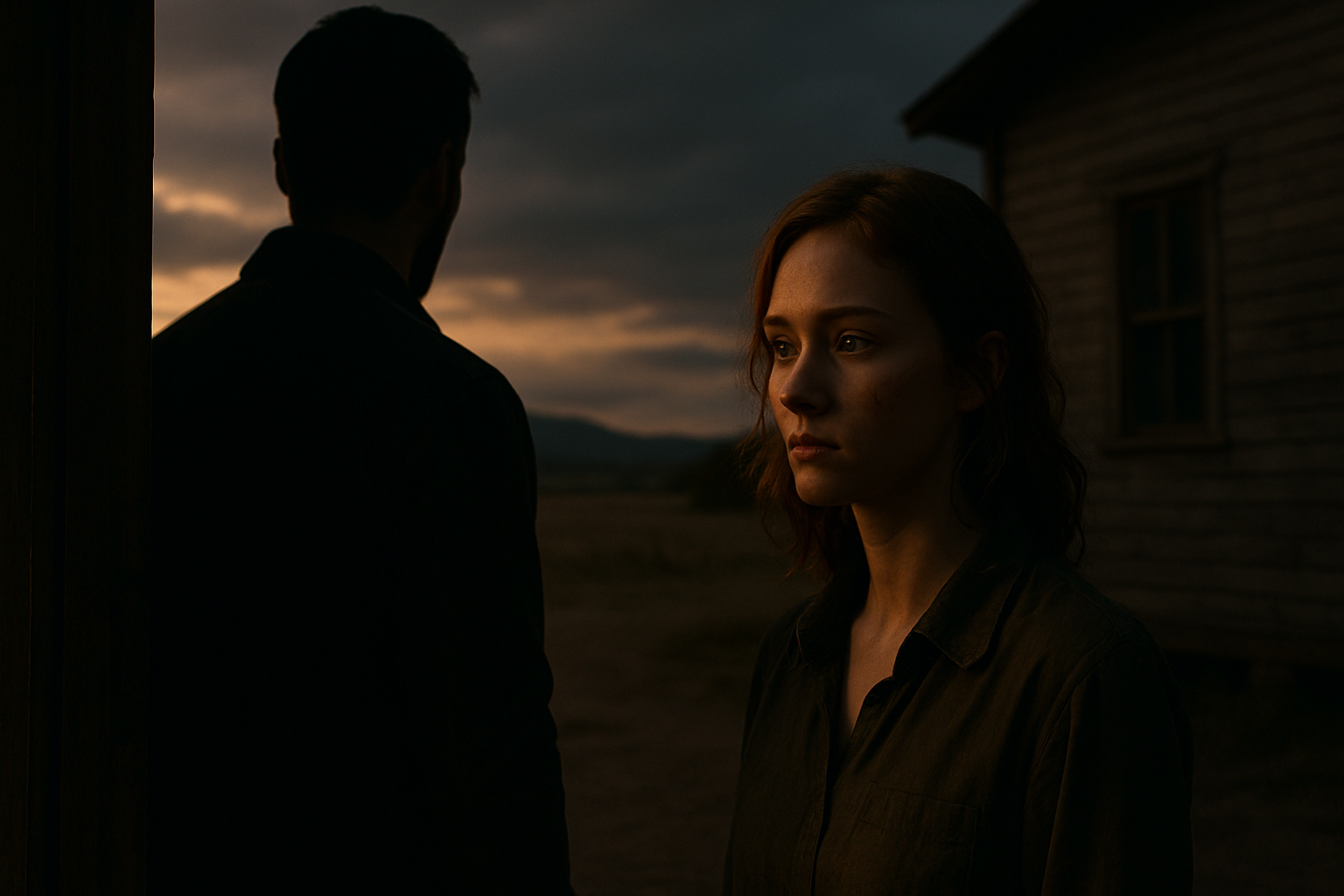
The foreman unfolded the paper.
Guilty.
The word passed through the room like a bell struck under water.
Guilty on conspiracy.
Guilty on falsification of records.
Guilty on arson leading to the death of Thomas Vale.
Other charges followed, legal words stacked one atop another, but Willa heard only the first.
Guilty.
It did not resurrect Thomas Vale. It did not give Caroline back the years she had spent looking over her shoulder. It did not place Wyatt at the births of his daughters, did not put his hand on Caroline’s belly when the babies kicked, did not let him hear their first cries or teach them to ride before the world taught them caution.
Guilty was only a word.
A necessary word.
A word with iron in it.
But still too small for all it had to carry.
Deke did not collapse. Men like Deke rarely gave anyone the satisfaction of visible ruin. His mouth tightened. His attorney whispered urgently to him. The deputy stepped forward. The judge spoke of sentencing, appeals, custody.
Willa barely heard it.
She was watching Wyatt.
He stood very still, hat in hand, rainlight silvering his hair. For years, he had lived as though every doorway opened only backward. Into regret. Into blame. Into the burning tack room and Thomas Vale’s grave and Caroline’s vanished silhouette.
Now, at last, a door had opened forward.
And this time, Wyatt walked through it.
Not quickly. Not triumphantly.
But he walked.
That summer, the Calder-Ward ranch changed in ways that seemed small until, all at once, they were everything.
The empty house gained one bedroom first, then another.
Willa refused to sleep in a room with rose wallpaper, so June chose it immediately and declared it “tragically charming.” Willa took the room facing the barn, where she could see the horses at dawn and pretend that was the only reason she liked it. Wyatt moved an old trunk out of the hall, patched cracks in the plaster, oiled hinges, and replaced the warped boards that groaned like ghosts at night.
June bought curtains in town.
Willa accused them of being too cheerful.
“They are not cheerful,” June said, standing on a chair with a curtain rod in one hand and three pins in her mouth. “They are alive. There is a difference.”
“They have yellow flowers.”
“Alive things often do.”
Wyatt, passing through with a toolbox, wisely said nothing.
A porch swing came next, delivered by Pastor Bell in the back of his pickup under the pretense that he “had no use for it.” Mrs. Harlan sent over jars of peach preserves, two quilts, and enough unsolicited advice to roof a barn.
“Men don’t know where to put grief,” she told June one afternoon while arranging dishes in Caroline’s old cabinet as though she had always belonged there. “So they nail things. Let him nail things.”
Wyatt did nail things.
Fence rails.
Loose shutters.
The sagging step off the back porch.
A shelf in the pantry because June said the flour deserved dignity.
Willa built a round pen near the barn, measuring the posts twice and accepting help only when Wyatt pretended not to notice she needed it. She had a way with horses that was not softness exactly. It was honesty. She did not coo or flatter. She stood her ground and expected the animal to do the same.
Wyatt watched her work a nervous bay mare one morning, the sunlight coppering dust around them.
“She’s got too much fear in her feet,” Willa called without looking at him.
Wyatt leaned against the fence.
“So did you.”
That earned him a glare.
But not a denial.
They cleared the spring together.
It had been half-choked with weeds and fallen branches, the stones slick with moss. Wyatt brought tools. Willa brought gloves. June brought sandwiches and claimed supervision as her spiritual gift.
They worked until their shirts stuck to their backs and mud striped their arms. Wyatt knelt in the shallows, shifting rocks with patient hands. Willa hauled brush. June filled bucket after bucket with black muck and announced every ten minutes that nature was overrated.
By late afternoon, the water ran clearer.
Not perfectly.
But moving.
That was enough.
They ran a new water line to the lower pasture, repaired the windmill, mended the north fence, and opened rooms that had been shut for years. Dust rose. Mice fled. Old curtains came down. Light entered places it had forgotten.
Wyatt did not say the house felt less haunted.
But one evening, he walked inside and heard June singing off-key in the kitchen while Willa cursed at a stuck window upstairs, and he had to stop in the hall with one hand against the wall.
For a moment, he could not breathe.
Not because of smoke.
Because of life.
On Caroline’s birthday, they rode out to the north parcel with a picnic basket tied shut with cloth and a jar of wildflowers June had picked along the fence line.
The day was hot, but not cruel. A high wind combed the grass flat and let it rise again. The sky arched immense and blue above them, the kind of sky that made a person feel both small and witnessed.