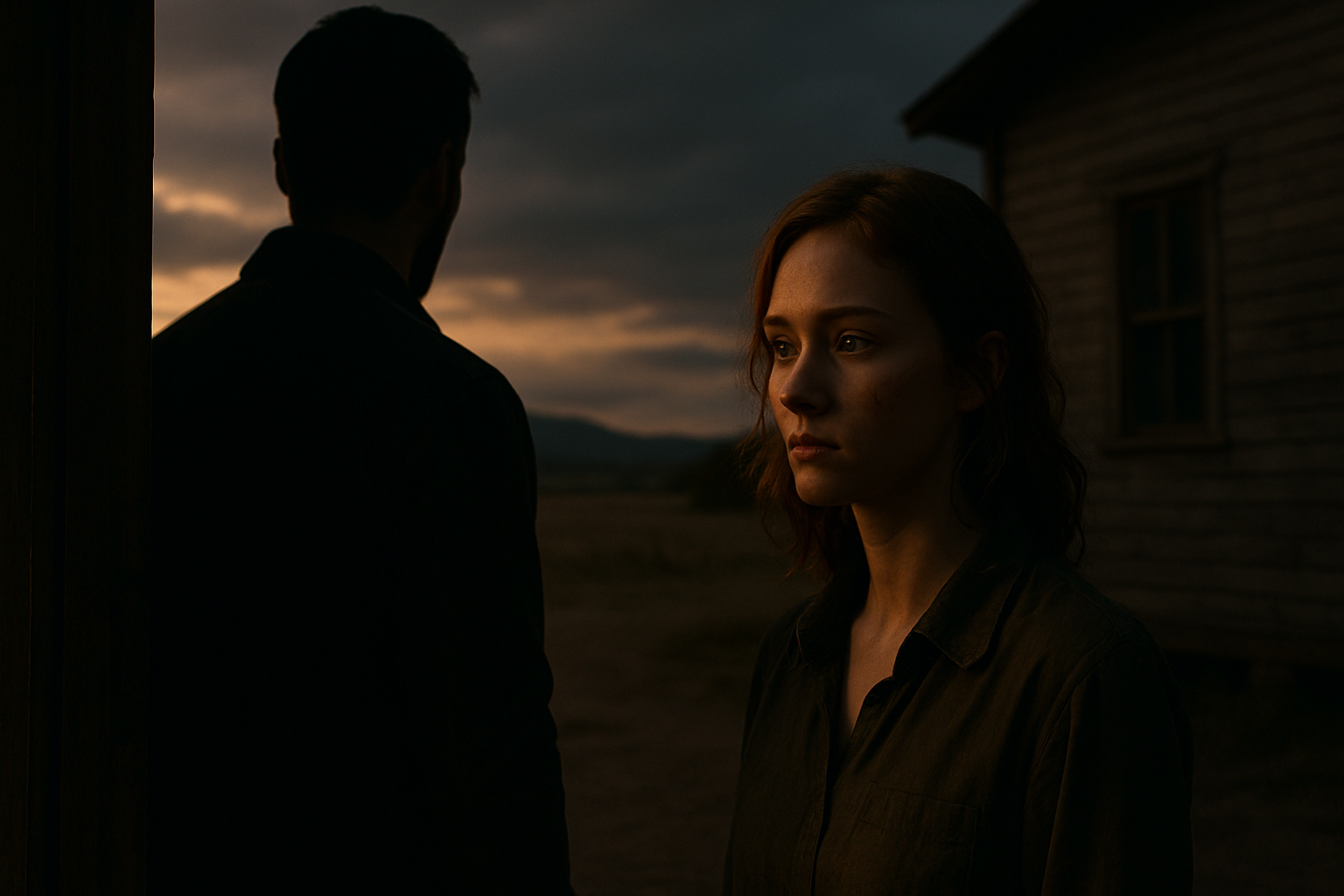
But he had never faced his daughters while telling the truth of the night he lost them before he even knew they existed.
He swore the oath. His voice was rough, scraped raw by all he had swallowed for too many years.
The prosecutor began simply.
“State your name.”
“Wyatt Thomas Calder.”
“Do you own the ranch north of Mercy Ridge?”
“Yes.”
“For how long?”
“It belonged to my father before me. And his before him.”
“Did you know Caroline Ward?”
Wyatt’s eyes closed for the briefest moment.
“Yes.”
“How well did you know her?”
He opened his eyes.
“I loved her.”
The words did not come out grandly. They came out plain. That made them worse, somehow. Made them truer. They sat in the courtroom with all the weight of a body laid gently down.
The prosecutor guided him through the old days.
Caroline arriving in Mercy Ridge with dust on her hem and defiance in her chin.
Thomas Vale offering her work at the store when others whispered she should go back wherever she came from.
Wyatt meeting her beside the feed sacks one spring afternoon and forgetting, for a moment, how words were meant to be arranged.
He spoke of the letters.
The plans.
The argument with Deke weeks before the fire, when Deke warned him that men who didn’t sell when told sometimes lost more than acreage.
He spoke of Thomas Vale’s suspicions.
How Thomas had believed county land records were being altered.
How he had promised Caroline he would help her and Wyatt file their claim properly, safely, beyond Deke’s reach.
Then came the night of the fire.
Wyatt’s hands, resting on the witness stand, curled into fists.
He remembered smoke before flame.
The smell of lamp oil where lamp oil had no business being.
Thomas shouting.
A blow.
Heat.
The world falling red.
The prosecutor did not rush him. No one did.
“I remembered pieces,” Wyatt said. “For years, just pieces. Enough to hate myself with, not enough to understand.”
He looked toward Deke then.
Deke still did not look back.
“After the fire, I was told Caroline had gone. That she chose to leave. That Thomas died because I failed to get him out.” Wyatt’s throat worked. “I believed what I was given because grief makes a man stupid, and guilt makes him obedient.”
Willa’s eyes filled, though her face stayed set.
“What changed?” the prosecutor asked.
Wyatt’s gaze moved to the evidence table, where the brass buckle rested sealed in a clear bag. It had been polished only by time and touch. The Calder mark was worn but visible, a small stubborn emblem of something that had survived being buried.
“That buckle,” Wyatt said. “Caroline had it. I gave it to her. Seeing it brought back the part I’d lost.”
“What did you remember?”
Wyatt drew a breath.
“Deke was there.”
Deke’s attorney objected. The judge overruled him.
Wyatt continued.
“He stood outside the tack room while it burned. I was on the ground. Thomas was inside.” His voice dropped. “Deke told someone to leave it. Said the fire would settle everything.”
A woman in the gallery gasped.
Deke remained motionless.
“He saw you?” the prosecutor asked.
“Yes.”
“And did he help you?”
Wyatt gave a short, humorless breath.
“No. But someone else dragged me clear before the roof came down. I never knew who. Might’ve been a hand. Might’ve been a passerby. Might’ve been God with a strong back and bad timing.”
A few people shifted uneasily. No one laughed.
The defense attacked him for his memory. For the years. For the drinking after the fire, though Wyatt had long since left the bottle behind. For the gaps in his recollection. For the bitterness he supposedly held toward Deke.
“You hated my client,” the attorney said.
Wyatt looked tired then. More tired than angry.
“I hated myself,” he said. “Deke was spared that inconvenience.”
The courtroom held its breath.
The attorney leaned in.
“Isn’t it possible you have invented these memories because these young women needed a father and you needed forgiveness?”
Wyatt’s eyes flicked to Willa and June.
Then back.
“I don’t expect forgiveness,” he said. “Not from them. Not from the dead. Not from myself.”
“Then what do you expect?”
Wyatt’s scar looked livid in the afternoon light, a pale seam across burned flesh, a line drawn by violence and kept by survival.
“I expect the truth to stop being afraid of him,” he said.
For the first time all morning, Deke raised his head.
Only an inch.
Only long enough for Wyatt to see his eyes.
There was no remorse there. No sorrow. No apology waiting beneath the skin. Just calculation, cornered and cold.
Wyatt had spent years imagining that if he ever looked into the face of the man who had broken his life, he would feel fire rise in him. He had thought rage would make him young again. Strong again. Whole.
Instead, he felt something far more final.
He felt Deke become small.
When the verdict came, rain had begun to tap against the courthouse windows.
It was a thin summer rain, the kind that never lasted long but made dust smell like memory. The jury filed in with solemn faces. Willa stood between June and Wyatt, though no one had told her to. June’s hand slid into hers. Wyatt stood close enough that his sleeve brushed Willa’s shoulder.