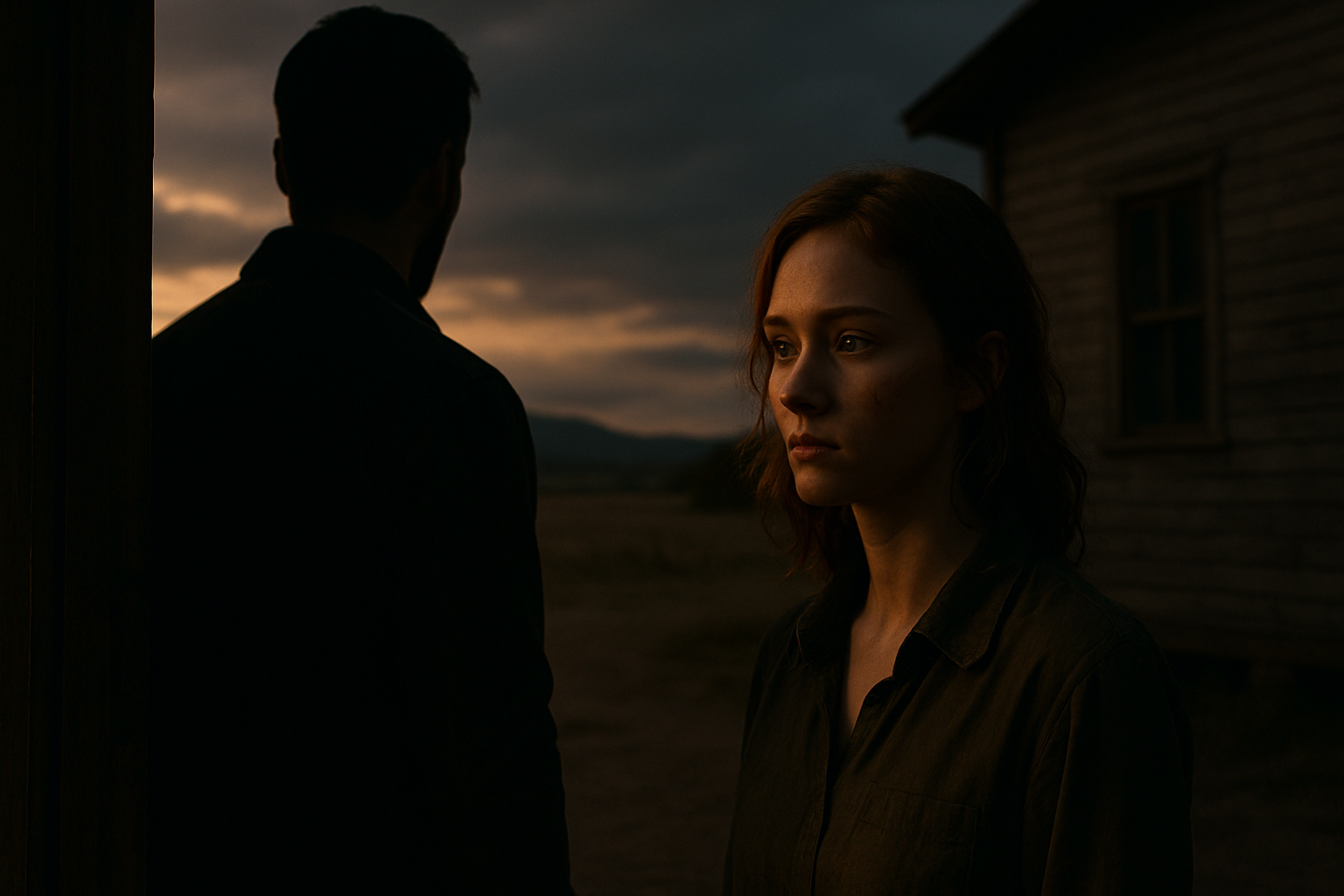
Willa remained standing.
Wyatt looked at her. “You all right?”
“No.”
“Fair.”
She looked toward the road where Deke had disappeared. “He’ll come back.”
“Yes.”
“With worse.”
“Yes.”
June wrapped her arms around herself. “What do we do?”
Wyatt looked at the barn, the house, the fields Thomas had died trying to protect, the daughters Caroline had sent home too late and just in time.
Then he looked toward Mercy Ridge, where old lies had lived so long they had learned to pass for history.
“We go to town,” he said.
Willa stared at him. “Now?”
“Now.”
“Why?”
Wyatt slipped the broken buckle back into his pocket and lifted his hat from the porch rail.
“Because Deke Barlow has spent twenty-two years telling this town who I am.”
He opened the door and reached for Caroline’s papers.
“It’s my turn.”
They bought what the season and decency demanded.
Two coats, heavy enough to turn a cutting wind. Three pairs of jeans, stiff and dark on the store counter. Socks rolled in twos. Work gloves with palms thick enough for fence wire. Underclothes wrapped by Mrs. Harlan in brown paper with a delicacy that made the act feel more exposed than if she had tossed them plain into the basket.
Then came the practical things: flour, sugar, beans, coffee, canned peaches because June’s eyes had drifted to them once and stayed there, salt pork, chicken feed, and a small tin of peppermint candy sitting near the register in a red-and-white-striped box.
June picked it up.
For a moment she held it like a thing from a memory she did not quite own. Her thumb traced the painted lid. Then, as if catching herself wanting too openly, she set it back.
Wyatt saw.
He reached around her and put the tin into the basket.
June’s head turned fast. “You don’t have to.”
“I know,” he said.
That was all.
It seemed to trouble her more than kindness ought to trouble anyone.
Mrs. Harlan watched the three of them from behind the counter with the still face of a woman who had spent a lifetime listening more than speaking and making a meal of what she overheard. She folded the brown paper around the underclothes slowly, tucking the edges in with unnecessary care. The paper crackled loudly in the store’s silence.
“Folks will ask,” she said.
Wyatt slid a sack of beans closer to the register. “Let them.”
Mrs. Harlan’s mouth tightened. Her eyes flicked from Wyatt to Willa, then to June, then back again. “Are these relatives?”
Wyatt reached for his wallet.
He had not decided what answer the town deserved. He only knew the one these girls did. But before he could put words to either, a voice carried from the doorway, smooth and pleased with itself.
“Now that is the question, isn’t it?”
The bell over the door gave a weak little shiver, though the man standing beneath it had already entered.
Sheriff Deke Barlow filled the doorway like he owned not just the store but the air inside it. Age had thickened him without softening him. His shoulders had rounded some, his belly pressed hard against the buttons of his uniform shirt, and the skin beneath his jaw had loosened. Silver threaded his hair at the temples, bright against the dark brim of his hat.
But his eyes had not aged.
Wyatt knew those eyes.
Pale. Small. Amused.
They had always looked at pain as if it were a show put on for his benefit.
At the sight of him, something old woke in Wyatt’s body. Not memory, not yet. Something lower. Animal. His ribs began to ache beneath his shirt, deep under the old scar, the way bones sometimes warned of weather before clouds arrived.
Deke smiled.
“Wyatt Calder,” he said, drawing the name out like it had a sour taste he enjoyed. “Didn’t figure you for a man bringing ladies into town.”
Willa stepped nearer to June without seeming to think about it. A small movement, protective and automatic.
Deke saw it.
His smile widened.
“Ladies might be generous,” he added, letting his gaze drag over them. “But I suppose lonely men can’t be choosy.”
The store went dead quiet.
Even Mrs. Harlan stopped folding.
A hard red pulse beat behind Wyatt’s eyes.
Willa’s cheeks darkened with rage or humiliation or both. June stared down at the floor, her eyes shining, her whole body gone still with the practiced stillness of someone who had learned early not to give cruel men the satisfaction of a flinch.
Deke took another step inside.
Then another.
He enjoyed each one. Wyatt could see that plainly. He had always been a man who understood the power of arriving slowly.
“Who are they?” Deke asked.
Wyatt’s voice came out quiet. Too quiet. “None of your business.”
Deke chuckled. “In my county, most things are my business.”
“Not them.”
The sheriff’s gaze slid again, lingering where it had no right to linger, measuring Willa’s height, June’s softness, their worn shoes, their new coats still folded on the counter. Wyatt felt the urge rise in him, hot and clean and dangerous. He wanted to put Deke Barlow through the front window. He wanted the glass to carry him out into the street in pieces.