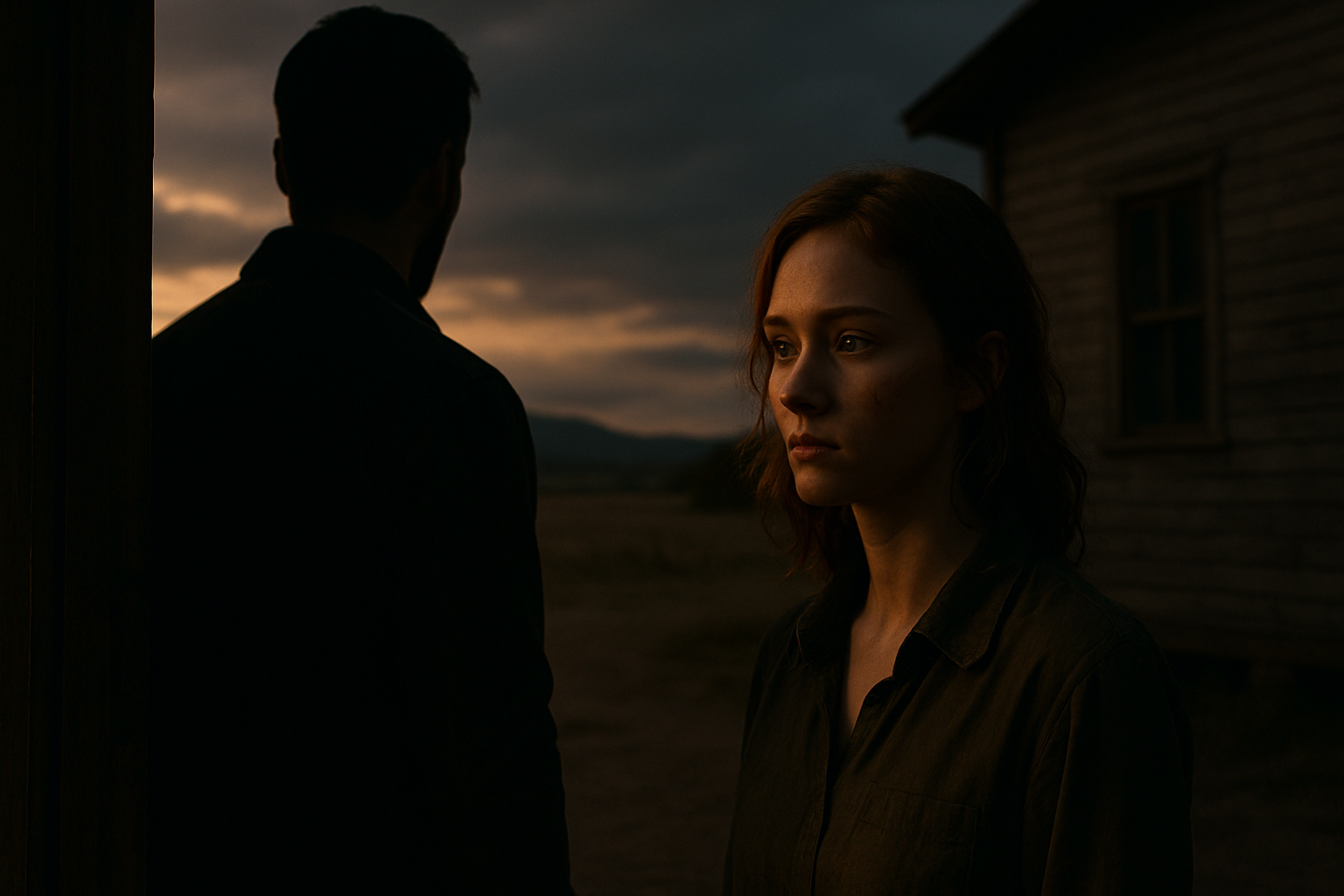
“Funny,” Deke said. “I heard Caroline Ward passed. Then two big gals show up on your porch.” His eyes sparkled. “World sure does enjoy a joke.”
Willa went rigid.
Not from the insult.
From the name.
Deke saw that too.
He turned his attention to her, taking his time. “You must be Willa.”
Her face changed in an instant. Rage narrowed into alarm.
“How do you know my name?”
Deke tapped one finger to his temple. “Sheriff hears things.”
June’s voice was barely breath. “Willa.”
Deke leaned a fraction toward her, as if she had invited him closer. “And you must be the sweet one.”
Wyatt moved before he thought.
He stepped between Deke and June.
The sheriff’s smile vanished.
Only for one second.
But in that naked second Wyatt saw the man beneath the badge, the same old rot dressed now in county authority. He saw anger there. Possession. A flash of resentment that Wyatt Calder, of all men, would dare stand upright in front of him.
Then Deke smiled again.
“Careful, Calder,” he said softly. “You always did get brave too late.”
The words struck like flint to dry straw.
For an instant the store disappeared.
Smoke.
Heat.
A flash of silver in firelight.
A voice, low and close.
Stay down, Calder.
Wyatt’s fingers curled into a fist at his side.
Deke’s gaze dropped to it.
“So they haven’t told you everything yet,” he said.
Wyatt held himself still by force alone.
Willa’s voice cut through the tension like a blade pulled clean from leather. “Mama told us enough.”
Deke turned his head slowly toward her. “Your mama was a frightened woman with a sick mind.”
“My mama was dying,” Willa said. Her voice trembled, but it did not bend. “There’s a difference.”
Something moved behind Deke’s pale eyes.
Not shame.
Never shame.
Anger.
He tipped his hat with two fingers. “I’ll be out to the ranch tomorrow.”
Wyatt did not answer.
Deke went on, his voice returning to that lazy public drawl meant for witnesses. “We need to discuss property records, stolen documents, and whether these two are in lawful possession of items belonging to the Ward estate.”
Wyatt said, “You’ll need a warrant.”
Deke smiled again.
“By tomorrow,” he said, “I’ll have one.”
Then he turned and left, the bell over the door jangling too cheerfully after him.
No one moved until the sheriff’s truck started outside. Its engine coughed, caught, and rolled away down the street. Only then did the store remember how to breathe. Somewhere near the back, a man cleared his throat. Mrs. Harlan busied herself with the register, though her hands fumbled twice before she got the drawer open.
She would not meet Wyatt’s eyes as she totaled the bill.
Wyatt paid in cash.
He carried the sacks out himself.
Willa took two before he could stop her. June gathered the lighter parcels, the brown-wrapped bundle held tight against her chest. The peppermint tin sat near the top of one bag, bright and foolish and brave among the flour and beans.
No one in the truck spoke at first.
The road home stretched pale beneath a sky that had begun to bruise at the edges. Dry grass bowed in waves across the open land. Fence posts ticked past one by one, marking time none of them trusted.
They passed the church, its white steeple thin against the darkening clouds.
Only then did June speak.
“He’s the man Mama was afraid of.”
Wyatt kept both hands locked on the wheel.
“Yes.”
Willa turned toward him. “Do you remember him in the fire?”
His ribs throbbed so sharply he nearly took his foot off the gas.
“No.”
Willa watched him with Caroline’s eyes, though there was iron in hers that was all her own. “But you’re starting to.”
Wyatt did not deny it.
Back at the ranch, the wind rose hard enough to worry the eaves.
By evening, clouds crowded low over the plains, pressing the sky down until the house seemed smaller beneath it. Wyatt brought in wood and lit the stove. Flame licked, caught, and began to warm the kitchen with a smell of pine and ash.
Willa put groceries away with fierce efficiency, as if every can and sack had personally offended her by being out of place. June folded their new clothes on the bed in the small back room, smoothing the sleeves of the coats, pairing socks, touching the denim with the shy wonder of someone not used to owning things chosen for fit rather than survival.
For a while, if Wyatt let his eyes blur and did not let himself think, they almost looked like a household.
A man by the stove.
A woman putting food on shelves.
Another making a room ready.
Rain threatening beyond the glass.
It was a cruel glimpse. The kind of mercy that made a wound ache worse.
Then Wyatt took the brass key from the tin on the shelf.
The little key lay in his palm, dull and harmless-looking.
“We need to find that lockbox,” he said.
Neither girl argued.
The barn waited under storm light.
It stood a short walk from the house, broad-shouldered and weather-beaten, its boards silvered by years of wind. Wyatt had rebuilt much of it after the fire. He had replaced the south wall, patched the roof, rehung the doors, set new rails. But inside, along the north side, one beam still bore the black scars of flame.