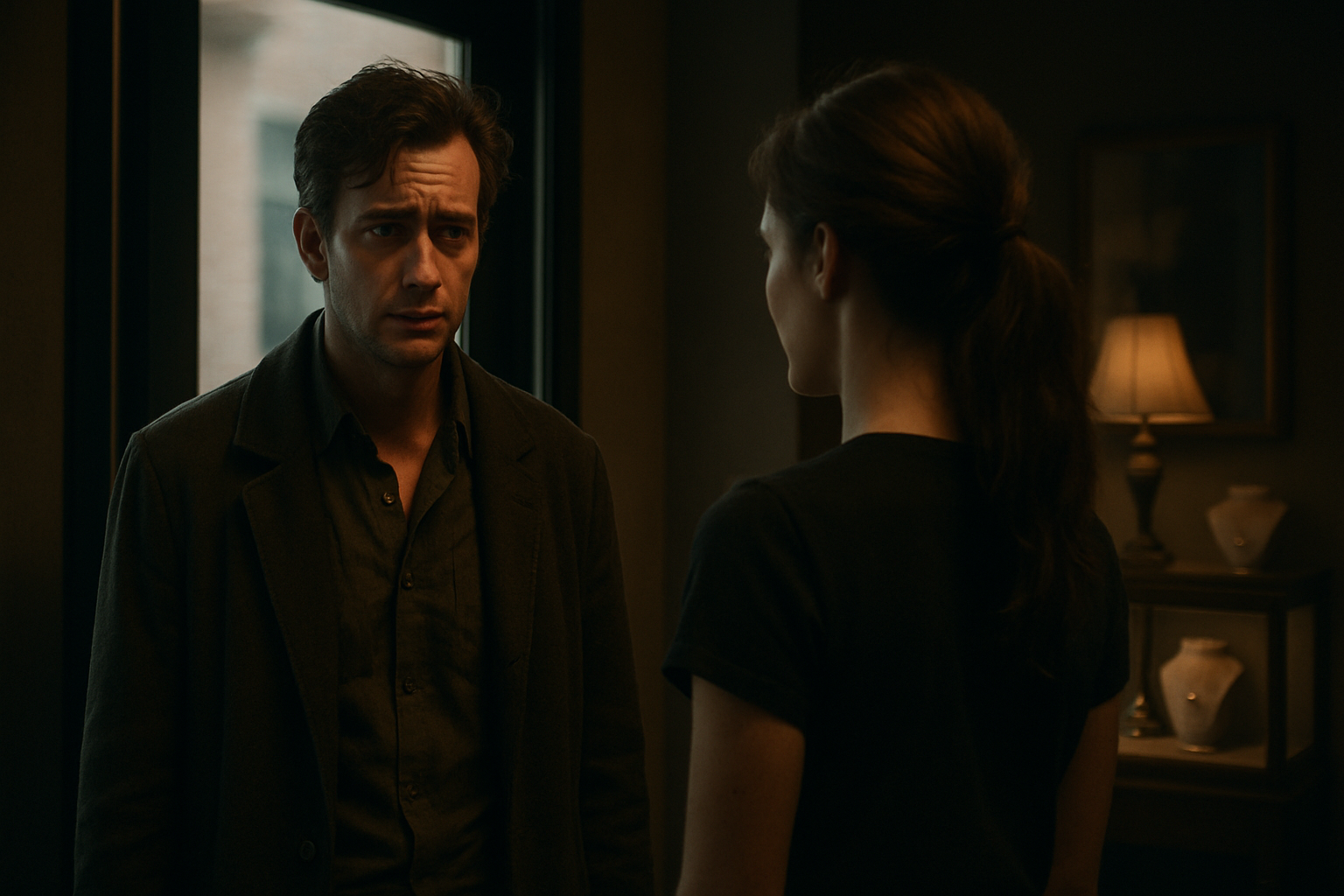
“I have it,” she said.
“I figured.”
“But thank you for not making it strange.”
“I am actively fighting the urge.”
“Good. Keep fighting.”
He sat in the corner while she worked through the night. Sometimes he brought water. Sometimes he entertained Finn on a video call when the boy woke from a nightmare at the sitter’s.
Mostly, Julian was simply present.
Steady and quiet.
Letting Elara lead in the kingdom she had built from pain.
At four in the morning, she set the sapphire.
The necklace came alive beneath the bench light. Blue fire caught in gold and diamond.
Elara leaned back, drained, and saw Julian asleep in the chair, still wearing his coat, neck bent at a terrible angle.
Years earlier, he had not come when she needed him.
Tonight, he had come and asked where to stand.
She crossed the studio and touched his shoulder.
He woke instantly.
“What’s wrong?”
“Nothing.”
“Did the setting fail?”
“No.”
“Finn?”
“He’s fine.”
“Then what do you need?”
Elara looked at him. At the worry still waiting in his body. At the man who had spent more than a year accepting boundaries he hated because they mattered to her.
The anger remained.
It might always remain in some form.
But it no longer filled every room he entered.
“I’m tired,” she said.
“I can go.”
“I’m tired of being afraid of you.”
He went still.
She sat on the edge of the workbench, hands clasped.
“I don’t mean I’m healed. I still have nightmares. My hands still ache. Sometimes I look at you and remember the hospital bed. Sometimes I look at you and remember being twenty-four and happy. Both are true. I hate that both are true.”
“I don’t want to hurt you again.”
“I know. That is what frightens me. I believe you.”
His breath caught.
“I don’t forgive what happened,” she said. “Maybe forgiveness is the wrong word. Maybe some things are not forgiven. They are understood, contained, and no longer allowed to govern every choice.”
Julian came closer slowly, stopping far enough away for her to choose.
“I love you,” he said. “I am not saying it to get anything. It is simply true.”
“I know.”
“I can keep loving you from outside your life if that is what keeps you safe.”
She closed her eyes. A tear slipped down her cheek.
“That would be noble.”
“I’m trying not to be noble. Noble is often dramatic selfishness in a better suit.”
The line startled a laugh from her.
Then she cried for real.
Not from fear.
From exhaustion. From grief. From the terrifying relief of wanting something she had forbidden herself to want.
“I want to try,” she whispered. “Slowly. Carefully. Therapy. Boundaries. No fairy-tale nonsense. No pretending the past did not happen.”
Julian nodded, eyes bright.
“Anything.”
“If I say stop, you stop.”
“Yes.”
“If I get scared, you do not punish me for it.”
“Never.”
“If Finn gets attached and you disappoint him, I will destroy you.”
“That seems reasonable.”
She laughed through tears.
Then she reached for his hand.
The contact was small.
Fingers against fingers.
Scarred knuckles against warm skin.
Julian looked at their joined hands as if she had handed him the world and trusted him not to break it.
“Do not make me regret this,” she said.
“I will spend my life trying not to.”
“No speeches.”
“Right. Sorry.”
She drew him down and kissed him.
It was not the kiss of young lovers who believed love could conquer everything.
That kiss had died years before.
This one was cautious. Trembling. Adult.
It carried grief, anger, longing, and the fragile courage of two people who knew exactly how badly love could fail, and chose to test it anyway.
A year later, Finn helped plan the proposal.
By then, Elara and Julian had survived twelve months of rebuilding.
They fought about fear, money, parenting, Isolde’s letters from prison, and Julian’s habit of preparing for every possible disaster.
They went to couples therapy and did not perform politeness there.
Elara admitted when resentment rose.
Julian admitted when guilt made him want to agree instead of telling the truth.
They learned honesty could be messy without becoming dangerous.
Isolde Harrow was serving an eight-year sentence after Vivienne, of all people, found the missing link. Her investigator uncovered an old payment route to a shell security firm.
Vivienne gave the file to Elara first.
“It is your story,” she said. “You decide.”
Elara chose to testify anonymously at first, then publicly after other victims came forward. Isolde had used intimidation for years against employees, rivals, and anyone she considered inconvenient.
The trial became larger than Elara’s pain.
Because the choice belonged to her, the courtroom did not feel like another theft.
Julian testified too, but this time he sat behind Elara, not in front of her, and spoke only when called.
Vivienne did not marry Julian.
Unexpectedly, she became a friend with sharp edges.
Later she joked that being left by a haunted billionaire had been excellent for her character and terrible for her mother’s blood pressure.