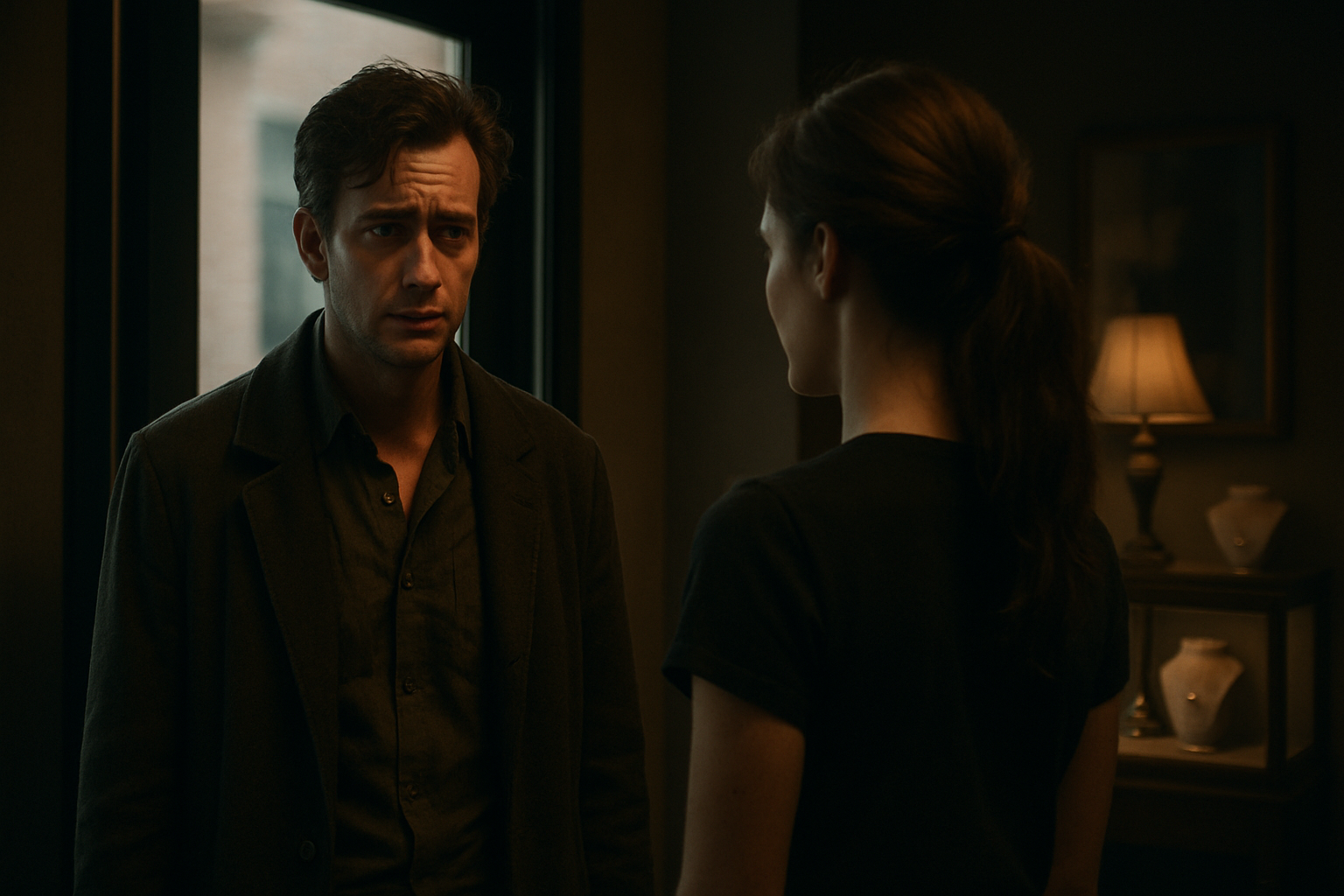
On the night of the proposal, Julian arrived at Elara’s apartment with a velvet box and the expression of a man walking toward both joy and possible execution.
Finn opened the door in dinosaur pajamas.
“She’s in the kitchen,” he whispered. “Remember, I say the cake part.”
“I remember.”
Elara looked up from packing Finn’s lunch.
“Why are you two whispering like criminals?”
“No reason,” Finn said, which was exactly how criminals answered.
Julian knelt in the middle of the kitchen.
Elara froze.
The box in his hand was not unfamiliar to her.
That was the trick.
And the truth.
They had designed the ring together months earlier, not as a promise, but as an exercise in trust. Two imperfect bands curved around one another. Not identical. Not smooth. But strong.
Tiny stars were engraved inside, where only the wearer would know.
At the center was a diamond from no Harrow vault, bought by Elara herself and set by her own hands.
“I had a speech,” Julian said.
Elara’s eyes filled.
“Of course you did.”
“I shortened it.”
“Miracle.”
He smiled, then drew a breath.
“Elara Wren, I loved you when I was too weak to deserve you. I lost you because I chose fear over faith. I cannot undo that. I cannot return what was taken from you. I will never pretend love erases harm. But the life we have built now is honest. It has survived truth, grief, therapy, peanut allergies, courtrooms, and Finn’s dinosaur phase.”
“Not a phase,” Finn whispered.
“Apparently not a phase,” Julian corrected. “I promise to choose you through action, not performance. I promise to ask, to listen, to stand beside you instead of in front of you. I promise to love Finn as a gift, not a possession. And I promise to treat every day with you as grace, not as something owed.”
Elara covered her mouth.
Julian opened the box.
“Will you marry me?”
Finn bounced on his toes.
“And cake after?”
Elara laughed and cried at once.
“Yes,” she said. “To you. To the work. To the cake. To all of it.”
Julian slid the ring onto her finger.
It rested beside the hammered silver band she had made after the attack, the one that reminded her she could still create beauty with damaged hands.
Survival and beginning sat together.
Neither canceled the other.
Their wedding six months later was small, held in a garden behind a restored brick house.
No society columns were invited.
Not one flower was paid for with Harrow money.
Vivienne came in a blue dress and cried discreetly into a napkin while insisting allergies were to blame.
Bea from the boutique gave a toast that threatened Julian with professional annihilation if he ever made Elara cry for the wrong reasons.
Finn, as ring bearer, walked too fast, dropped one ring, recovered it with tremendous dignity, and announced to the guests that cake was next.
Elara wore a dress with sleeves that left her hands visible.
Once, she had hidden her scars from cameras, clients, and herself.
Now she let the sunlight catch them as Julian held her fingers through the vows.
“I do not stand here because I was saved,” she said, voice steady. “I saved myself. I was helped by my sister, my son, my friends, time, work, and every stubborn morning when I chose to keep living. Real love does not ask a woman to become less whole so a man can feel necessary. Julian, you are not my rescuer. You are my partner. That is better.”
Julian cried openly.
No one mocked him for it.
When he spoke, his voice trembled but held.
“I once believed love was passion, possession, and promises. I was wrong. Love is responsibility. Love is asking when pride wants to decide. Love is staying steady when fear wants to run. Love is not being forgiven because you are sorry. Love is becoming safe enough that forgiveness, if it comes, has somewhere to rest. Elara, thank you for letting me spend my life learning how to love you correctly.”
After the ceremony, Finn dragged them both to the cake table before photographs were finished.
The cake leaned slightly because Elara had ordered it from a neighborhood bakery instead of a luxury vendor.
It was imperfect.
Delicious.
Gone too quickly.
Later, as evening settled and guests danced under warm lights, Elara stepped away.
Julian found her near the gate, watching the first stars appear.
“Hands hurt?” he asked.
“A little.”
“Want to go inside?”
“Not yet.”
He stood beside her, not touching until she leaned her shoulder against his arm.
“Do you ever think about who we would have been?” she asked. “If none of it had happened?”
“Yes.”
“And?”
“I think we would have been happy sooner,” he said. “But I don’t know if I would have become someone worthy of staying happy with.”
Elara considered that.
“I hate that answer.”
“I do too.”
She took his hand.
“I still miss the baby.”
His fingers tightened gently around hers.
“So do I.”
For a while, they said nothing.
The silence was no longer empty.
It carried grief without drowning in it.
From the dance floor, Finn shouted, “Mom! Julian! Vivienne says I can have more cake if you say yes!”
Vivienne called back, “I said ask your mother!”
Elara laughed.
The sound rose into the night, bright and astonished, as if some part of her still could not believe joy had found a path through all that ruin.
She looked at Julian.
At the man who had once failed her, then spent years becoming someone who would not.
She thought of the boutique. The ring. The child behind the counter. The terrible sentence that had opened the door to their second life.
That setting was made for the child you left behind.
The sentence was still true.
But it was not the only truth.
Some loves die because they are too delicate for pain.
Some loves survive as scars. Not smooth. Not pretty. But proof the wound closed.
And some loves, tended with humility, accountability, and time, become stronger than innocence ever could have been.
Elara squeezed Julian’s hand and walked with him back toward their son, their friends, and the imperfect cake waiting beneath the lights.
She had not been made whole by love.
She had made herself whole.
Then she chose love anyway.