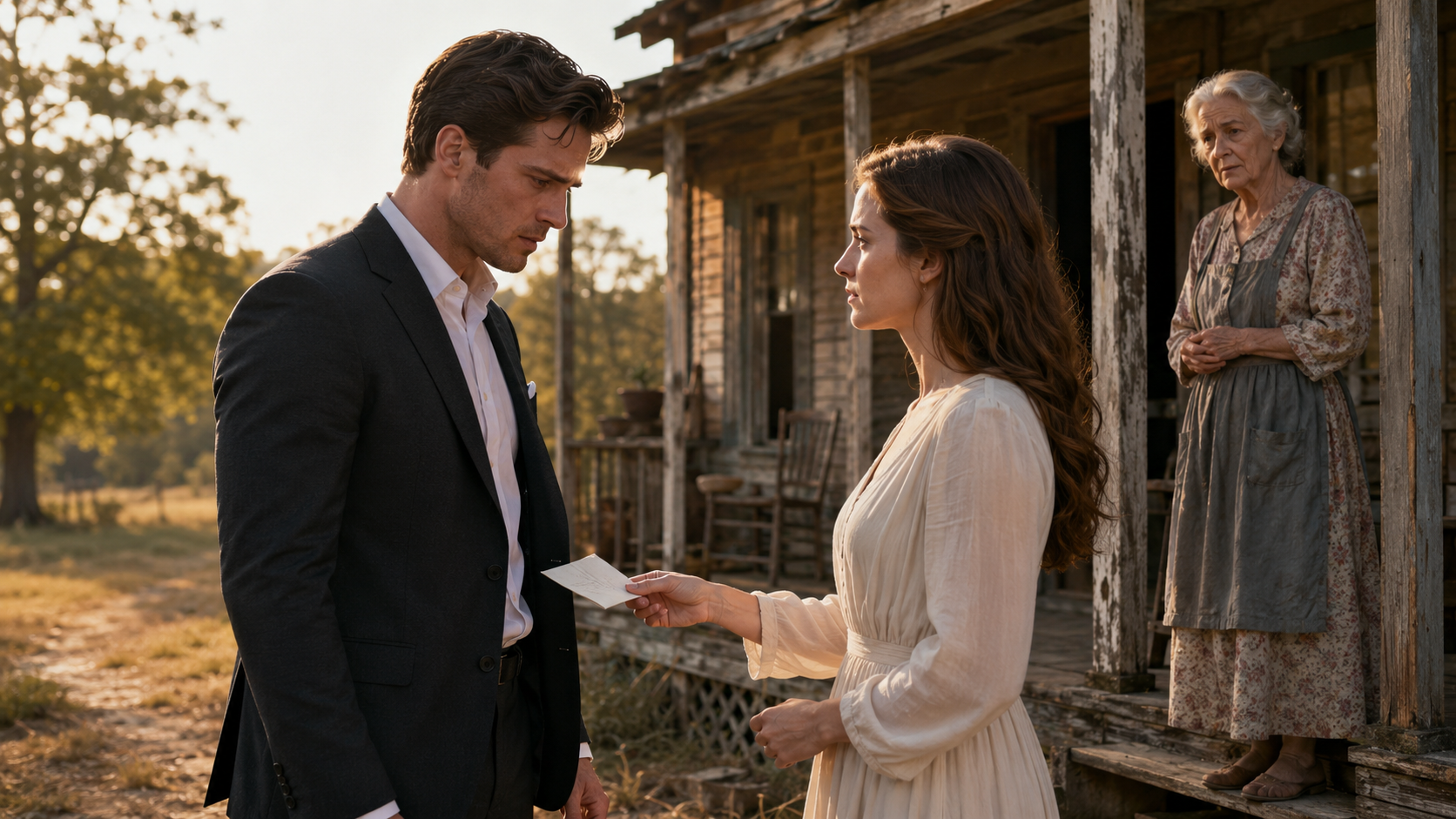
At eight, he had sat on that sofa with a fever while Ruth placed cool cloths on his forehead.
At eleven, he had hidden report cards under the cushion because he had gotten a B in math and thought the world had ended.
At sixteen, he had promised himself he would never live in a house like this again.
He had kept the promise too well.
Near dawn, Ethan rose and found Ruth in the kitchen making biscuits.
She did not look surprised.
“Couldn’t sleep?” she asked.
“No.”
“Good.”
He almost smiled. “Good?”
“Some things should cost a man rest.”
He stood in the doorway, feeling again like a boy.
“Ma, I’m sorry.”
Ruth pressed dough with the heel of her hand. “You said that.”
“I’m saying it when you’re ready to hear it.”
She stopped kneading.
“That is better.”
He stepped into the kitchen. “I was ashamed of the house.”
“I know.”
“I told myself I wasn’t ashamed of you, only the way things looked.”
Ruth looked at him then.
“And now?”
“Now I think that was a lie I used because it sounded less ugly.”
She studied his face for a long moment.
Then she nodded toward the counter. “Wash your hands.”
He blinked. “What?”
“Wash your hands. You’re helping.”
“Ma, I don’t know how to make biscuits.”
“That has been clear for thirty-four years.”
Despite everything, he laughed.
It came out broken.
She gave him a lump of dough and showed him how to fold it, press it, turn it, and press again. His first biscuit looked like a stone. His second looked worse. Ruth inspected it with the seriousness of a judge.
“I have seen prettier accidents,” she said.
Ethan laughed again, and this time it hurt less.
From the hallway, Clara appeared quietly. Her hair was loose over her shoulders, and she wore one of Ruth’s old sweaters against the morning chill. She watched mother and son standing side by side at the counter.
Ethan met her eyes.
There was no forgiveness there yet.
But there was attention.
That was something.
Later that morning, Ethan walked outside with his phone and called Blake.
“Man,” Blake answered, “how’s the country trial going? She pass?”
Ethan looked at the porch steps, at the weak handrail, at the place where rain had eaten a line through the wood.
“No,” he said.
Blake laughed. “That bad?”
“She didn’t fail. I did.”
Silence.
“What are you talking about?”
“I tested her. It was wrong.”
Blake scoffed. “Don’t get dramatic. Better to know before marriage.”
Ethan looked through the kitchen window. Clara was helping Ruth pack biscuits into a basket for a neighbor recovering from surgery.
“Better to be the kind of man who doesn’t need tricks,” Ethan said.
Blake made a dismissive sound. “You’ve changed.”
“I hope so.”
He ended the call.
For the first time, he did not care whether the men at work found him foolish.
By noon, Ethan had called the church and the venue. He asked what it would mean to postpone the wedding. There would be fees. There would be questions. There would be relatives whispering and friends making jokes.
He accepted all of it.
In the afternoon, he found Clara sitting under the pecan tree behind the house. Ruth had gone inside to rest, though Ethan suspected she was near a window, listening with all the subtlety she did not possess.
Clara held a glass of sweet tea in both hands.
Ethan sat a careful distance away.
“I called the church,” he said.
Clara looked at him.
“I told them we might need to postpone.”
Her expression changed, but he could not read it.
“I’m not saying that to pressure you,” he continued quickly. “I’m saying the opposite. I don’t want you walking down an aisle in three weeks because invitations are printed and people bought clothes. After what I did, you deserve time to decide whether I am still someone you want to marry.”
Clara looked down at the grass.
“That sounds like the man I thought I knew,” she said.
The words gave him hope and pain at the same time.
“I want to be that man,” he said.
“Wanting is easy.”
“I know.”
“Do you?”
He nodded. “I’m beginning to.”
She watched him for a long moment. “What happens after you feel guilty for a week? You go back to Charlotte, work gets busy, the apartment feels normal, and this place becomes uncomfortable again. What then?”
Ethan had no polished answer ready.
So he told the truth.
“Then I come back anyway.”
Clara waited.
“I come back when it’s inconvenient,” he said. “I fix the porch because it needs fixing, not because guilt is loud. I call my mother on Wednesdays because you were right and because she deserves more than leftover minutes. I stop pretending money is the same thing as presence. And I stop letting embarrassed men teach me how to love.”
Clara’s eyes filled with tears.
She blinked them back. “Do not say beautiful things to escape doing hard ones.”
“I won’t.”
“Don’t promise me loudly.”
He understood then.