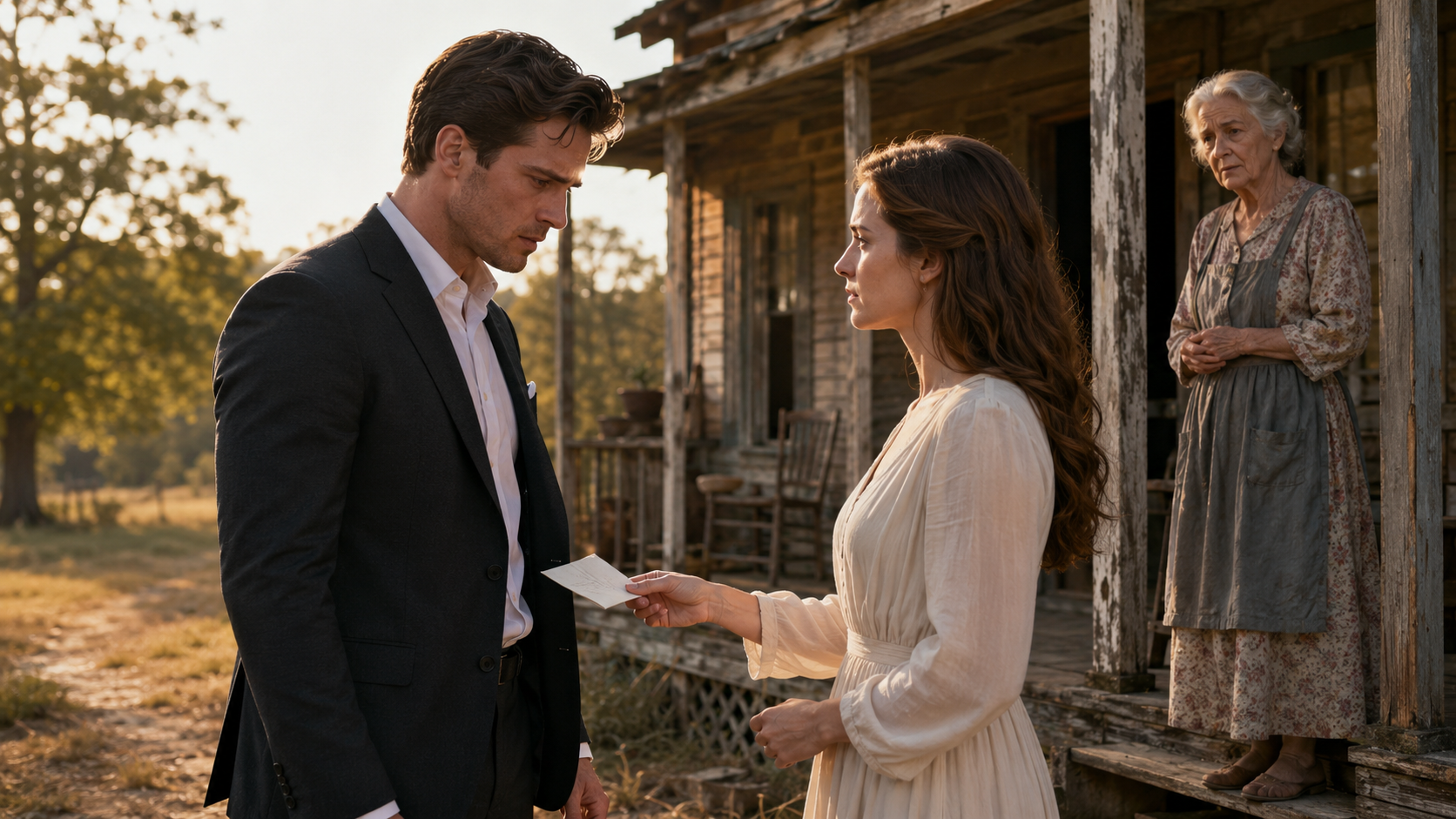
“Watch me quietly,” he said.
For the first time since she had handed him the envelope, Clara smiled.
It was small.
But it was real.
The wedding was postponed.
Some people complained. Clara’s aunt said it was bad luck. Ethan’s colleagues joked that he had been “domesticated.” Blake stopped inviting him to lunch as often. Ethan found he did not miss him.
Every Wednesday evening, Ethan called Ruth and did not multitask. At first, she answered with suspicion.
“You driving?” she asked the first week.
“No.”
“Emailing?”
“No.”
“Watching television?”
“No, Ma.”
“Good. Then tell me something true.”
So he did.
He told her work made him tired. He told her he was afraid Clara might still leave. He told her he had spent years acting as if ambition had no cost. Ruth listened, sometimes gently, sometimes with the mercy of a hammer.
On Saturdays, he drove to her house.
The first time he came alone with lumber, tools, groceries, and a contractor, Ruth stood on the porch with both hands on her hips.
“What is all this?”
“Repairs.”
“I didn’t ask for repairs.”
“I know.”
“I don’t want guilt money.”
“It isn’t guilt money.”
She narrowed her eyes.
He corrected himself. “Some of it started that way. But I’m trying to do better than starting.”
Ruth looked at the lumber, then at him. “Do not turn my house into something cold.”
“I won’t.”
“And don’t touch my kitchen curtains.”
“I wouldn’t dare.”
The porch was repaired first. Then the roof. Then the window. Ethan learned the names of neighbors he had forgotten, people who remembered him as “Ruth’s boy” before they remembered him as any kind of director. Clara came most weekends, not always with him, sometimes on her own. She brought Ruth knee braces, appointment notes, recipes she wanted corrected, and stories from the clinic.
Slowly, the house changed.
Not into a showroom.
Into a safer version of itself.
The old yellow chair stayed. The garden stayed crooked. The stove stayed because Ruth said a stove that had survived that much deserved respect. The walls were painted a warm cream, but the family photos went back exactly where Ruth wanted them.
Three months later, Ethan and Clara stood again under the pecan tree.
The wedding was two weeks away.
This time, smaller.
No rooftop rehearsal dinner. No extravagant performance. The ceremony would be held at Ruth’s church, with a reception in the fellowship hall and food cooked by women who had known Ethan when his knees were always scraped.
Clara had chosen it.
Ethan had agreed before she finished asking.
“Are you sure?” he said now.
Clara looked at the house. Ruth was on the porch, pretending not to watch them.
“No,” Clara said.
His heart dropped.
Then she turned to him. “I’m not sure in the way people are sure when nothing bad has happened. I’m sure in the way people become sure after seeing someone fall and then watching whether they get up differently.”
He exhaled slowly.
“I am still sorry,” he said.
“I know.”
“I will probably spend a long time being sorry.”
“Good,” she said. “Not because I want you punished. Because some kinds of sorrow keep people careful.”
He nodded.
She reached into her bag and pulled out the same envelope.
His name still written across it.
The paper was softer now from being handled.
“I kept this,” she said.
“I thought you might have thrown it away.”
“I almost did.”
“Why didn’t you?”
She opened it and showed him the last page. Beneath her original list, new lines had been added in different ink.
Ethan recognized his own handwriting.
Call Wednesday.
Repair porch.
Ask before deciding.
Come back without being asked.
Learn biscuits.
Tell the truth before fear turns it into a test.
He looked at her.
Clara’s eyes shone. “You added to it.”
“I needed instructions.”
“You still do.”
“I know.”
She folded the paper and placed it in his hand.
“Then keep it,” she said. “Not as proof that I forgave you. As proof that love should make us remember who paid the price for us to become ourselves.”
Two weeks later, Ethan stood at the front of a small church with wooden pews and uneven floors. He wore a navy suit, but no expensive watch. Ruth sat in the first row in the blue dress with pearl buttons, the one she had refused to wear before. Clara had insisted on helping her choose it.
When Clara entered, the whole room seemed to inhale.
She did not look like a woman entering a perfect life.
She looked like a woman choosing a real one.
Ethan cried before she reached him.
Ruth cried harder.
During the vows, Ethan did not promise Clara a life without fear, pride, mistakes, or painful lessons. He promised her honesty before fear, humility before pride, repair after mistakes, and gratitude before ambition.
Clara held his hands.
Her voice was steady when she said, “I promise to love the man you are, challenge the man you pretend to be, and honor the people who made you possible.”
At the reception, Ruth danced once, badly, with her son. Her knee hurt afterward, but she said it was worth it. Clara saved the folded envelope in a small wooden box with their marriage certificate, a pressed flower from Ruth’s garden, and a biscuit recipe written in Ruth’s slanted handwriting.
Years later, when people asked Ethan how he knew Clara was the right woman, he never told the polished version.
He told the true one.
“I took her home to test her,” he would say. “And she handed me a paper that showed me I was the one who needed examining.”
Then he would look toward Clara, who always raised an eyebrow as if to warn him not to make himself sound too noble.
And he would add, “The best thing she ever did was not pass my test. It was refusing to let love become one.”