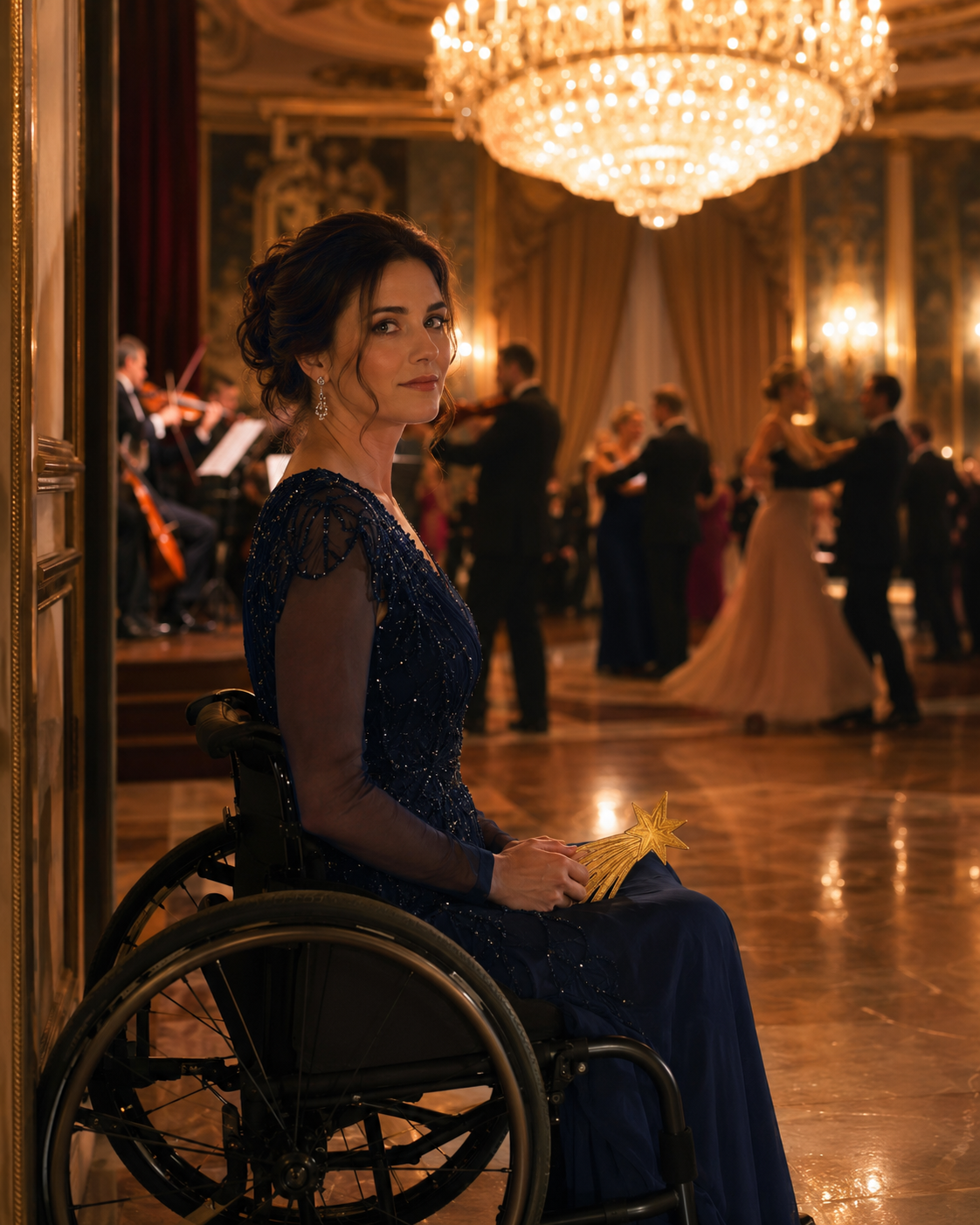
The winter garden was cooler than the ballroom. Condensation covered the lower edges of the glass walls, and the river beyond reflected the lights of the city in broken lines.
Richard closed the doors behind them.
Mara placed the paper comet on a small table.
For a moment, neither spoke.
Then Richard said, “You were extraordinary.”
Mara looked away.
“That is not the conversation we came here to have.”
“I know.”
“Do you?”
He took a slow breath.
“I was afraid.”
“You are always afraid.”
“Yes.”
“You think admitting it excuses everything.”
“No.”
“Sometimes it sounds as though it does.”
Richard moved toward the window.
“When the hospital called me after the accident, they said you might not survive the night.”
Mara had heard this before.
Richard had never described the call without using the same words. She realized that he was still living inside that moment, answering a telephone five years ago and learning that the world could take his daughter without asking permission.
“You survived,” he continued. “Then the doctors told me what might never return. Every day brought another uncertainty. Pain. Infection. Surgery. I could not fix any of it.”
“So you decided to control everything else.”
“Yes.”
The answer came so plainly that Mara was unprepared for it.
Richard turned from the window.
“I controlled the house. Your appointments. Your transportation. Your visitors. I told myself I was creating stability.”
“You created a smaller life.”
“I know that now.”
“No, you know it tonight. Knowing something for ten minutes is not the same as changing.”
“You’re right.”
Mara studied him.
He usually defended himself through explanations, solutions and carefully structured apologies. This time he seemed to have none.
“I wanted to return to music two years ago,” she said.
Richard lowered his eyes.
“I remember.”
“You told me the rehearsal hall had steps.”
“It did.”
“I told you there was another entrance.”
“The alley was poorly lit.”
“I told you I could manage it with assistance.”
“The weather was terrible.”
“There was always something.”
“I thought there would be another opportunity.”
“There was. You found a reason to fear that one too.”
Richard sat on the bench opposite her.
“I saw the way people looked at you after the accident.”
“So did I.”
“They spoke to you differently.”
“Yes.”
“They invited you places because they wanted to feel generous.”
“Some did.”
“They treated you as fragile.”
“And you answered by treating me as fragile more efficiently than any of them.”
The words landed hard.
Richard looked down at his hands.
“I did not realize that was what I was doing.”
“I told you.”
“You did.”
“You thought I was angry because I hadn’t accepted my new life.”
“I thought you were pushing yourself because you wanted your old life back.”
“Of course I wanted parts of it back. They were mine.”
Richard nodded.
“You were afraid I would fail,” Mara said.
“Yes.”
“I was afraid too.”
He looked at her.
“I’m still afraid. I’m afraid of being stared at. I’m afraid of a lift breaking. I’m afraid someone will grab my chair without asking. I’m afraid of falling during a transfer. I’m afraid of being invited somewhere and discovering the accessible entrance is beside the garbage containers.”
Richard’s jaw tightened.
Mara continued before he could interrupt.
“But I am more afraid of waking up one day and realizing I allowed your fear to make every decision for me.”
“I never wanted that.”
“Intentions do not give me back the things I missed.”
“No.”
“I don’t need you to stop caring.”
Richard’s voice became quiet.
“Then what do you need?”
The question remained between them.
Mara had waited years to hear it.
Not what was safest.
Not what was practical.
Not what the doctors recommended.
What do you need?
“I need you to ask before helping me,” she said. “I need you to believe me when I tell you what I can manage. I need you to stop speaking for me in rooms where I am present.”
Richard nodded slowly.
“And if you believe I’m making a mistake?”
“Tell me once.”
“Once?”
“Then let it be my mistake.”
“That may be the most difficult thing you have ever asked me to do.”
“It is not as difficult as living inside decisions someone else makes for you.”
He closed his eyes.
“No,” he said. “It isn’t.”
Mara looked toward the ballroom doors.
Through the glass, she could see Theo and Elena waiting near the curtain. Theo had probably been ordered not to move.
He was moving his hands anyway, silently replaying the rhythm of the concert.
“There is something else,” Mara said.
Richard followed her gaze.
“The boy?”
“Not only him.”
“What, then?”
“The foundation.”
Richard’s expression changed.