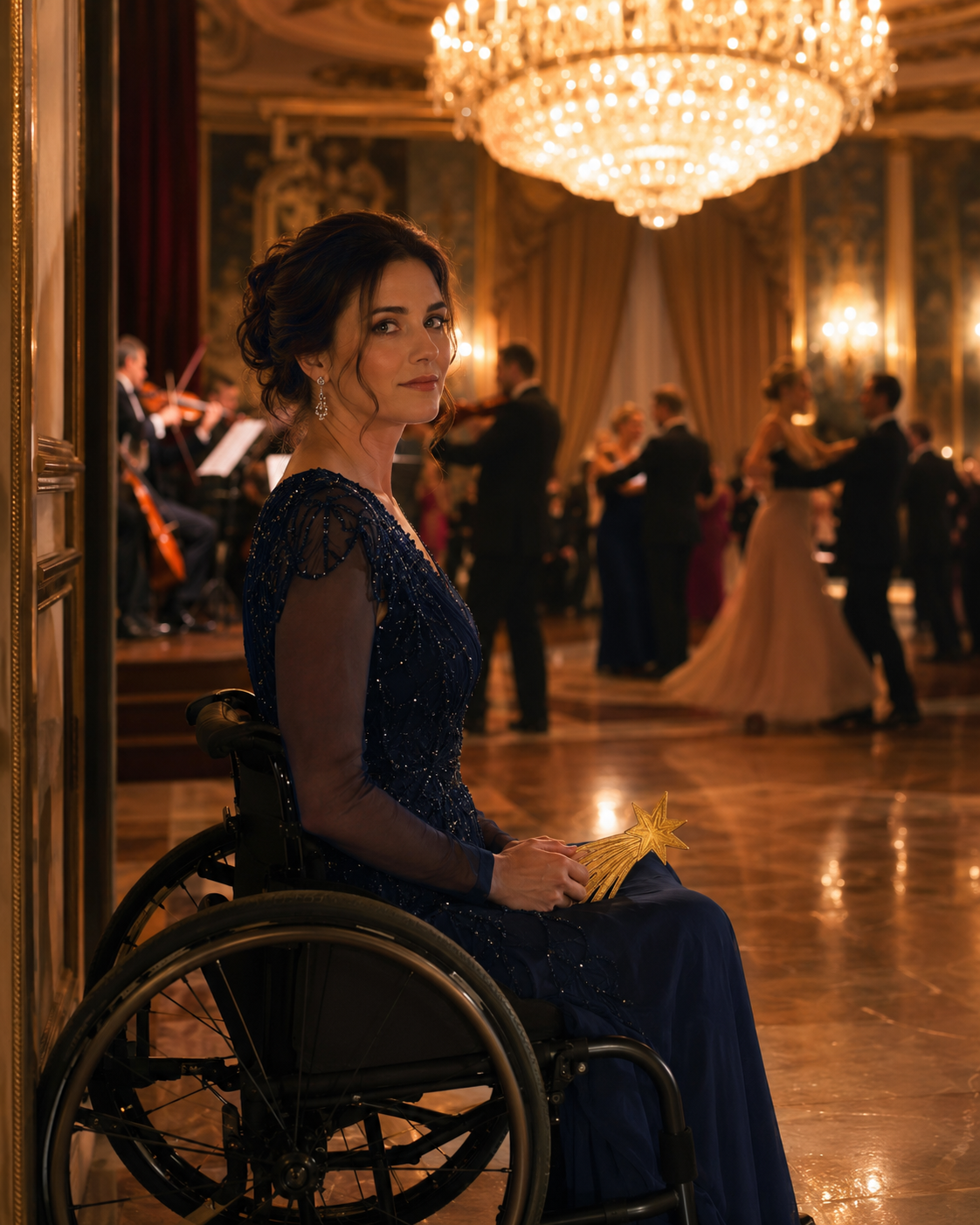
Her first cue came too early, and the second violin corrected half a second late. A horn entered more loudly than she wanted. For one terrifying moment, the tempo threatened to escape.
Mara did not stop.
She brought the baton down, tightened the rhythm and opened her left hand.
The musicians responded.
The music expanded.
It did not matter that she was sitting below the platform.
It did not matter that she could not feel the floor beneath her feet.
The orchestra did not require her to stand.
It required her to listen.
Mara heard each section clearly. She shaped the cellos, restrained the brass and allowed the woodwinds to rise above the melody.
The ballroom disappeared.
There was only sound.
Movement.
Choice.
Conversation without words.
When the final section began, Samuel quietly gestured to the couples on the floor.
A woman in a red dress took her husband’s hand.
Another couple followed.
Then another.
Soon the dance floor began moving again, but the guests were no longer watching themselves.
They were watching Mara.
At first, that awareness frightened her.
Then she saw Theo.
He stood beside the orchestra, moving the paper comet through the air in time with the music.
He was not looking at her wheelchair.
He was watching her hands.
Mara raised the baton higher.
The orchestra reached the final chord.
She held it.
The sound remained suspended beneath the chandelier.
Then she closed her fingers.
Silence.
For several seconds, nobody applauded.
Mara’s heart pounded.
She wondered whether she had misunderstood the room.
Then Samuel Crowe struck his baton gently against the music stand.
One musician began applauding.
Another joined.
The orchestra stood.
The sound spread through the ballroom until every guest was on their feet.
Mara remained seated in the center of it.
Not below them.
Not apart from them.
At the center.
Theo hurried toward her and placed the paper comet on her lap.
“You dropped this,” he said.
“It was never mine.”
“It is now.”
Richard stood several feet away.
He was not applauding.
His eyes were wet.
Mara could not tell whether he was proud, afraid or grieving for all the years that had led them there.
Perhaps he was all three.
Vivian approached him.
“The press will want a statement,” she whispered.
“No,” Richard said.
“We need to control the story.”
He looked at his daughter.
“That is what I have been doing for too long.”
Vivian stared at him.
Richard walked toward Mara.
Theo immediately stepped back.
Richard noticed.
“You don’t have to leave,” he told the boy.
Theo remained where he was, uncertain.
Richard looked at the paper comet.
“Did you make that?”
“Yes, sir.”
“From one of our menus?”
“Yes, sir.”
Richard almost smiled.
“Vivian spent six weeks approving those.”
Theo looked worried.
“Should I unfold it?”
“No. I think it has finally become useful.”
Mara studied her father’s face.
“You told Samuel it was inappropriate.”
“I did.”
“You tried to stop him.”
“Yes.”
“Why?”
Richard looked around the room.
Many guests were still watching, though they pretended to resume their conversations.
“Could we discuss this somewhere private?”
Mara’s first instinct was to refuse. She had spent years allowing private conversations to replace public truths.
But Richard was not ordering her.
He was asking.
“All right,” she said.
They moved toward the hotel’s winter garden, a glass-walled room overlooking the river. Theo followed at a distance until his mother appeared through the service curtain.
Elena Vale was still wearing a catering apron. Her face was pale with alarm.
“Theo!”
He stopped.
She rushed toward him but slowed when she noticed Richard and Mara.
“Mr. Ellison, I am so sorry. He was told to remain downstairs. I had no idea he had entered the ballroom.”
“He didn’t break anything,” Mara said.
Elena looked at the orchestra, the guests and the paper comet on Mara’s lap.
“What happened?”
“Theo interrupted the concert,” Richard said.
Elena closed her eyes.
“I’ll take him home immediately.”
Richard continued, “Then he persuaded Samuel Crowe to give my daughter the orchestra.”
Elena opened her eyes again.
Theo lifted one shoulder.
“They gave it back afterward.”
Mara laughed.
Elena stared at her son.
“Have you completely lost your mind?”
“Not completely.”
“Theo.”
“I heard the music.”
“That is not an explanation.”
“It usually is,” Mara said.
Elena looked embarrassed.
“I’m sorry. He has always believed curiosity excuses everything.”
“It doesn’t,” Mara replied. “But tonight it helped.”
Theo glanced toward Mara.
“I should have asked you first.”
“Yes.”
“I’m sorry.”
“I accept.”
Richard watched this exchange carefully.
Mara turned toward him.
“We still need to talk.”