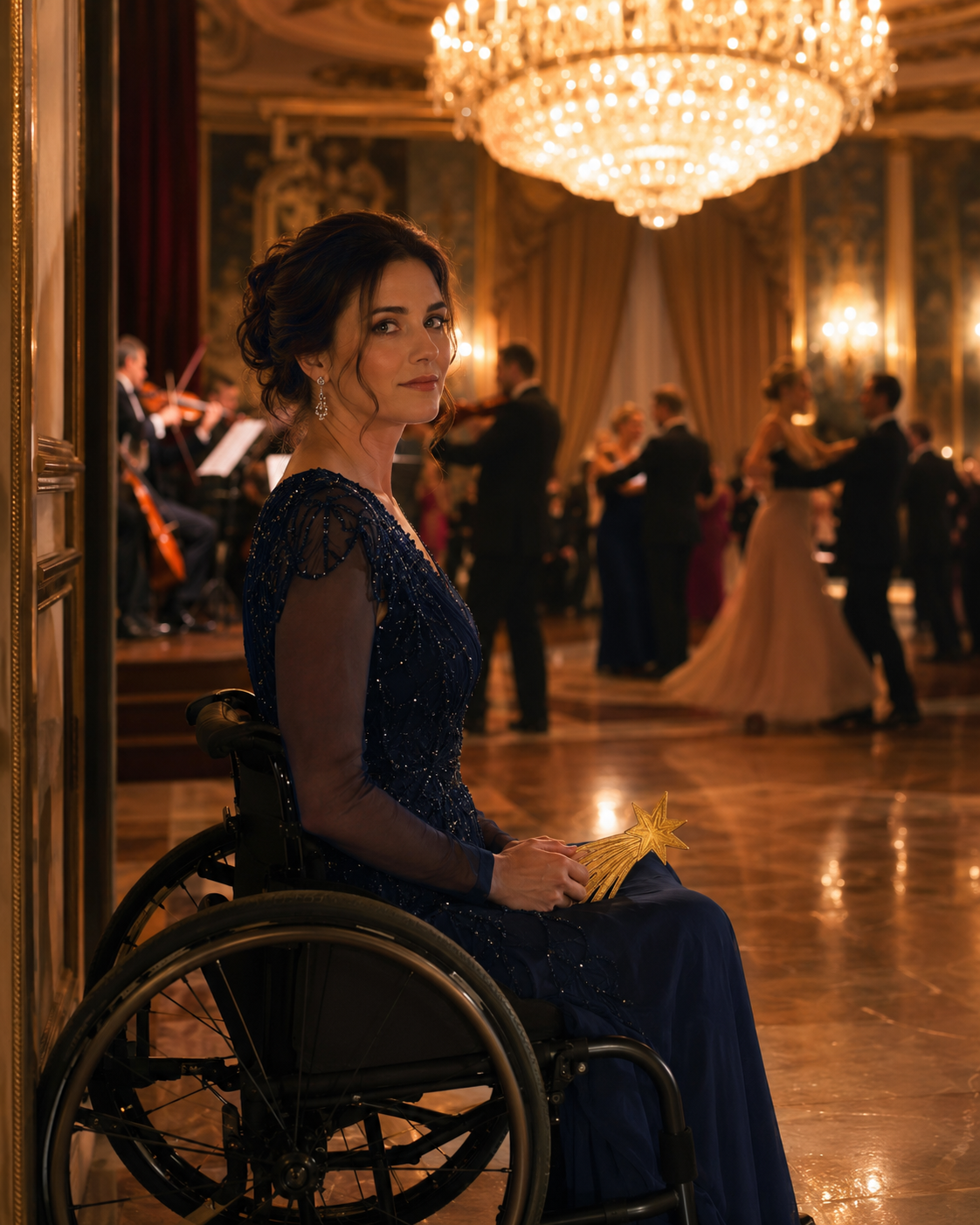
Across the ballroom, Richard Ellison was speaking with three members of the hotel’s board. He looked distinguished in his black tuxedo, silver beginning to show at his temples. He was sixty-one, though magazines regularly described him as ageless, disciplined and impossible to surprise.
He was also watching Mara.
Even while speaking to other people, part of his attention remained fixed on her.
It always did.
Mara touched the folded comet.
“My father chose the table because there is more space here.”
“There is more space everywhere,” Theo said. “The ballroom is enormous.”
“He wanted me to be comfortable.”
“Are you?”
The question came without pity.
That made it harder to answer.
Before Mara could speak, a woman in a fitted black gown approached the table. Vivian Harrow managed public relations for the Ellison Foundation and treated every room as if it were already appearing in tomorrow’s newspapers.
“There you are,” Vivian said to Mara. “Your father has been wondering whether you’d like to move closer to the family table.”
“He put me here.”
“Yes, but several photographers have arrived. The foundation’s family portrait will be taken after the next dance.”
Theo began stepping toward the curtain.
Vivian noticed him.
Her smile did not disappear, but it became thinner.
“And who are you?”
“Theo Vale.”
“Are your parents among the guests?”
“My mother is working in the kitchen.”
Vivian looked toward the service corridor.
“You need to return to the staff area immediately. Guests are not permitted behind the curtains, and staff families are certainly not permitted in the ballroom.”
“He’s speaking with me,” Mara said.
Vivian’s smile tightened further.
“Of course. But the hotel has procedures.”
“My family owns the hotel.”
“That is precisely why procedures matter.”
Mara looked at Theo.
“Would you like to stay for the end of the piece?”
“Yes.”
“Then stay.”
Vivian lowered her voice.
“Mara, there are cameras throughout the room.”
“I had noticed.”
“We need to avoid misunderstandings.”
“What misunderstanding?”
“A child wearing a borrowed jacket is standing beside the daughter of the foundation’s chairman during an event attended by the national press.”
Mara’s expression cooled.
“That sounds less like a misunderstanding and more like a photograph.”
“You know what I mean.”
“I do. That is the problem.”
Vivian glanced at Theo, who was pretending not to listen.
“I’ll speak to your father.”
“You usually do.”
Vivian walked away.
Theo watched her cross the ballroom.
“She doesn’t like my jacket.”
“She doesn’t like anything she cannot arrange in advance.”
“Do you like her?”
“Occasionally.”
“When?”
“I’m still collecting evidence.”
The orchestra completed the waltz. Applause rolled politely through the ballroom.
Theo studied Mara’s face.
“You stopped moving your hand.”
“You distracted me.”
“Do it during the next song.”
“I told you, I wasn’t conducting.”
“You were.”
“Theo.”
“Try.”
Mara looked at the orchestra.
The musicians adjusted their pages. The conductor, Samuel Crowe, raised his baton. He had known Mara since she was a teenager. Years ago, when she was still studying composition, Samuel had allowed her to sit in on rehearsals. Once, when the regular assistant conductor had become ill, he had given Mara the baton for twenty minutes.
She remembered the terror of that moment.
Then the power.
Not power over the musicians, but responsibility for them. Every breath, pause and entrance passed through her hands. She had not controlled the music. She had opened a door and asked it to come through.
She had planned to study conducting in Vienna.
Then, five years earlier, a delivery truck had crossed a red light on a rainy morning.
There had been surgery.
Rehabilitation.
Months of unfamiliar ceilings.
Pain that arrived without warning.
Doctors who spoke carefully.
Friends who visited frequently at first and less frequently later.
Her mother had died when Mara was seventeen, so Richard had faced the accident alone. He reorganized his company, canceled meetings, hired specialists and converted an entire floor of the family home.
He had fought for Mara with the ferocity of a man who believed love meant defeating every possible danger before it reached her.
At first, she had been grateful.
Later, she had begun to feel as though the danger he fought most desperately was her own life.
The orchestra started a livelier composition.
Mara recognized the piece immediately.
“The Northern Sky,” she whispered.
Theo’s eyes widened.
“You know it?”
“I wrote part of it.”
He turned toward her so quickly that his oversized sleeve fell over his hand.
“What?”
“I was a student. Samuel Crowe was preparing a concert and let several of us submit variations. He kept mine.”
“Which part?”
“The middle section.”