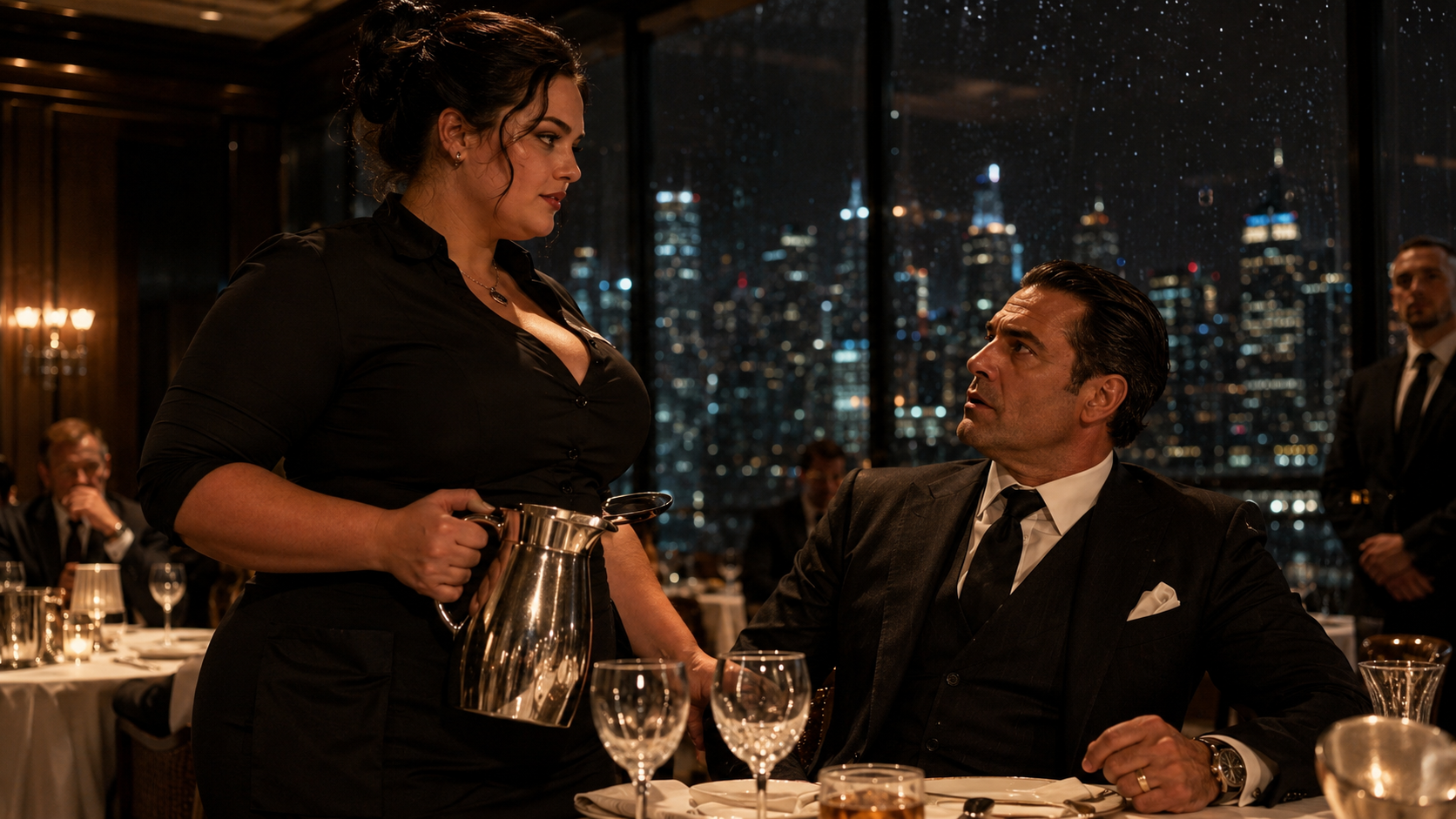
A muscle moved in Dante’s jaw.
For the first time all night, he looked at her as though she had become real.
The guard started to rise.
Dante lifted one hand.
The guard froze.
Lena switched back to English and straightened.
“I’ll give you a moment with the menu.”
Then she turned and walked away.
Her back stayed straight until she reached the service corridor.
Only then did she grab the wall.
Her ankle throbbed. Her heart slammed against her ribs. In the kitchen, steam rose from boiling pans, cooks shouted orders, and someone dropped a tray with a crash that made her flinch.
Her best friend, Nora, caught her by the elbow.
“What happened?”
Lena shook her head. “I may have just insulted Dante Marrow.”
Nora’s face emptied of color. “You may have what?”
“He insulted me in Arabic.”
“And you understood him?”
“Yes.”
“Why do you understand Arabic?”
Lena looked toward the dining room doors.
Because my mother translated refugee interviews in Queens for twenty years.
Because my father taught language at community centers until a car bomb outside a courthouse in Tripoli took his hearing in one ear and his courage in both.
Because I grew up falling asleep to Arabic, Spanish, and English mixing through the walls of our apartment.
Because language had fed us before restaurants did.
Because men like Dante Marrow always thought knowledge had to wear a suit before it became dangerous.
Instead, Lena only said, “Long story.”
Nora grabbed both her shoulders. “Make it a short story. Are we dying tonight?”
“Probably not tonight.”
“That does not comfort me.”
For the rest of the evening, Dante Marrow’s table needed nothing.
No wine recommendations.
No dessert.
No extra napkins.
No attention.
They paid in cash. The tip was five hundred dollars.
Lena did not touch it.
She left it on the table and went home in the rain.
Her apartment was on the third floor of an old brick building in Astoria, above a laundromat that smelled like detergent and hot coins. She locked the door twice, kicked off her shoes, and sat in the dark with her swollen ankle resting on a pillow.
At 12:43 a.m., her phone rang.
Unknown number.
She let it ring.
It stopped.
Then a message appeared.
You speak beautifully. We should talk.
Lena stared at the screen until it went black.
The next morning, she changed her number.
By noon, someone had sent flowers to the restaurant.
White lilies.
No card.
Nora threw them in the trash.
By Saturday, Lena had convinced herself the worst had passed.
Men like Dante Marrow did not waste time on waitresses. They had warehouses to own, witnesses to silence, politicians to feed, and enemies to bury. Her pride had made him uncomfortable for thirty seconds. His world would move on.
But on Sunday night, five minutes before closing, the elevators to The Sapphire Room opened and every conversation died.
Dante’s men entered first.
They were polite.
That made it worse.
They paid every guest’s bill. They arranged cars. They apologized for the inconvenience. They tipped the staff as if kindness could be used as a weapon when delivered by people with guns under their jackets.
Within ten minutes, the restaurant was empty.
The city glittered outside the windows.
Lena stood behind the bar with Nora gripping her wrist so tightly it hurt.
Dante Marrow sat at table seventeen.
Alone.
The woman in the silver suit stood near the elevators.
Dante looked across the room and pointed to the chair opposite him.
Lena did not move.
The woman in silver approached. “Mr. Marrow would like a conversation.”
Lena looked at her. “Does Mr. Marrow know conversations usually require consent?”
Something like respect flickered in the woman’s eyes.
“He knows many things,” she said. “Consent is not always one of them.”
Lena almost smiled despite herself.
“What’s your name?”
“Imani.”
“You work for him?”
“I survive near him.”
“That sounds exhausting.”
“It is.”
Dante’s voice cut across the room. “Miss Ward.”
Lena’s stomach dropped.
He knew her last name.
Of course he knew her last name.
She walked to the table and sat. Not because he ordered it. Because she would not tremble standing up.
Dante studied her with that same cold focus, but the mockery was gone.
“You embarrassed me,” he said.
“You embarrassed yourself.”
Imani’s mouth twitched.
Dante noticed. “You find that amusing?”
Imani looked straight ahead. “No.”
Lena folded her hands on the table. “Why am I here?”
“I need a translator.”
She laughed once. “Hire one.”
“I did. Three. One lied, one was bought, and one disappeared.”
“That is supposed to persuade me?”
“It is supposed to explain urgency.”
“I serve food.”
“You understand dialect.”
“I understand when men are cruel because they think no one can hear them.”