By morning, she picked up the hammer again.
People in town began to talk.
Some said Julian Vale’s widow had lost her mind. Some said the Vale family had been crueler than anyone knew. Some came quietly and left things at the trailhead: canned soup, candles, nails, a kettle, a bag of salt, a faded quilt.
Mara accepted what she needed and remembered every name.
On the ninth day, Vivienne Vale came.
Her black SUV crawled up the road like it resented the mud. She stepped out in boots too clean for the mountain and stared at the cabin.
It no longer looked dead.
Smoke rose from the chimney. The door stood straight. The broken window was covered. Freshly cut wood was stacked beneath a tarp. The gaps between the logs had been packed and sealed. A lantern glowed inside.
Vivienne’s shock lasted only a second, but Mara saw it.
“How charming,” Vivienne said. “You’ve made a little museum of poverty.”
Mara stood on the porch with a hammer in one hand. “Did you come to insult the architecture?”
“I came for Julian’s notebooks.”
“They were in his study. You locked me out before I could take anything.”
Vivienne’s eyes cooled. “You have always had a talent for making yourself the victim.”
Mara stepped down from the porch. “And you have always had a talent for confusing cruelty with class.”
Vivienne looked toward the trees, then back at the cabin.
“You cannot live here forever.”
“I don’t need forever. I need the truth.”
For the first time, something moved behind Vivienne’s polished face.
“What truth?”
Mara watched her carefully.
The fear was small.
But it was there.
That night, while pulling up a rotted floorboard near the back wall, Mara found the metal ring.
It was set into a square outline beneath years of dust and mouse droppings. Rowan helped her pry it open the next morning. Beneath the floor was a shallow stone-lined space, cold and dry.
Inside sat a black waterproof case.
Mara’s pulse hammered so hard she could hear it.
The case contained survey maps, old deeds, photographs, a flash drive, and an envelope with her name written in Julian’s hand.
Not Mara Vale.
Mara Ellison.
She opened it with shaking fingers.
My Mara,
If you are reading this, then I failed to bring the truth home myself.
I am sorry.
I thought I was protecting you by keeping you away from this. I was wrong. You always deserved the whole truth, not the gentle version I thought you could survive.
North Hollow is not worthless.
The cabin sits on the oldest access claim to the upper ridge. More importantly, the spring beneath the property feeds the lower valley and carries historic water rights that my father needs for the Alder Crown Resort expansion. Without those rights, the project collapses. The investors were promised land and water my family does not legally control.
I found evidence that safety reports were buried. The road where I died had been marked unstable. Someone approved travel anyway. Someone needed me quiet.
Do not trust my parents.
Do not trust Vale attorneys.
Trust the documents. Trust Beatrice. Trust Rowan if he is still willing to help.
And trust yourself most of all.
You see homes where others see ruins.
That is why I loved you.
J.
Mara pressed the letter to her chest.
For days, grief had been a heavy, shapeless thing. Now it sharpened into purpose.
Julian had not simply died in bad weather.
He had died in the shadow of his family’s ambition.
And the shack Vivienne had mocked was the piece they needed most.
Mara called the number attached to the legal packet. A lawyer named Helena Ortiz answered on the second ring and went silent when Mara gave her name.
“I have been trying to find you,” Helena said.
“My in-laws made that difficult.”
“I suspected they might.”
“No,” Mara said, looking around the cabin Julian had led her to. “You suspected. Now we’re going to prove.”
The storm arrived four days later.
Weather reports called it a historic blizzard.
Briarfall called it trouble.
Mara prepared like a woman who had learned that survival was not a feeling. It was a list.
Wood stacked inside. Water stored. Blankets near the hearth. Tools by the door. Battery lanterns charged. Gaps checked. Roof cleared. Food counted. Firewood split. The old spring pipe behind the cabin thawed and protected. Rowan helped secure the last roof brace before the wind became dangerous.
By evening, the mountain vanished.
By midnight, the town lost power.
Mara stood at the window and watched the valley go dark in sections: the hotels first, then the shops, then the estate on Alder Ridge.
The Vale mansion disappeared into blackness.
The cabin held.
The wind slammed against it. Snow screamed over the roof. The repaired chimney drew clean and strong. The walls trembled but did not open. The fire burned steady.
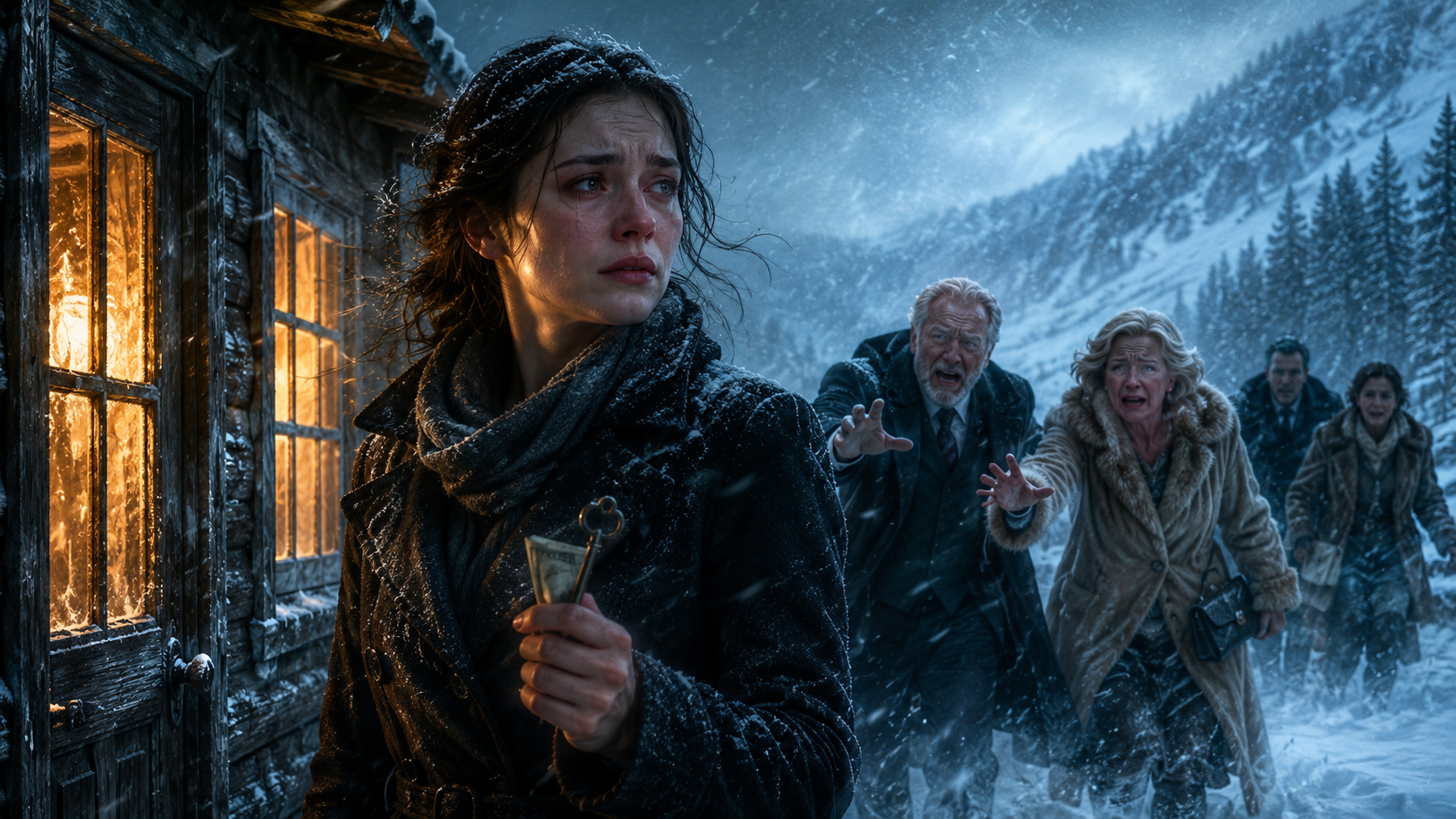
At 3:17 in the morning, someone pounded on the door.