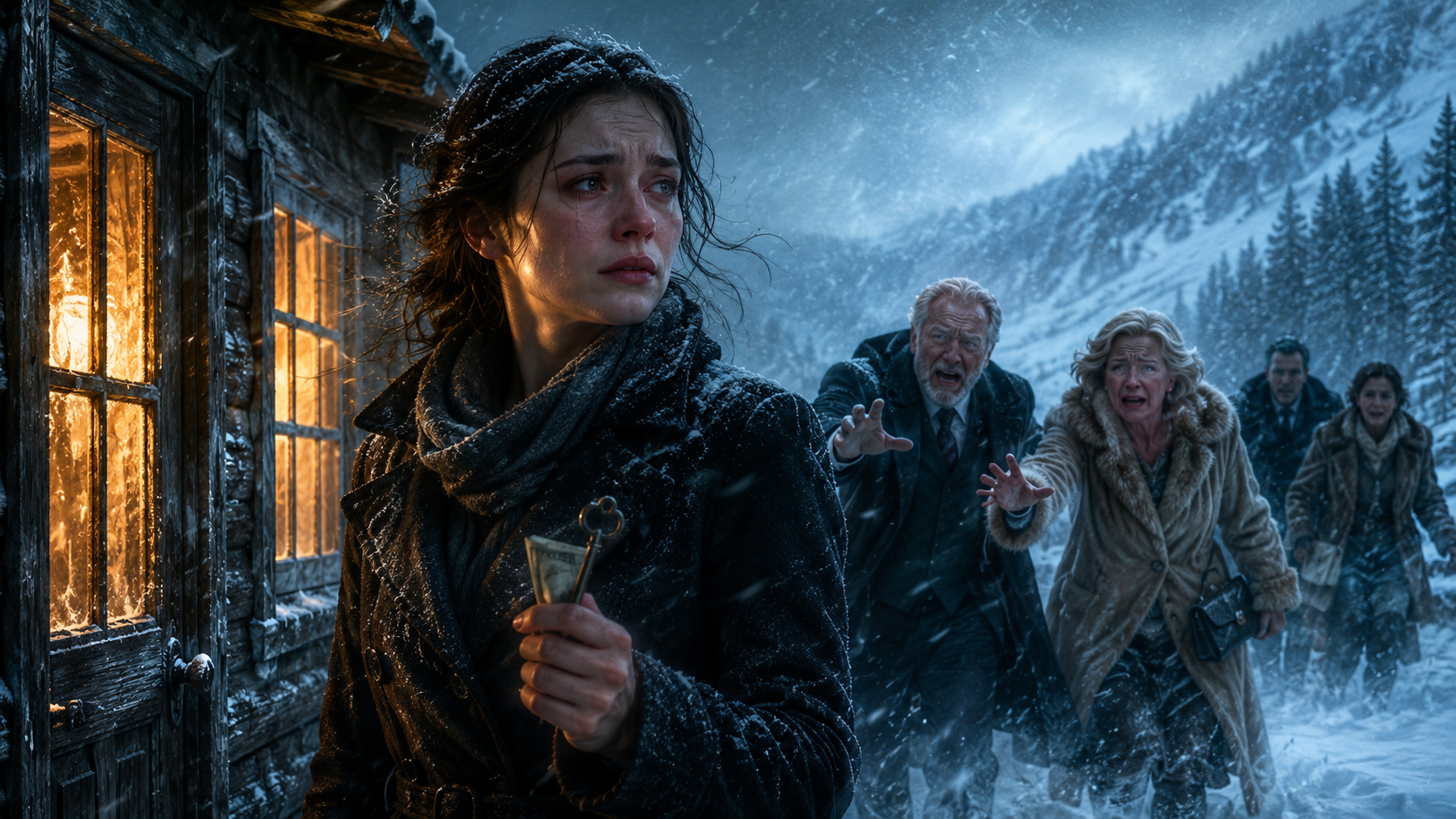
Mara grabbed a lantern.
When she opened it, Rowan stood outside with ice in his hair and a child wrapped in his coat.
Behind him were more people.
Beatrice, leaning on her stick but refusing help. A diner waitress with a bleeding cut on her forehead. Two hotel workers. An elderly couple. Sheriff Dane Cross carrying a medical bag. A teenage boy shaking with cold.
And behind them, stumbling through the storm in a ruined cashmere coat, came Vivienne Vale.
Conrad was with her, pale and breathing hard.
For one second, no one spoke.
The people who had thrown Mara into winter now stood at her door because winter had found them too.
Sheriff Cross shouted over the wind. “Community shelter roof failed. Main road’s blocked. The Vale estate lost heat and the pipes burst. We need shelter until rescue gets through.”
Vivienne’s lips were blue. Her perfect hair hung wet against her face.
“Mara,” she said, and for the first time her voice contained no command. “Please.”
Mara looked at her.
She thought of the gate.
The suitcase.
The five-dollar bill.
The words: Perhaps you can buy yourself a shack.
Then she looked past Vivienne at the child in Rowan’s arms.
Mara stepped back.
“Bring the child in first.”
People crowded into the cabin. Beatrice took charge of blankets. Rowan fed the fire. The sheriff checked injuries. Mara gave water to the elderly couple and wrapped the shaking boy in the quilt someone had left at the trailhead.
Vivienne stood near the door, dripping melted snow onto the floor.
Conrad stared around the room as if seeing the cabin for the first time.
“This place,” he said quietly. “You repaired it.”
“No,” Mara said. “I rebuilt what you thought was worthless.”
Vivienne’s eyes moved to the locked black case on the table.
She knew.
Mara saw the exact moment she knew.
By morning, rescue crews reached North Hollow.
By noon, Helena Ortiz arrived with county officials and investigators.
By evening, the story had spread farther than Briarfall.
The billionaire family who mocked a five-dollar cabin had survived the storm only because the woman they cast out opened its door.
But Mara did not let the town turn her into a saint.
She had not opened the door for Vivienne.
She had opened it because freezing people were still people.
That did not mean she forgave.
Three weeks later, the Alder Crown Resort expansion was suspended pending investigation. Old safety reports surfaced. Shell companies were traced. Water rights were confirmed under Mara’s deed. The access claim belonged to North Hollow, and North Hollow belonged to Mara Ellison.
Vivienne came one last time in early spring.
This time, she arrived without a driver.
The snow had begun to melt. Water ran silver down the rocks. The cabin stood in morning light, no longer beautiful by accident, but strong by choice.
Mara was planting herbs in a wooden box beneath the window.
Vivienne stopped at the edge of the yard.
“I came to apologize,” she said.
Mara did not look up. “For which part?”
Vivienne swallowed. “All of it.”
“That’s a large word when you’ve lived a small conscience.”
The older woman flinched.
“I lost my son,” Vivienne whispered.
Mara finally looked at her.
“So did I.”
For a moment, there was only the sound of melting snow dropping from the pines.
Vivienne looked at the cabin. “He loved this place?”
Mara shook her head. “No. He loved what it could become.”
“And what will it become?”
Mara turned toward the ridge, where the old trail curved down toward town. Rowan was there, repairing a fence post. Beatrice sat on a stump giving orders no one had asked for. Smoke lifted from the chimney. The spring ran clear.
“A shelter,” Mara said. “A legal office twice a month for people who can’t afford one. A winter emergency stop. Maybe someday, a real home.”
Vivienne’s eyes filled, but Mara did not soften.
“You can’t buy your way through this door,” Mara said. “You can only be invited.”
Vivienne nodded slowly.
“Am I invited?”
Mara picked up the small hand shovel and returned to the planter.
“Not today.”
Vivienne accepted that.
It was the first decent thing Mara had ever seen her do.
Months later, when summer came to North Hollow, wildflowers grew around the cabin in yellow and blue waves. The roof was straight. The porch was rebuilt. The springhouse had been restored. A sign hung beside the door, carved by Rowan and painted by the diner girl who used to bring chili.
It did not say Vale.
It did not mention money.
It did not tell the world what had happened there.
It simply read:
HOLLOW HOUSE
Inside, above the fireplace, Mara framed the old deed.
Beside it, she placed an empty frame.
Not for a photograph.
For a five-dollar bill that was no longer there.
The original had bought the cabin.
It had done what Julian always believed impossible things could do.
It had become a beginning.
And whenever storms rolled over the mountain, people in Briarfall looked up toward North Hollow and knew one light would still be burning.
Not because wealth had built it.
Not because power had allowed it.
But because a woman who had been thrown away refused to stay broken.
And because sometimes the door everyone laughs at becomes the only door left standing.