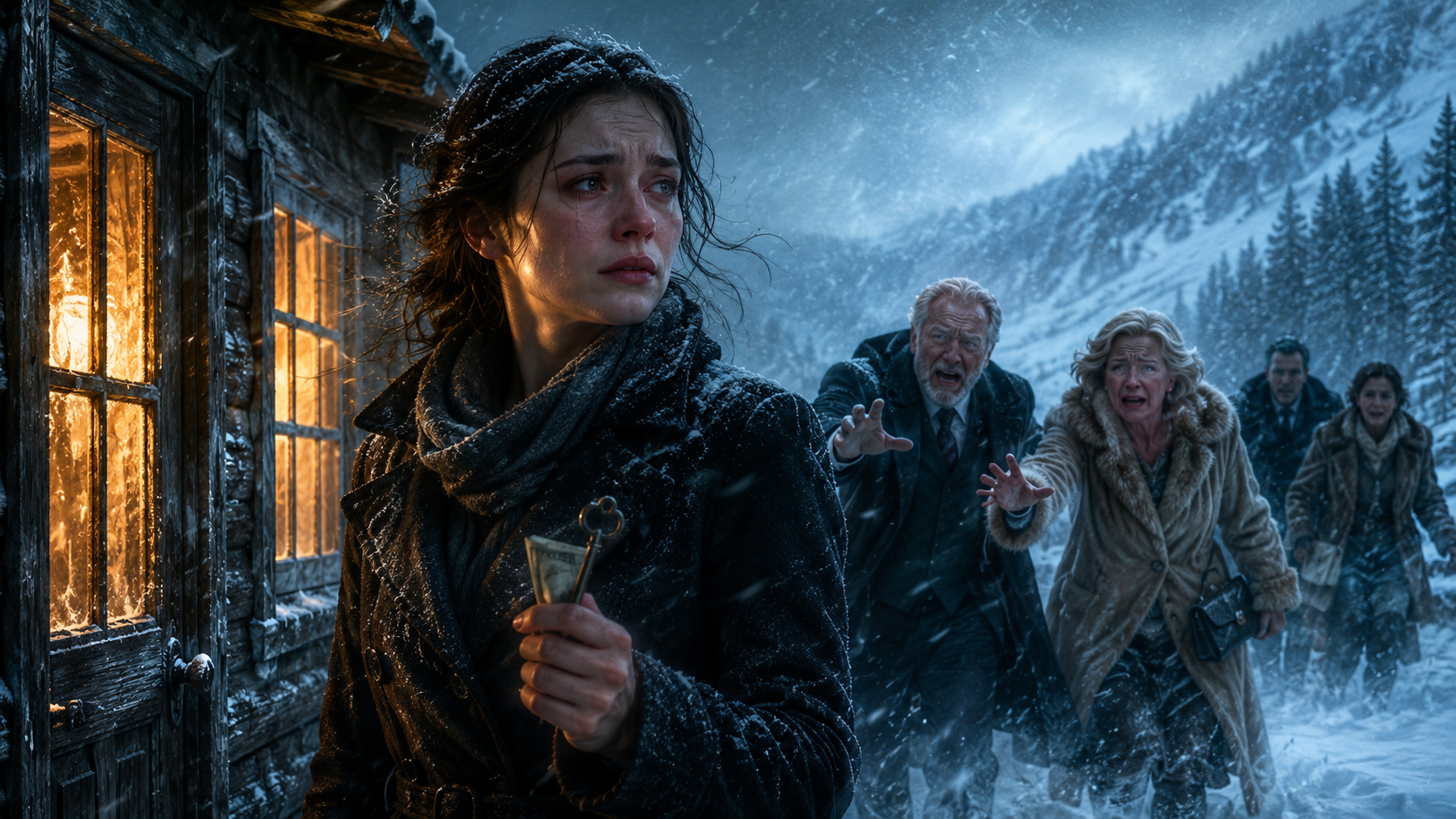
“If anything happens,” he had told her, “remember North Hollow.”
She had thought he meant a memory. A place. A strange romantic clue from a man who loved old roads and forgotten things.
Now she looked down at the five-dollar bill in her hand.
For our impossible home.
The clerk inside was a broad-shouldered woman named Agnes Pike with silver hair, a red cardigan, and the expression of someone who had spent thirty years watching desperate people make dangerous choices.
“The auction closed at four,” Agnes said.
Mara looked at the clock. “It’s four-ten.”
“And that cabin should have been burned down ten years ago.”
“I have five dollars.”
Agnes took off her glasses. “Honey, that place is not a bargain. It’s a coffin with a door.”
“I still want it.”
“There’s no heat.”
“I understand.”
“No road service.”
“I understand.”
“The roof may not hold snow.”
“I understand.”
Agnes studied her for a long moment. Then her eyes dropped to the bill in Mara’s hand. She saw the writing. Something in her face softened, though not enough to become pity.
“You got a name for the deed?”
Mara almost said Vale.
The name sat on her tongue like a cold stone.
Then she remembered the gate closing.
“Mara Ellison,” she said. “My name is Mara Ellison.”
Agnes nodded and pulled out the paperwork.
Twenty minutes later, Mara stepped back into the snow owning the least wanted piece of land in the county.
The cabin was six miles uphill.
She dragged the suitcase until one wheel broke, then carried what she could. She left the cardboard box hidden beneath a fallen fir and promised herself she would come back for it, though she was not sure promises meant anything anymore.
By the time she reached North Hollow, night had fallen hard.
The cabin appeared between the trees like a dare.
It was worse than the photograph.
The front steps sagged. Snow had blown through the broken window. One side of the roof dipped under the weight of old damage. The door was swollen and stubborn. When Mara shoved it open, something small and alive skittered across the floor.
The air inside smelled of rot, dust, cold ash, and old pine.
Mara laughed once, without humor.
“So this is what five dollars buys.”
Then she touched the deed in her coat pocket.
No gate code. No guard. No mother-in-law measuring her worth. No lawyer deciding whether she deserved to sleep indoors.
It was ugly.
It was dangerous.
It was hers.
That night, she wrapped herself in her coat and slept sitting upright against the wall with a tire iron in her lap. The wind moved through the cracks like fingers. Snow drifted across the floorboards. Somewhere in the darkness, a branch scraped the roof again and again.
Mara did not cry.
Crying required a kind of safety she did not yet have.
At dawn, someone knocked on the door with the end of a walking stick.
Mara jolted awake and grabbed the tire iron.
“Don’t swing that unless you’re good at it,” a voice called from outside.
Mara opened the door a few inches.
An older woman stood on the porch wearing a green parka, heavy boots, and a wool hat pulled low over white hair. Her face was narrow and weathered, her eyes bright as sparks.
“I’m Beatrice Crowe,” the woman said. “I live down the creek. Saw smoke where there shouldn’t be smoke. Thought I’d check whether you were a criminal, a fool, or a corpse.”
Mara stared at her.
“And?”
“Too early to tell.”
Despite everything, Mara almost smiled.
Beatrice pushed a thermos into her hands. “Coffee. Drink before you freeze standing up.”
“Why are you helping me?”
“Because I’ve been thrown away before.” Beatrice looked past her into the cabin. “And because this place has been waiting for someone too stubborn to die.”
Over the next three days, Beatrice came back with old gloves, two blankets, a sack of potatoes, and advice that sounded like insults but kept Mara alive.
“Seal the cracks before you decorate your tragedy.”
“Don’t burn wet wood unless you enjoy smoke in your lungs.”
“That chimney will kill you faster than loneliness.”
On the fourth day, a truck climbed the icy trail.
A man stepped out carrying tools and a coil of rope. He was tall, dark-haired, with sawdust on his jacket and tired eyes that had seen too many rich people treat workers like weather.
“I’m Rowan Hale,” he said. “Beatrice sent me.”
“I don’t have money,” Mara said immediately.
“I didn’t ask for money.”
“People always ask eventually.”
Rowan glanced at the roof. “Then let’s make sure you live long enough for them to disappoint you.”
He repaired the chimney first. Then the door. Then he showed Mara how to brace the broken roof beams with salvaged lumber from a collapsed shed behind the cabin. He did not do the work for her. He taught her. He handed her the hammer. He corrected her grip. He made her redo every crooked nail.
At night, Mara’s hands throbbed.