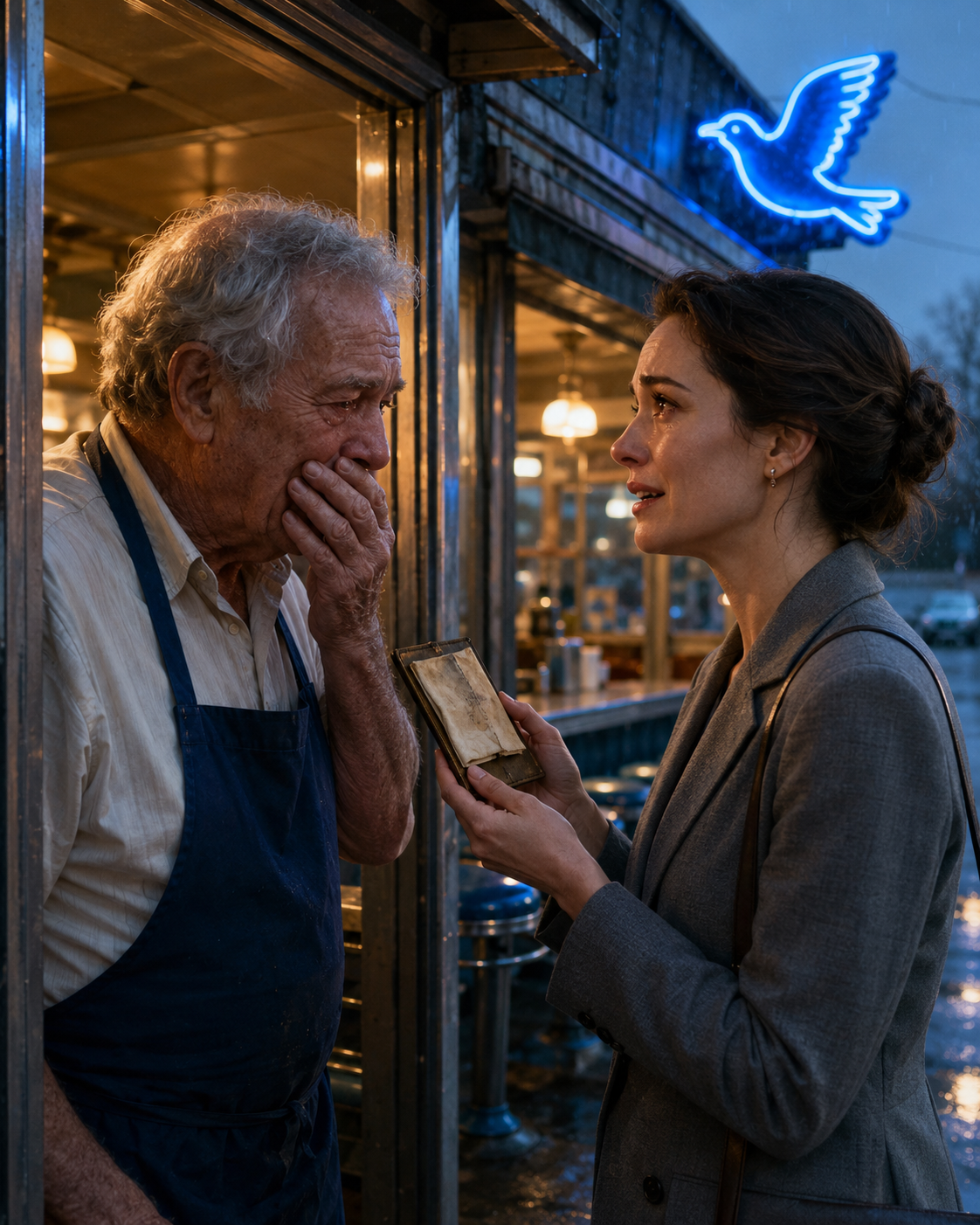
She held it beneath the document camera.
The uneven bird and faded words appeared on the screen.
“Twenty-two years ago, Arthur and Rose Cole fed two homeless children. They did not demand identification, publicity, or repayment. They gave us a table and allowed us to remain human.”
Arthur lowered his head.
“I kept this napkin because it reminded me that dignity can be offered before it is earned. The Bluebird has repeated that act thousands of times. Most were never recorded because kindness rarely expects to become evidence.”
Behind Nora, Priya uncovered three large display boards.
They were covered in copies of napkins sent by residents.
Hundreds of promises.
Hundreds of memories.
Hundreds of moments the official report had called irrelevant.
Nora faced the council.
“You are not deciding whether one old restaurant is more important than public transportation. That is a false choice created by a private developer seeking additional commercial space. You are deciding whether public progress requires erasing the places that made a community worth reaching.”
Applause erupted outside.
The council chair called for order.
Martin requested a recess.
During the break, he found Nora alone near a service corridor.
“You planned that well,” he said.
“I wish I had found the truth sooner.”
“You are turning an engineering dispute into a morality play.”
“You turned it into a profit calculation.”
“Northstar will sue.”
“Then the documents will enter discovery.”
His eyes narrowed.
“You think the council will cancel a billion-dollar agreement over a napkin?”
“No.”
Nora closed the case.
“I think they will revise it because you falsified the cost of preserving the diner.”
Martin’s silence confirmed what she suspected.
“The thirty-eight million,” she said. “It includes redesign work Northstar already planned for phase two.”
“You cannot prove that.”
“Your former engineering consultant sent us the internal estimate this morning.”
For the first time, Martin Vale looked frightened.
The true cost of preserving the Bluebird was four million dollars.
Northstar could cover it without public funding.
When the hearing resumed, the council suspended demolition authorization pending an ethics investigation.
The crowd outside cheered.
Arthur did not.
He remained seated, staring at the table.
Nora touched his arm.
“We stopped the demolition.”
“For now.”
“For now.”
“What happens next?”
“We build something stronger than an emergency order.”
Over the following weeks, Northstar’s agreement was renegotiated.
Martin resigned before the investigation concluded.
The transit station remained approved, but its entrance shifted east.
The commercial tower lost part of its retail frontage.
The Bluebird remained exactly where it had always been.
That alone did not solve Arthur’s problems.
The bank still expected payment.
The roof still leaked.
The refrigerator still made a sound Hector described as “the dying prayer of an angry whale.”
Nora proposed creating a neighborhood cooperative.
Arthur refused immediately.
Then he listened.
The cooperative would purchase the building using grants, community shares, and a contribution from Common Ground.
Arthur would continue operating the diner.
Employees would receive ownership shares.
No developer could sell the property without community approval.
A training kitchen would open upstairs for young people leaving foster care.
Eli Evans, now a recovery counselor and restaurant manager, would supervise the program.
Arthur stopped her.
“Eli is coming?”
“He is waiting outside.”
Arthur turned toward the door.
A man in his late twenties stood on the sidewalk.
He was broad-shouldered and nervous, holding a plastic shopping bag.
Arthur walked outside.
Eli looked at him for a long moment.
“You carried me out from under a table.”
Arthur smiled.
“You were lighter then.”
Eli held up the bag.
Inside were two grilled-cheese sandwiches.
“My sister said we still owed you.”
Arthur’s eyes filled.
“You paid a long time ago.”
“We would like to overpay.”
Hector came outside and pulled Eli into a hug before anyone introduced them properly.
That evening, Nora, Eli, Daniel, Arthur, Hector, and the regular customers gathered after closing.
They filled the booths with legal papers, calculators, coffee, and pie.
At midnight, Arthur signed the cooperative agreement.
Daniel signed as a founding community member.
Hector signed as an employee-owner.
Nora signed for Common Ground.
Eli signed for the training program.
Mrs. Holloway signed as a neighborhood representative, though she complained that the pen was terrible.
When everything was finished, Arthur placed the original napkin in a wooden frame Rose had once bought for “something important we haven’t found yet.”
They hung it beside the register.