Below it, Arthur installed a small box filled with clean napkins and pens.
A handwritten card read:
TAKE ONE WHEN YOU NEED A PROMISE.
RETURN ONE WHEN YOU CAN GIVE ONE.
The Bluebird reopened after three weeks of repairs.
Its floor was still cracked in several places because Arthur claimed new tiles would make the diner arrogant.
The neon sign was restored, though the B remained brighter than every other letter.
The jukebox continued selecting the wrong songs.
The first official customer was Nora.
She sat in the booth closest to the door.
Arthur brought two bowls of soup.
“I ordered coffee,” she said.
“Kitchen mistake.”
“There are spoons beside them.”
“We make very organized mistakes.”
Eli arrived carrying bread from the bakery.
Daniel entered with his wife and daughters.
Hector rang a metal triangle from the kitchen and announced that anyone allowing food to become cold for emotional reasons would be removed.
People laughed.
Arthur looked around the room.
Rose’s photograph stood beside the register.
For years, he had believed keeping the diner unchanged was the same as keeping her close.
Now he understood that Rose had never loved the Bluebird because it remained unchanged.
She loved it because the door continued opening.
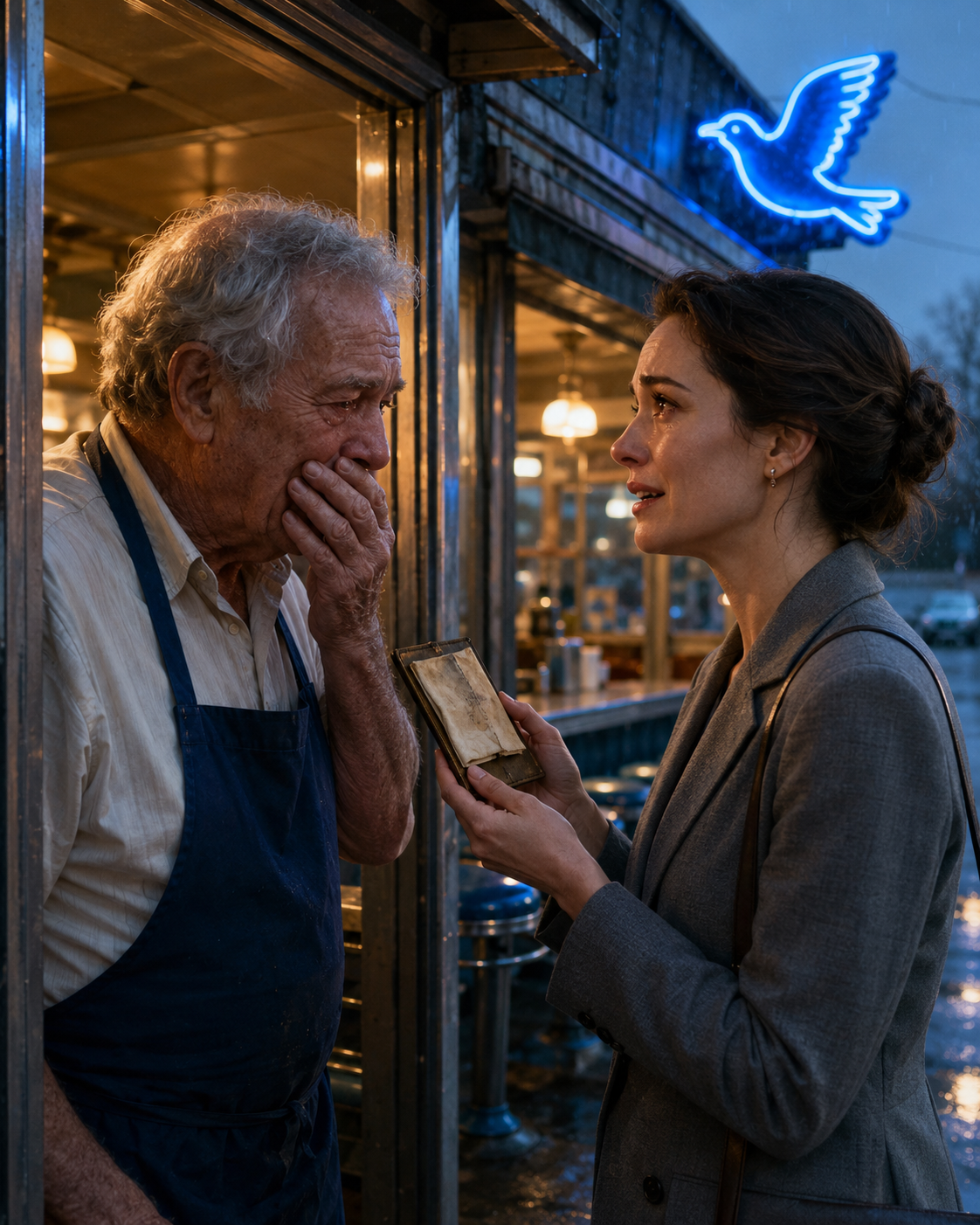
Nora removed the old napkin from its metal case one final time.
Together, she and Arthur placed it in the wooden frame.
“Do you regret giving it to me?” she asked.
“The napkin?”
“The promise.”
Arthur considered the question.
“At the time, I thought I was telling a frightened girl that she could pay later.”
“And now?”
“Now I think you were the one extending credit.”
Nora smiled.
“To you?”
“To all of us.”
Arthur looked across the diner.
Daniel was helping his youngest daughter spin on a blue stool.
Eli was discussing the training kitchen with Hector.
Mrs. Holloway had already complained that the soup needed salt.
Outside, construction cranes moved above the future transit station.
The city was changing.
It would always change.
Some buildings would rise.
Others would fall.
But progress had not required the Bluebird to disappear.
It had required people to decide what deserved to travel with them into the future.
Arthur poured coffee into Nora’s cup.
She lifted the napkin box.
“There is something missing.”
“What?”
“Your first new promise.”
Arthur took a pen.
He thought for a moment, then wrote:
THERE WILL ALWAYS BE A SEAT FOR SOMEONE WHO HAS NOWHERE ELSE TO GO.
He signed it with a small, uneven bluebird.
Nora placed the napkin inside the box.
Before noon, someone took it.
That evening, another napkin appeared in its place.
I WILL HELP MY BROTHER FIND WORK.
The following day:
I WILL DRIVE MRS. HOLLOWAY TO HER APPOINTMENTS.
Then:
I WILL PAY FOR THE NEXT CHILD WHO ORDERS ONLY WATER.
The promises multiplied.
Some were large.
Some were ordinary.
Some were fulfilled quickly.
Others waited months.
Arthur kept every returned napkin in a thick binder beneath the register.
Years later, when reporters asked Nora which legal argument had saved the Bluebird, she explained the survey failure, the engineering estimate, and the cultural protection order.
But when children asked her the same question, she gave a different answer.
She showed them the framed napkin.
She told them that, long ago, two people had fed a frightened girl without asking whether she deserved it.
The girl carried their promise until she became strong enough to return it.
And because kindness had been written down, she remembered exactly where it belonged.
Late one winter night, Arthur locked the diner after the last customer left.
Snow covered Harbor Street.
The transit station shone at the end of the block, its glass roof reflecting hundreds of city lights.
Commuters crossed the plaza carrying briefcases, grocery bags, flowers, and tired children.
Many of them stopped beneath the bright blue sign.
Arthur stood outside with Nora.
He was older now.
Slower.
He worked fewer hours because Daniel had finally convinced him that grandchildren were also a responsibility.
Through the window, Eli was teaching two teenagers how to close the kitchen.
Hector sat at the counter pretending he had retired.
The jukebox began playing Rose’s favorite song.
Arthur laughed.
“That machine has ignored me for forty years.”
“Maybe it finally learned gratitude,” Nora said.
Arthur looked at the framed napkin beside the register.
“Do you think the world became kinder?”
Nora watched a teenage employee carry a container of soup to a man waiting near the station.
“No,” she said.
Arthur raised an eyebrow.
She smiled.
“I think people keep making it kinder before it has a chance to stop them.”
The blue neon bird flickered above the door.
Once.
Twice.
Then it remained steadily illuminated as snow continued falling over the city.
Inside the Bluebird, one empty booth waited beside the window.
The table had already been set.
Two cups.
Two spoons.
And one clean napkin, ready for the next promise.