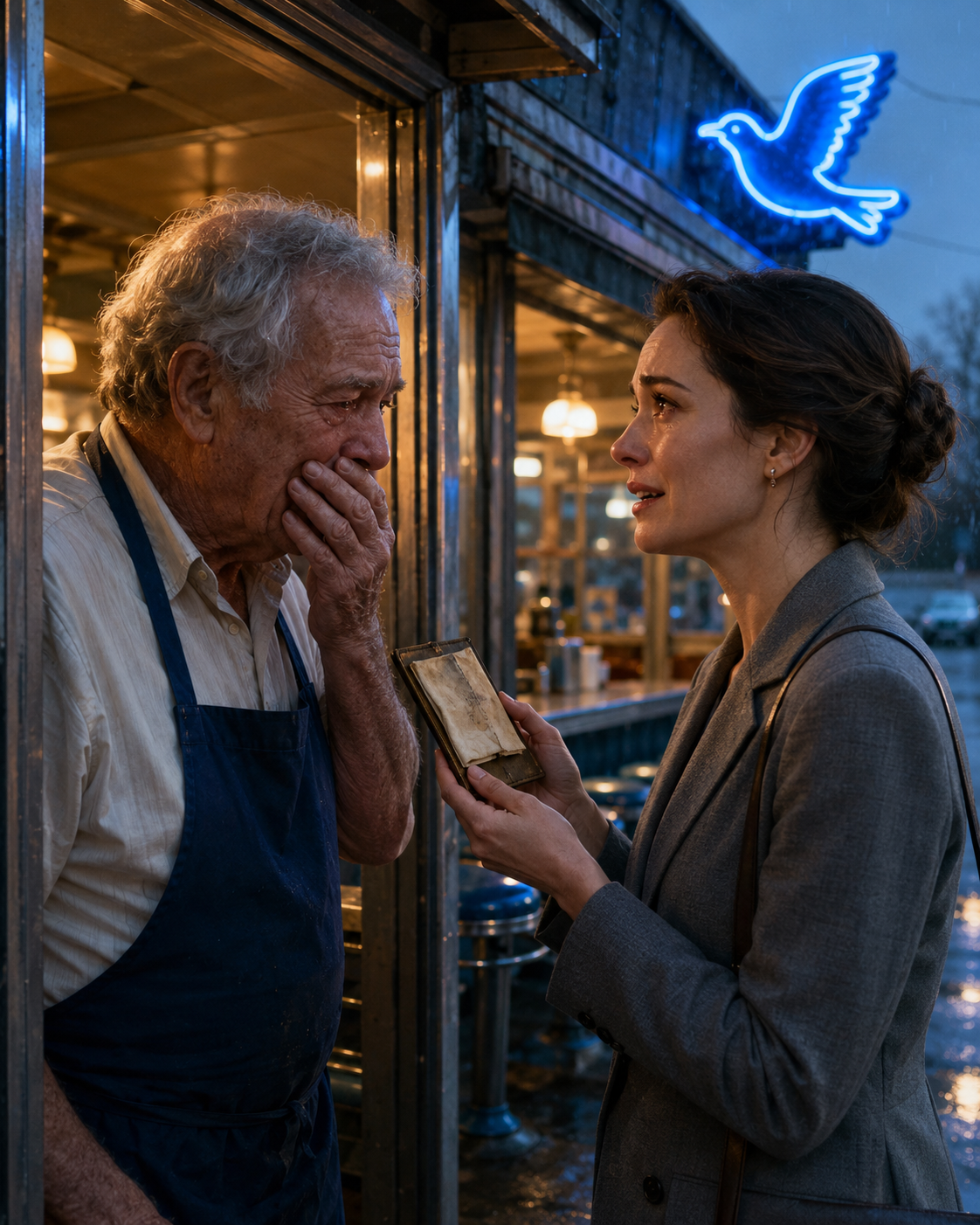
The Bluebird kept my job application behind the register until I found housing.
I met my wife in booth six.
I became sober after Arthur refused to serve me coffee at two in the morning and drove me to the clinic instead.
Arthur read them slowly.
“What is this?”
“Nora asked people to send their Bluebird stories.”
“She should not have done that.”
“She did not publish them. These are statements for the hearing.”
Arthur reached the last page.
It showed the uneven bluebird from Nora’s napkin.
Beneath it was the sentence:
A building becomes important when people trust it with the parts of their lives no official record keeps.
Arthur placed the page down.
“Rose wrote better sentences.”
“She did.”
Daniel sat on a stool.
“I am sorry.”
Arthur remained silent.
“I thought selling the diner would make you choose us.”
Arthur frowned.
“What does that mean?”
“You visit once a year. You leave after two days because Hector calls about a broken freezer. My daughters know the Bluebird better than they know you.”
Arthur looked away.
Daniel’s voice softened.
“I was angry at a building because I did not know how to tell my father I missed him.”
Arthur removed his glasses.
“I did not know you wanted me there.”
“You never asked.”
“You always seemed busy.”
“So did you.”
They stood on opposite sides of the counter.
Years of careful silence pressed between them.
Arthur looked at Rose’s photograph.
“She would be furious with both of us.”
Daniel laughed through sudden tears.
“She would make us peel potatoes until we apologized.”
“Two sacks each.”
“Three for me because I signed the form.”
Arthur walked around the counter.
The embrace was awkward.
Daniel was taller.
Arthur’s shoulder hurt.
Neither let go quickly.
The next morning, Arthur signed the application.
The public hearing took place in a converted warehouse near the harbor.
More than a thousand people arrived.
Only three hundred were allowed inside.
The rest stood outdoors beneath umbrellas, watching a live broadcast on portable screens.
Arthur sat at the front table with Daniel, Hector, Nora, and Priya.
Martin Vale represented Northstar.
Behind him were architects, transportation officials, and attorneys carrying binders thick enough to stop bullets.
The city council chair began with financial projections.
Northstar presented diagrams showing the diner as a small red square inside a complex network of tracks, tunnels, and commercial space.
An engineer explained that preserving the building would require moving a ventilation shaft and narrowing a service road.
The projected cost was thirty-eight million dollars.
Martin spoke clearly.
“We respect the emotional connection some residents feel toward the Bluebird. However, public planning cannot be governed by nostalgia. The city must choose infrastructure serving millions over a single private restaurant.”
Several council members nodded.
Then Nora stood.
She did not begin with the napkin.
She began with evidence.
Emergency response reports.
School meal records.
Neighborhood referral logs.
Testimony from social workers.
Documents proving Northstar’s survey team had categorized community services as anecdotal comments and omitted them from the impact analysis.
Martin objected.
The council chair allowed Nora to continue.
She placed a map on the screen.
It showed the original transit plan.
Then an earlier alternative.
In that version, the ventilation shaft stood thirty yards east of the Bluebird.
“The diner was not an unavoidable obstruction,” Nora said. “It became one after Northstar shifted the commercial tower entrance to maximize retail frontage.”
Murmurs filled the room.
A council member leaned forward.
“Mr. Vale, is that accurate?”
Martin rose.
“The revision improved pedestrian circulation.”
“It also increased Northstar’s rentable ground-floor area by eighteen thousand square feet,” Nora replied.
The room grew louder.
Martin’s composure tightened.
“The change underwent technical review.”
“Using an impact report that excluded the diner’s documented community function.”
Nora turned toward the council.
“I signed the recommendation based on that report. I failed to examine the raw evidence. That failure is mine, and I accept responsibility.”
Outside, cameras focused on her face.
She knew what the admission could cost.
Board members might remove her.
Future city partners might distrust her.
Donors might decide she was reckless.
She continued.
“Professional credibility does not mean defending every decision we make. It means correcting the decisions that evidence proves were wrong.”
Then she opened the metal case.
“This napkin is not legal evidence.”
Martin’s attorneys shifted uneasily.
“It does not establish ownership. It does not change engineering. It is not worth money.”