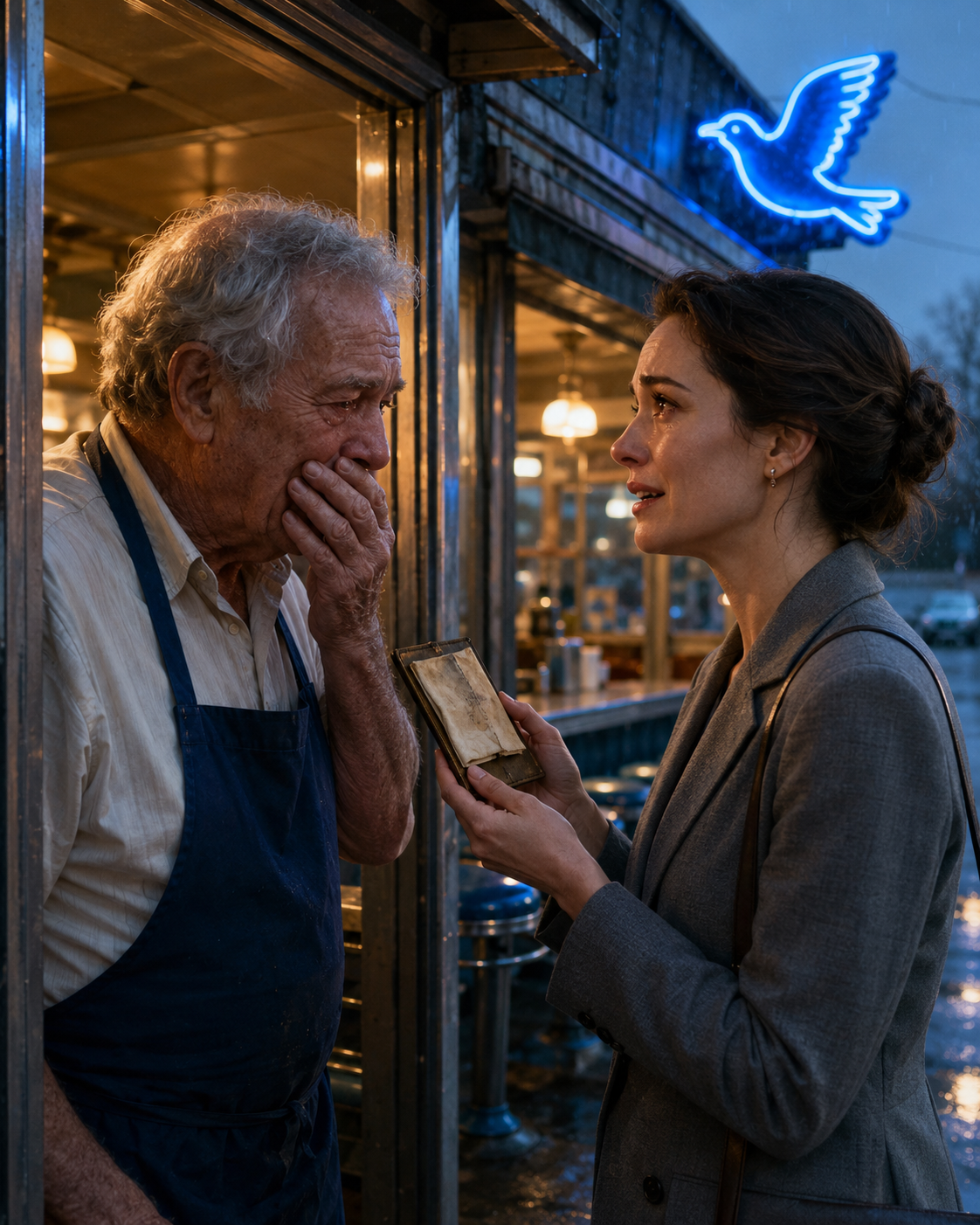
Instead, she began making calls.
They requested the unedited survey.
They obtained fire-department records showing that the Bluebird had served as an emergency warming center during three winter power failures.
They found school letters thanking Arthur and Rose for providing breakfast to children during a teachers’ strike.
They located photographs from the nineteen nineties showing neighborhood meetings held in the diner during a housing crisis.
The building might not qualify for architectural landmark status.
But the institution could qualify for cultural preservation protection.
There was one problem.
Applications usually took months.
The demolition would begin in thirty days.
Nora needed an emergency hearing.
She also needed Arthur’s cooperation.
He refused to speak to her.
On the third day, Daniel arrived at the church basement.
Nora recognized him from a family photograph near the Bluebird’s register.
“You are Arthur’s son.”
“And you are the woman who approved the project.”
“Yes.”
“At least you admit it.”
“I am becoming very experienced at admitting it.”
Daniel looked around at the files covering folding tables.
“What are you doing?”
“Trying to prove the diner performs an essential community function.”
“It does.”
“Your father will not sign the declaration.”
“He thinks accepting help is surrender.”
“I noticed.”
Daniel picked up a photograph of Rose serving food during a snowstorm.
“My mother would have signed.”
“Arthur is not Rose.”
“No. Mom knew when stubbornness was useful.”
“And Arthur?”
“He thinks it is a religion.”
Nora offered him a chair.
Daniel remained standing.
“I signed the relocation consent.”
“I know.”
“He told you?”
“Martin did.”
Daniel looked ashamed.
“I thought if the city had our cooperation, they would increase the payment. Dad could retire. He could live near my family.”
“Did you ask him?”
“He would have said no.”
“So you removed his chance to say it.”
Daniel’s expression hardened.
“You do not know my father.”
“No. But I know what it is like when powerful people decide they understand your needs better than you do.”
That silenced him.
Nora continued more gently.
“You were frightened.”
“He is alone in that place.”
“He is not alone.”
“He goes home alone.”
Nora looked toward the ceiling.
There were different kinds of loneliness.
Some were created by empty rooms.
Others by being surrounded by people who loved only the version of you they wanted to save.
“Help me protect the building,” she said. “Then talk to him about what happens afterward.”
Daniel sat down.
“What do you need?”
On the seventh day, the city announced an emergency public hearing.
Northstar responded by accelerating preparatory work.
Survey markers appeared on the sidewalk.
Metal barriers were delivered.
Martin Vale gave an interview describing the diner as a deteriorating private business blocking public progress.
Arthur watched the interview on the small television above the Bluebird counter.
Hector threw a dish towel at the screen.
“That man smiles like a funeral director.”
Arthur turned off the television.
The diner had become busier than it had been in years.
People arrived after reading about the dispute.
Some bought breakfast.
Some donated money.
Some only wanted photographs.
Arthur disliked the attention.
He disliked strangers turning Rose’s booth into a background for social media videos.
He disliked reporters asking how it felt to become a symbol.
“I am not a symbol,” he told one of them. “I am behind on my electric bill.”
But each evening, after the doors closed, he counted the signatures on petitions.
Ten thousand.
Then twenty-five thousand.
Then sixty thousand.
Still, he refused to sign Nora’s cultural protection application.
On the tenth night, Daniel found him repairing the jukebox.
“You know it will still play the wrong song,” Daniel said.
Arthur tightened a screw.
“That is part of its personality.”
Daniel placed the application on the counter.
Arthur did not look at it.
“I said no.”
“This is not Nora’s application. It is yours.”
“I do not want my diner turned into a museum.”
“It won’t be.”
“I do not want a board telling me what color the stools must be.”
“No one will.”
“I do not want people saving this place because they pity an old man.”
Daniel rested his hands on the counter.
“They are not saving it because you are old.”
Arthur looked up.
“They are saving it because you spent forty years making sure no one felt poor while sitting here.”
Arthur’s face shifted.
Daniel took out a stack of photocopies.
Napkins.
Hundreds of them.
Each carried a handwritten message.
Arthur let me pay on Friday when my first paycheck was late.
Rose fed my children during the blackout.
Hector taught me to cook eggs after my father died.