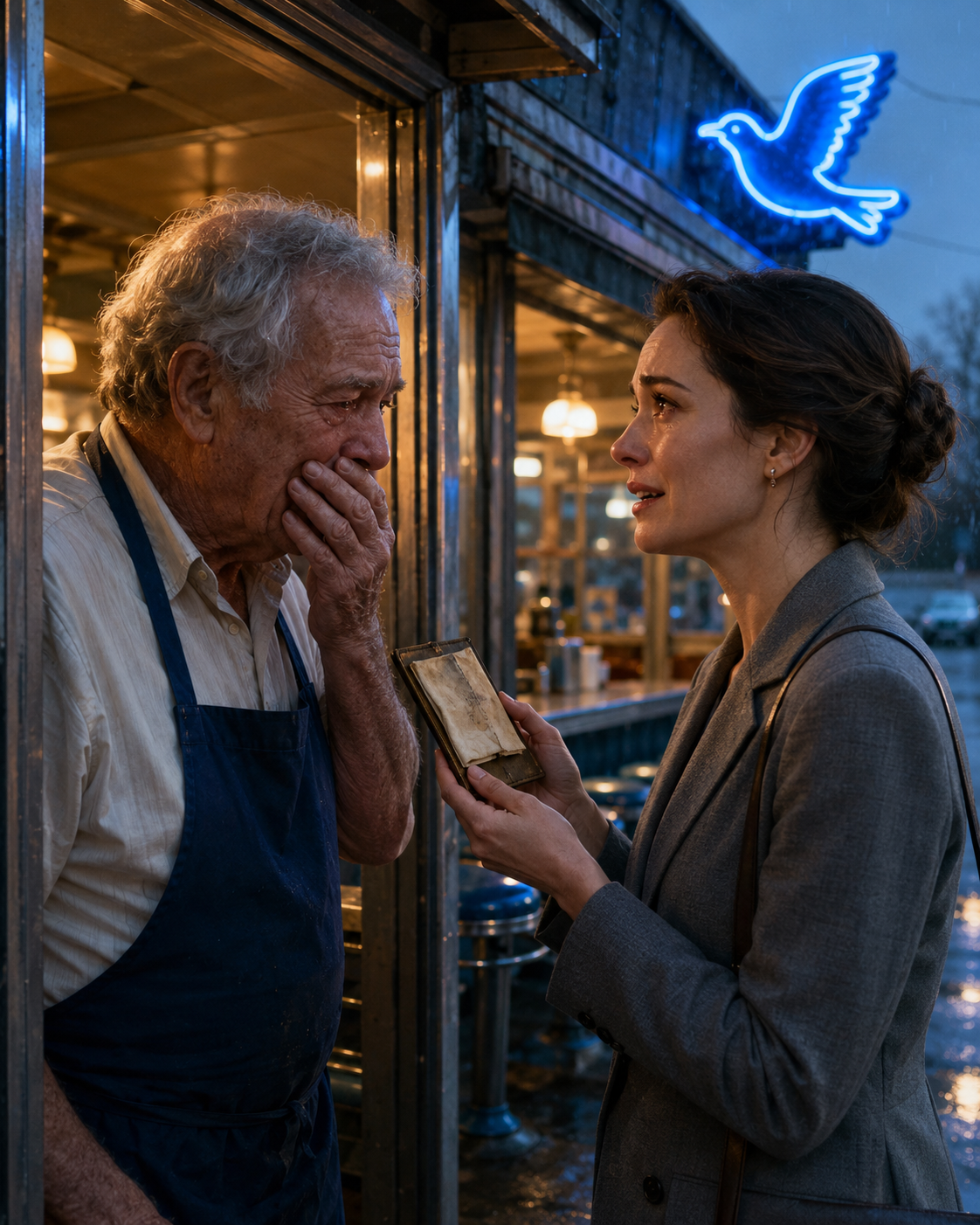
A girl sitting too close to the door.
A shopping bag beneath the table.
Rose pretending the soup was a mistake.
Arthur gripped the edge of the counter.
“The boy.”
“My brother.”
“Eli.”
Nora inhaled sharply.
“You remember his name?”
“Rose wrote it on the hospital form.”
Arthur looked behind Nora as if the twelve-year-old girl might still be waiting near the door.
“You were so thin.”
“So were you.”
Hector laughed softly.
Arthur ignored him.
“What happened to your mother?”
“She survived the collapse, but her health never fully recovered. We stayed together for another year. Then Eli and I entered foster care.”
Arthur lowered his head.
“We tried to find you.”
“I know. The church kept your letters. I received them much later.”
“Why didn’t you come back?”
Nora looked toward Rose’s photograph.
“Because this place reminded me of the worst week of my life.”
Arthur nodded.
“That makes sense.”
“And the best hour.”
He looked at her again.
“That makes less sense.”
“You gave us a table when everyone else saw a problem.”
“It was soup.”
“It was permission to stop being ashamed.”
Arthur closed the case gently.
“Did the world become kinder?”
Nora considered the question.
“Not by itself.”
Outside, another black sedan stopped.
Martin Vale emerged with two city representatives.
Nora watched him approach.
Arthur saw her expression change.
“You know him.”
“Yes.”
“Friend?”
“No.”
“Enemy?”
“Not exactly.”
“That usually means lawyer.”
“Close.”
Martin entered the diner and stopped when he saw her.
“Nora.”
“Martin.”
“You missed the advisory meeting.”
“I found an error.”
“In the environmental report?”
“In our understanding of this building.”
Martin glanced at the napkin.
His face remained calm, but his eyes hardened.
“The acquisition is complete.”
“No. The approval is complete. Acquisition cannot conclude until the community impact conditions are satisfied.”
“They were satisfied.”
“By a survey conducted on a Tuesday afternoon during street repairs, when half the block was inaccessible.”
“That survey was approved by your panel.”
“I had not seen the raw interviews.”
“You signed the recommendation.”
Nora absorbed the accusation.
Arthur looked between them.
“You helped approve this?”
Nora turned toward him.
“Yes.”
The diner seemed to contract around that word.
Mrs. Holloway closed her newspaper.
Hector folded his arms.
Arthur’s voice became colder.
“You came here to apologize?”
“I came here to stop it.”
“After helping start it.”
“I did not know what the Bluebird was.”
“You knew where it was.”
Nora had no defense.
Arthur pushed the metal case toward her.
“You should leave.”
“Arthur—”
“You kept the napkin.”
“Yes.”
“You kept the promise.”
“I tried.”
“But you signed a paper telling them this place did not matter.”
Pain crossed her face.
Martin remained silent.
Arthur pointed toward the door.
“Leave.”
Nora closed the case.
She picked it up with both hands.
At the threshold, she turned.
“You are right.”
Arthur did not look at her.
“I should have remembered sooner.”
The bell rang as she walked out.
Martin followed.
On the sidewalk, he spoke quietly.
“That could have gone better.”
Nora faced him.
“You knew.”
“Knew what?”
“That the diner was still operating as a community support site.”
“It serves breakfast.”
“It provides free meals through the church network, emergency shelter referrals, and an informal credit system for low-income families.”
“None of that changes its structural classification.”
“You removed those interviews from the executive summary.”
“I condensed irrelevant testimony.”
“You erased evidence.”
“I simplified a planning document.”
Nora stepped closer.
“Withdraw the demolition request.”
“I cannot.”
“You mean you will not.”
“The transit project creates thousands of jobs.”
“And Northstar receives two towers on public land.”
“That agreement funded the station.”
“The station can be redesigned.”
“At an additional cost of forty million dollars.”
“Then redesign it.”
Martin gave a humorless smile.
“You are allowing a childhood memory to influence public infrastructure.”
“No. I am allowing suppressed information to correct a dishonest decision.”
“You signed the recommendation.”
“And I will say publicly that I was wrong.”
He studied her.
“You would destroy your career for a diner?”
Nora looked through the window.
Arthur stood beside Rose’s photograph, pretending not to watch.
“No.”
She held the metal case against her chest.
“I would use my career for the reason I built it.”
By noon, Nora had assembled her legal team in a church basement across the street.
She did not return to the diner.
Arthur had asked her to leave, and she respected the boundary.