One November afternoon, their mother did not come home.
The landlord locked the room after discovering two children alone.
Nora and Eli spent three nights moving between a bus station, a church basement, and the waiting room of a hospital.
On the fourth morning, snow began falling.
Eli had a fever.
Nora had forty-three cents.
She walked into the Bluebird because the windows were warm.
Rose Cole had been working behind the counter.
Arthur was in the kitchen arguing with a delivery driver.
Nora sat in the booth closest to the door.
When Rose placed a menu in front of her, Nora pretended to study it.
“What will you have, sweetheart?”
“Just water.”
“Are you waiting for someone?”
“My father.”
It was a lie.
Nora did not know where her father lived.
Rose brought water.
Then she brought soup.
Nora pushed the bowl away.
“I didn’t order that.”
“Kitchen mistake.”
“It has a spoon beside it.”
“We make very organized mistakes.”
“I can’t pay.”
Rose glanced toward the kitchen.
“Arthur.”
Arthur came out wiping his hands.
“What?”
“This young customer has discovered a flaw in our business.”
Nora prepared to run.
Arthur looked at the untouched soup.
Then at her wet shoes.
Then at the plastic shopping bag beneath the table.
Something moved inside it.
A cough.
Arthur’s expression changed.
“Who is in the bag?”
Nora pulled the bag closer.
“No one.”
Eli coughed again.
Rose knelt beside the booth.
Nora began to cry.
Not loudly.
The tears simply appeared, as if her body had decided secrecy was too heavy.
Arthur carried Eli from beneath the table.
The boy was six years old, shivering, and burning with fever.
Rose called a doctor who ate lunch at the diner.
Hector wrapped Eli in his own coat.
Arthur made grilled cheese.
Nora refused everything until Arthur placed a white cloth napkin on the table.
He drew a small bluebird in one corner.
Beneath it, he wrote:
SEAT SAVED. PAY WHEN THE WORLD IS KINDER.
He pushed the napkin toward her.
“This is your bill.”
Nora read the words twice.
“How much do I owe?”
Arthur pointed to the final sentence.
“You pay when the world is kinder.”
“What does that mean?”
“It means you eat now.”
“And later?”
“Later, you decide what it means.”
Nora folded the napkin carefully.
That night, Arthur and Rose found emergency housing for the children.
Two days later, police located their mother in a hospital after she had collapsed at work.
The family eventually moved away.
Nora never returned to the diner.
But she kept the napkin.
She kept it through foster placements after her mother’s illness worsened.
She kept it through high school, when she worked at a pharmacy and studied after midnight.
She kept it through college, where she slept in the library during winter break because she could not afford a ticket home.
She kept it when Eli dropped out of school.
She kept it when he disappeared for six months.
She kept it during law school interviews, court defeats, and the night she founded Common Ground with two folding tables and a borrowed printer.
She kept it because the words did not say the world was kind.
They said it might become kinder.
That possibility had been enough.
Now Northstar Development planned to demolish the place where someone had first offered her a future.
Nora stepped out of the car.
Inside the Bluebird, Arthur was arguing with a coffee supplier when the bell rang.
He looked toward the door.
Nora stood beneath the faded sign wearing a rain-dampened suit.
No motorcade waited outside.
No reporters followed her.
She looked nervous.
That was the first thing Arthur noticed.
The second was that she seemed to recognize everything.
The pie case.
The jukebox.
The stools.
Rose’s photograph.
Nora approached the counter.
“Are you Arthur Cole?”
“Depends who is asking.”
“Nora Evans.”
The name meant nothing to him.
“I’m with Common Ground Urban Trust.”
Arthur’s expression closed.
“If you’re here to explain my relocation options, Martin Vale already used all the polite words.”
“I’m not here for Northstar.”
“Everyone is here for Northstar eventually.”
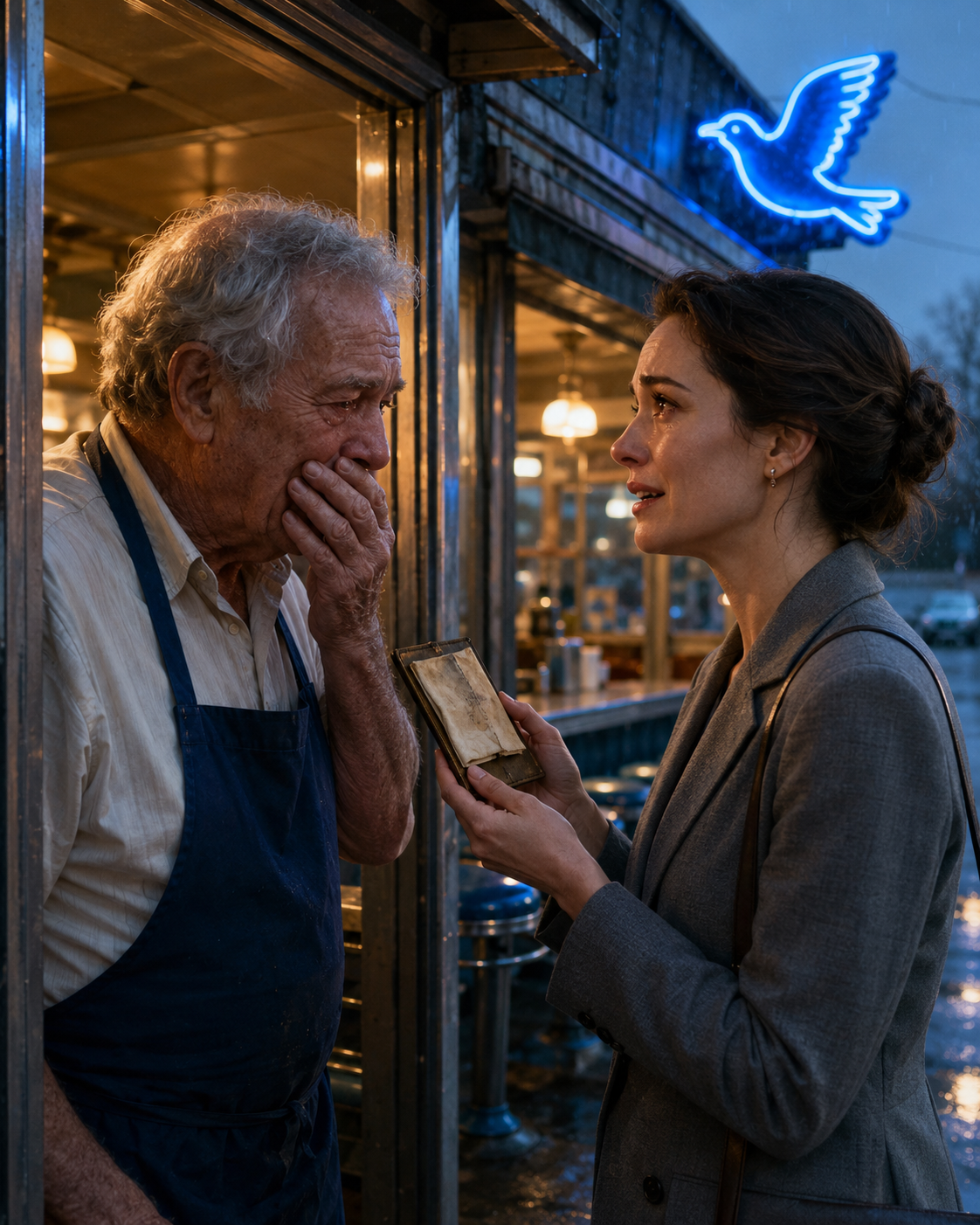
Nora placed the metal case on the counter.
Hector appeared at the kitchen opening.
Mrs. Holloway lowered her newspaper.
Nora opened the case.
Inside, protected between two clear sheets, was the white napkin.
The ink had faded to blue-gray.
The bird was uneven.
One wing was larger than the other.
The words remained readable.
Arthur stared at it.
His face lost its color.
Hector stepped closer.
“Arthur?”
Arthur did not answer.
He touched the glass protecting the napkin.
“I drew this.”
Nora nodded.
“You did.”
“When?”
“Twenty-two years ago.”
He looked at her eyes.
Memory came slowly.
Snow on the windows.