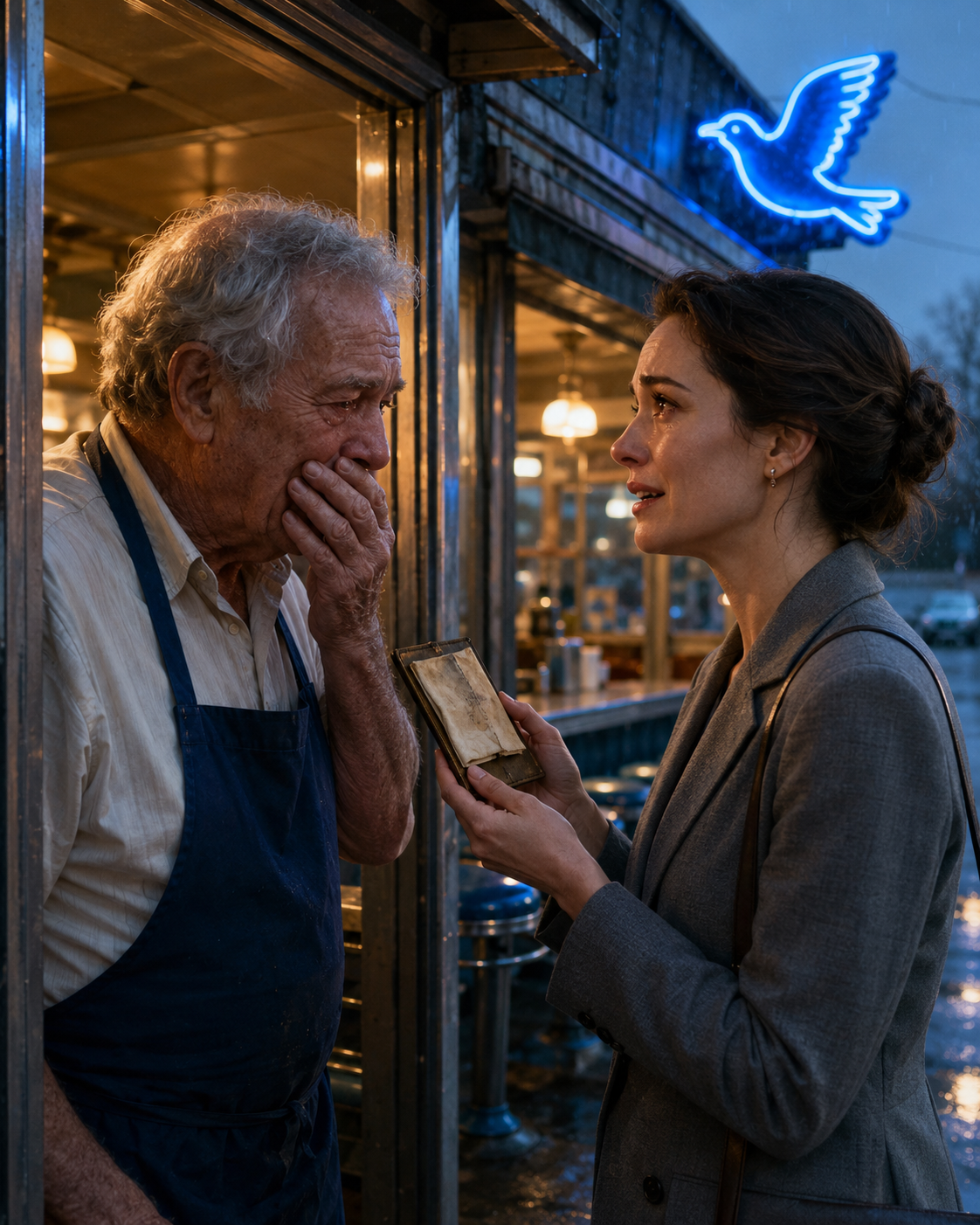
The demolition notice was taped to the front window before sunrise.
Arthur Cole found it when he arrived at the Bluebird Diner at five fifteen in the morning, carrying a paper bag of fresh rolls under one arm and fighting with the stubborn lock using his free hand.
At first, he thought the bright orange sheet was an advertisement.
Then he saw the city seal.
He stopped moving.
The rolls slipped from beneath his arm and landed softly on the sidewalk.
Inside the diner, the familiar blue neon bird continued blinking above the counter, unaware that someone had decided the building beneath it had thirty days left to live.
Arthur removed his glasses, wiped them on his shirt, and read the notice again.
The words did not change.
PROPERTY ACQUISITION AND STRUCTURAL CLEARANCE.
The city had approved the final phase of the Harbor Transit Corridor. The block would be cleared to make room for a glass transportation hub, two commercial towers, and a pedestrian plaza surrounded by stores Arthur would never be able to afford.
Bluebird Diner had been designated an obstructing structure.
An obstructing structure.
That was what forty-three years of breakfasts, apologies, celebrations, funerals, first dates, last chances, and unpaid coffee had become.
Arthur pressed one palm against the cold window.
Beyond the glass were twelve blue stools, nine booths, a silver coffee machine that hissed like an irritated cat, and a pie case his late wife, Rose, had bought at an auction before either of them understood how much it cost to repair old equipment.
The diner was not beautiful.
Its floor tiles were cracked.
The ceiling fan trembled whenever it reached its highest setting.
The jukebox accepted coins but played whatever song it wanted.
The letter B in the neon sign had been repaired so many times that it was brighter than the rest of the word.
But the diner had survived.
It had survived recessions.
It had survived floods.
It had survived a kitchen fire, three robberies, six broken refrigerators, and the opening of a fashionable café across the street that sold coffee in cups smaller than Arthur’s sugar bowl.
It had survived Rose’s death.
That had been the hardest winter of all.
Arthur had opened the diner two days after her funeral because he could not bear the silence in their apartment.
He had stood behind the counter wearing the same black suit he had worn at the cemetery.
No one had asked him for a menu.
Mrs. Holloway had brought flowers.
The dockworkers had fixed the leaking sink.
A nurse from Mercy Hospital had made coffee while Arthur sat in Rose’s favorite booth and stared at the empty seat across from him.
The Bluebird had survived because people refused to let Arthur grieve alone.
Now the city was going to erase it with machinery.
A black sedan stopped at the curb.
Arthur did not turn around.
He already knew who it was.
The rear door opened, and Martin Vale stepped onto the sidewalk in an expensive charcoal coat. He was forty, polished, and permanently composed. He represented Northstar Development, the corporation selected to construct the new transit complex.
Martin approached the diner with a leather folder tucked beneath his arm.
“You received the notice,” he said.
Arthur kept looking through the window.
“I found it.”
“I wanted to deliver it personally.”
“You taped it to the glass.”
“My office did.”
“Then your office delivered it.”
Martin took a measured breath.
“We’ve offered you a generous relocation package.”
“You offered enough money to rent a kitchen for eight months.”
“The property is not worth what you believe it is.”
Arthur finally looked at him.
“This property is worth exactly what I believe it is. That is how worth works.”
“Sentiment is not a valuation method.”
“Neither is greed, but your company seems comfortable using it.”
Martin’s jaw tightened.
For months, he had spoken to Arthur in conference rooms, city offices, and once beside the diner’s freezer while Arthur was repairing a pipe.
Every conversation ended the same way.
Martin presented numbers.
Arthur presented memories.
Martin called the building inefficient.
Arthur asked how efficiently a skyscraper could remember someone’s favorite breakfast.
Neither man convinced the other.
“The approval is final,” Martin said. “The demolition contractor begins preparation in thirty days.”
Arthur pulled the notice from the glass.
The tape tore one corner.
“Then he’ll be wasting his time.”
“Mr. Cole, refusing to accept reality will not protect you.”
Arthur folded the orange paper twice and placed it in his coat pocket.
“I’ve been refusing to accept reality since nineteen eighty-three. That is how this place stayed open.”
He picked up the fallen rolls and unlocked the door.
The bell above it gave a tired ring.
Martin remained on the sidewalk.