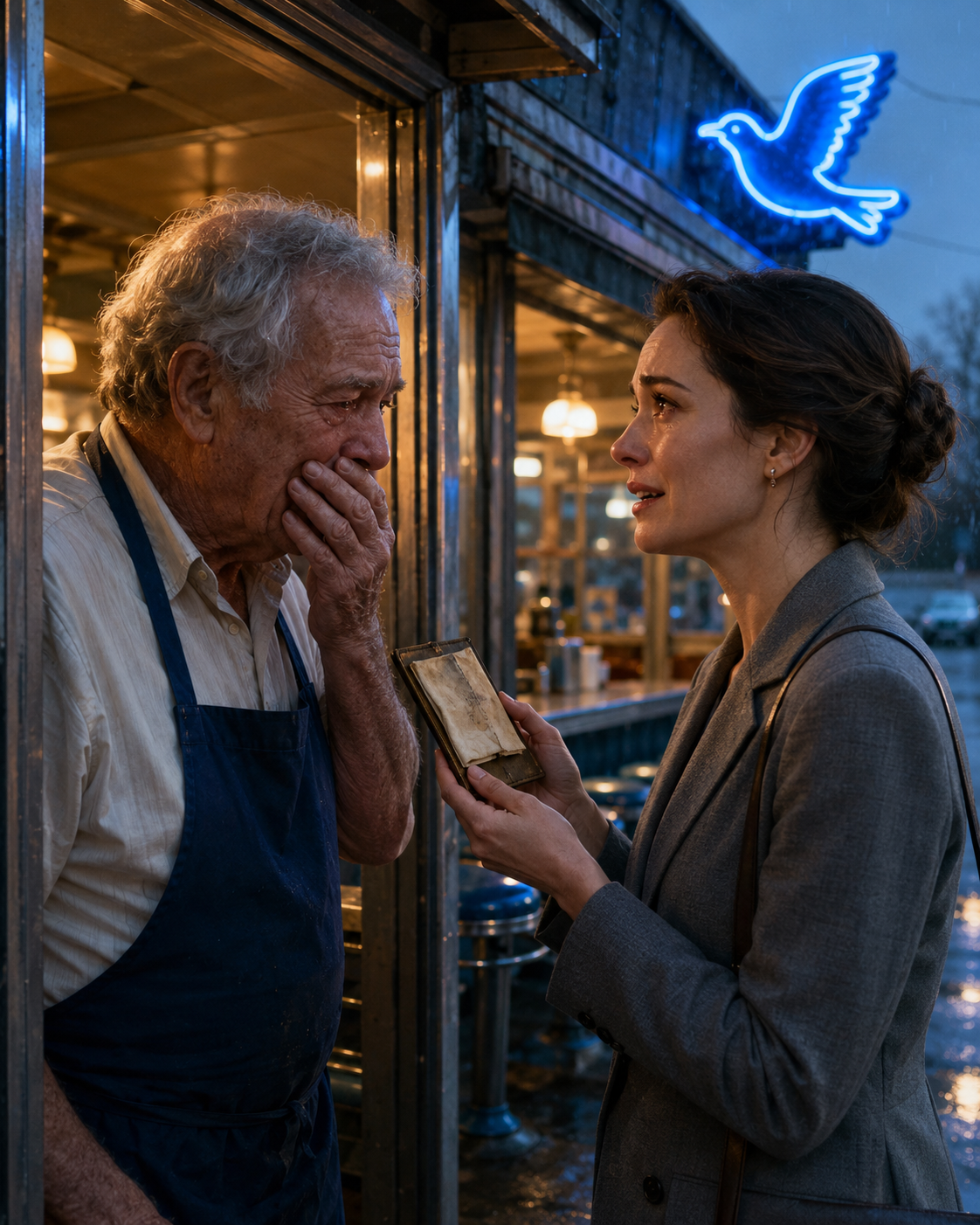
“Your son signed the preliminary consent form.”
Arthur froze.
He did not turn around.
Martin continued carefully.
“Daniel contacted us three weeks ago. He believes accepting the offer is in your best interest.”
Arthur’s fingers tightened around the bag.
“My son does not own the Bluebird.”
“He will eventually inherit your liabilities.”
Arthur stepped inside.
Before closing the door, he looked at Martin one last time.
“Tell Northstar that thirty days is a long time.”
“For what?”
Arthur glanced at the empty booths, the blue stools, and the framed photograph of Rose beside the register.
“For people to remember what they refuse to lose.”
Then he closed the door.
At six o’clock, Hector Ruiz arrived through the kitchen entrance wearing a red baseball cap and carrying a box of onions.
He had cooked at the Bluebird for thirty-one years.
When Arthur first hired him, Hector claimed the job would be temporary. He had been twenty-four, newly married, and saving money to open his own restaurant.
He never opened it.
Instead, he raised three children while flipping pancakes beneath the Bluebird’s rattling exhaust fan.
He attended Rose’s funeral.
Arthur attended Hector’s daughter’s graduation.
Neither man used the word family because neither needed to.
Hector noticed the demolition notice on the counter.
He read it once.
Then he removed his cap.
“They approved it?”
Arthur filled the coffee machine with water.
“So they say.”
“What did Daniel do?”
Arthur’s hand stopped.
“How do you know Daniel did anything?”
“Because you have the same face you made when he moved to Seattle without telling you.”
Arthur pushed the coffee basket into place.
“He signed something.”
Hector swore quietly in Spanish.
“He thinks he’s helping.”
“That does not make it help.”
“What are we going to do?”
“We open.”
“Arthur.”
“We have customers coming.”
“We might have bulldozers coming.”
“Bulldozers do not order breakfast.”
Hector stared at him for a moment.
Then he placed his cap back on his head.
“I’ll start the bacon.”
By seven, every stool was occupied.
News moved quickly along Harbor Street.
Mrs. Holloway arrived first, leaning heavily on her cane. She had eaten oatmeal at the Bluebird every morning since her husband died.
Then came firefighters finishing an overnight shift, two teachers from the elementary school, a taxi driver named Reggie, three construction workers, and Officer Sarah Kim, who had been drinking Arthur’s coffee since she was a nervous police academy trainee.
No one talked about the orange notice at first.
They discussed rain.
Parking.
Baseball.
The price of eggs.
They studied their menus as if breakfast required serious research.
Finally, Mrs. Holloway put down her spoon.
“How long?”
Arthur stood behind the counter drying a clean glass.
“Thirty days.”
The diner went quiet.
Reggie looked through the window toward the buildings across the street.
“They can’t do that.”
“They already did,” Arthur replied.
Officer Kim shook her head.
“There must be an appeal.”
“Two appeals. We lost both.”
“What about historic protection?” one of the teachers asked.
“The building was renovated too many times. They say it no longer qualifies.”
Mrs. Holloway touched the edge of the counter.
“My Harold proposed to me in that booth.”
Arthur nodded.
“I remember.”
“He dropped the ring in the syrup.”
“I remember that too.”
“He was so nervous.”
“You said yes before I found the ring.”
“I knew what he was trying to ask.”
Around the room, people began offering their own memories.
A firefighter had eaten his first meal there after moving to the city.
The teacher by the window had celebrated passing her certification exam in the corner booth.
Officer Kim remembered hiding in the restroom before her first night patrol because she was terrified. Rose had found her, given her a slice of lemon pie, and told her that courage was often just fear wearing comfortable shoes.
Hector listened from the kitchen opening.
Arthur continued wiping the same glass.
He had known the Bluebird mattered.
He had not understood how many lives had quietly attached themselves to it.
The bell above the door rang.
A tall man in a navy raincoat entered.
Daniel Cole looked like Arthur had looked twenty-five years earlier, except his hair was shorter, his shoes were more expensive, and his expression carried the exhaustion of someone who had rehearsed an argument all night.
Arthur placed the glass on the counter.
Daniel glanced at the customers.
“We need to talk.”
“We are talking.”
“Privately.”
“No one here is interested in your business.”
Every person in the diner immediately became fascinated by a menu, coffee cup, or napkin dispenser.
Daniel lowered his voice.
“Dad.”
Arthur walked toward the empty booth near the kitchen.