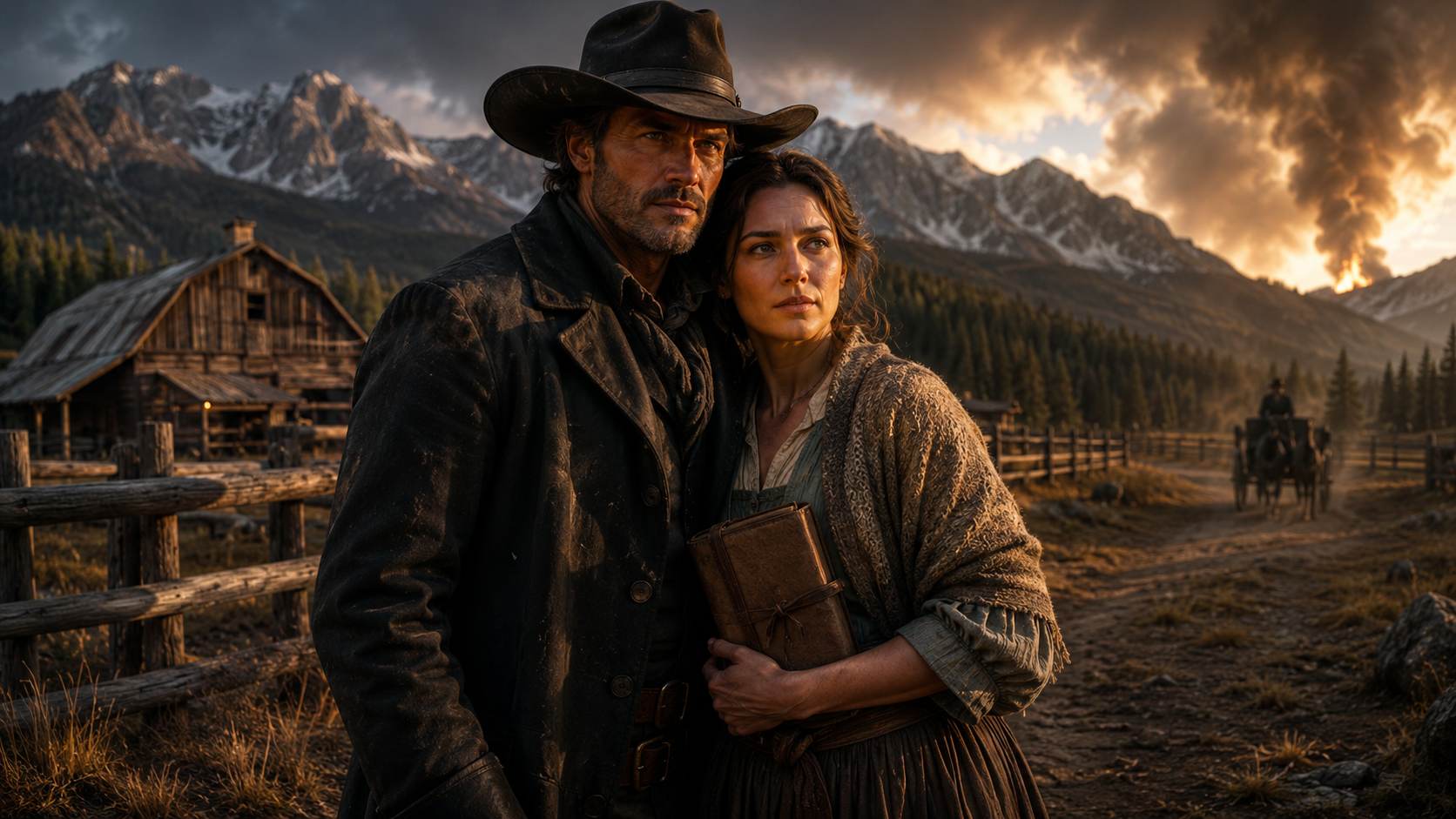
Rowan looked toward the road.
Then toward Stonefall.
A bank notice sat on his desk. Thirty days until foreclosure. The debt had grown in strange increments. Fees added twice. Interest recalculated. Records missing, then found with new signatures. His father had died believing he had mismanaged everything. Rowan had inherited the same shame and worked himself half-dead under it.
Now a thought colder than mountain water entered him.
“What land parcels?” he asked.
Lila studied him. “What?”
“You said the ledger included land parcels.”
“Yes.”
“Stonefall?”
She turned fully toward him.
“I don’t know,” she said. “I never decoded all of it.”
Rowan stared down at the pasture, at the fence his father had built, at the cattle moving like dark stones across the grass.
“You’re not leaving,” he said.
“Mr. Pike—”
“Rowan.”
Her expression changed at the name. Not soft. Careful.
“Rowan,” she said, “men like Thorne do not send polite visitors twice. Graves came here to learn what stood between me and that ledger.”
“Then he learned.”
“That should frighten you.”
“It does.”
She blinked.
He looked at her directly. “I’m not fearless, Lila. I’m tired of being robbed and told it’s weather.”
For the first time since the carriage arrived, something broke through her guarded face.
Not hope.
Not yet.
But the shape of it.
The next morning, Rowan rode to Silver Creek to see Deputy Marshal Miriam Hale.
Miriam had once dragged two horse thieves out of a canyon with a broken wrist and no patience for male foolishness. Rowan trusted her because she disliked charm and collected facts the way other women collected china.
She read the pages Lila had copied first.
Then she read four entries from the original ledger.
By the time she finished, her office felt colder.
“This is larger than trafficking,” Miriam said. “There are land acquisitions tied to false debt instruments. Tax pressure. Forged liens. Forced foreclosure.”
Rowan leaned forward. “Stonefall?”
Miriam ran one finger down a column.
Her face gave the answer before her mouth did.
“Say it,” Rowan said.
“Stonefall appears twice. Once under projected purchase. Once under secured route.”
“Route for what?”
“Rail spur through the lower pass.” She tapped the page. “Water, high ground, access to timber. If Thorne controls your land, he doesn’t have to negotiate with four smaller owners.”
Rowan stood.
For years, he had believed Stonefall was dying because his father had failed and because he himself had not been enough to repair it. Every bank letter had carried his father’s ghost. Every unpaid bill had sounded like judgment.
But the ranch had not simply been failing.
It had been hunted.
“What can you do?” he asked.
“I can wire Denver and Kansas City. I can request federal warrants. I can put the county clerk under quiet review. But Thorne has lawyers, judges, newspapers, and men who make witnesses vanish.”
“Lila won’t vanish.”
Miriam folded the ledger pages. “That woman is evidence. So are you. Evidence has to survive long enough to speak.”
Rowan returned to Stonefall after sundown.
Lila had supper ready. The men were quieter than usual. Old Amos Finch watched Rowan’s face from the far end of the table, and Will stopped pretending he was not worried.
Rowan waited until the plates were filled.
Then he told them enough.
Not everything. Enough.
He told them the ranch debt was likely false. He told them Meridian Rail had been pushing Stonefall toward foreclosure. He told them Lila’s evidence might stop it.
Then he offered every man a choice.
“If you want to leave, you’ll get what wages I can pay and a written reference. No shame. No argument.”
Amos snorted. “I’m too old to run from a city vulture in shiny boots.”
Will swallowed. “Miss Lila taught me numbers without laughing. I’m staying.”
Tomas, who rarely spoke unless a horse was bleeding, lifted his coffee. “I never liked rail men.”
One by one, they stayed.
Lila stood in the kitchen doorway, holding a towel in both hands.
Rowan did not look at her too long. If he did, every man at the table would see what he had not yet admitted to himself.
That decision cost them before dawn two nights later.
Graves’ men cut the north fence and drove cattle toward Deadman’s Wash. They did not take many. Theft was not the purpose. Ruin was. By sunrise, three steers were dead, one horse had torn a tendon, and the men came back with mud to their knees and fury in their throats.
Lila had breakfast waiting.
No one spoke for several minutes. Forks scraped plates. Coffee steamed. The kitchen smelled of biscuits and wet wool.
At last Will asked, “What now?”
Lila set a fresh pot on the table.
“Now we mend the fence,” she said. “We count what remains. We bury what we lost. Men like Graves want fear to make us stupid. So we refuse to be stupid.”
Amos looked at Rowan. “She gives orders better than you.”