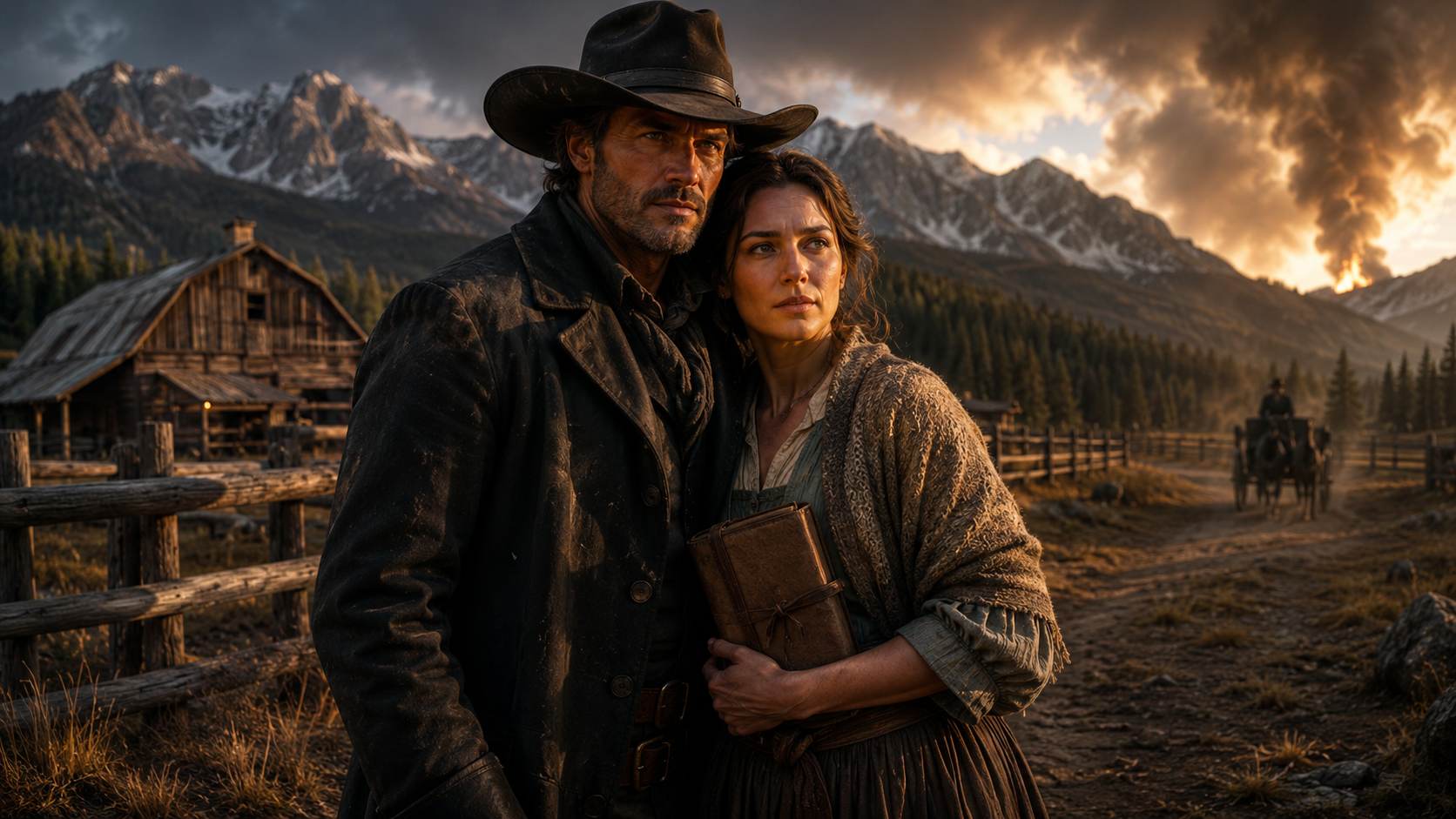
Rowan nodded. “Most people do.”
A tired laugh moved around the table.
It mattered more than any speech could have.
The second attack came at the barn.
A torch landed in the hayloft just after midnight. The bell clanged. Men ran half-dressed into smoke and orange light. Rowan saw shadows near the tack room and fired above them. Someone fired back.
Tomas went down with a bullet through the upper arm.
Lila reached him before Rowan did.
She pressed both hands to the wound, looked directly into Tomas’s panicked face, and said, “You are not dying before you admit my coffee is better than Amos’s.”
Tomas gasped. “It ain’t.”
“Then stay alive and be wrong.”
He did.
By dawn, the east wall of the barn was blackened, the hay was gone, and Tomas was in a wagon bound for the doctor. Lila rode beside him, holding pressure on the wound, talking with such steady command that panic seemed embarrassed to remain.
At the doctor’s office, Tomas was stitched and declared survivable.
Outside, Lila scrubbed blood from her hands until her skin reddened.
“It happened because of me,” she said.
“No.”
“Rowan—”
“No.” He faced her. “Thorne marked my land before you ever crossed my gate. Graves lit that barn because he is afraid of what you carried. Tomas got hurt because bad men chose violence. Not because you told the truth.”
Her composure trembled once.
Only once.
But Rowan saw what it cost her to keep standing.
He wanted to touch her. Her shoulder, her hand, her cheek—something simple and human.
He did not.
Wanting was not permission.
Instead, he said, “We take the ledger to Miriam today. The original. Your statement. My bank papers. We force the case open before Graves burns the rest of Stonefall down.”
“And if he waits on the road?”
“Then he learns Amos taught me to shoot before he taught me to curse.”
For the first time that day, she smiled.
Small.
Brief.
Enough to ruin his peace.
Before they left, Amos pulled Rowan aside near the saddle room.
“You know what this is, don’t you?”
“A federal case.”
Amos stared at him. “Try again, boy.”
Rowan tightened the cinch on his horse.
The old man lowered his voice. “That woman came here carrying hell in a flour sack, and somehow she made this place warm again. You were drying up faster than the creek. She noticed.”
Rowan looked toward Lila. She was tying her satchel to the saddle with careful, efficient knots.
“She may leave when this is finished,” Rowan said.
“Maybe.” Amos spat into the dust. “But if you never ask her to stay, don’t blame her for not hearing you.”
The road to Silver Creek ran between gray hills and early grass.
For the first hour, Rowan and Lila rode in silence. The ledger sat between them like a loaded gun.
At last Lila said, “I don’t know how to live after running.”
Rowan glanced at her.
“I know how to change names,” she continued. “I know how to sleep lightly, count exits, hide money in hems, and leave before breakfast. I know how to become useful so people ask fewer questions. But if Thorne falls? If I do not have to run anymore? I don’t know what remains.”
“What did you want before Denver?”
She was quiet a long time.
“A kitchen that belonged to me,” she said. “A garden. A table where people came because they wanted to, not because they were hungry and desperate.”
Rowan felt the answer before he dared speak it.
“Stonefall has a kitchen.”
Her eyes turned toward him.
“And poor soil,” he added. “But you’ve already started arguing with it.”
“Are you offering me permanent employment?”
“No.”
The word lay between them.
Her breath changed, soft enough that a less attentive man would have missed it.
“What are you offering?”
Rowan gripped the reins.
He could face fire, debt, armed men, and a rail baron’s hired wolves. He could ride toward a gun without thinking. But saying a plain truth to a woman beside him on a cold road felt like stepping beyond the edge of a cliff.
“A reason not to run,” he said.
Lila did not answer.
But she did not ride farther away.
Miriam Hale was waiting when they arrived.
So was a federal prosecutor named Beatrice Wynn, a woman with iron-gray hair, calm hands, and a voice that sounded like courtroom oak.
Lila gave her statement for four hours.
She did not make herself pitiful. She did not dramatize. She told them names, dates, rooms, freight markings, payment codes, and the exact color of the ink used on forged contracts. When she did not know something, she said so. When she remembered something, she placed it like a nail driven straight.
Beatrice checked the ledger against Lila’s statement.
Once.
Twice.
By the sixth match, she looked at Miriam.
“This will hold.”
Lila closed her eyes for one breath.
Rowan did not take her hand, though he wanted to.
Warrants went out before sunset.