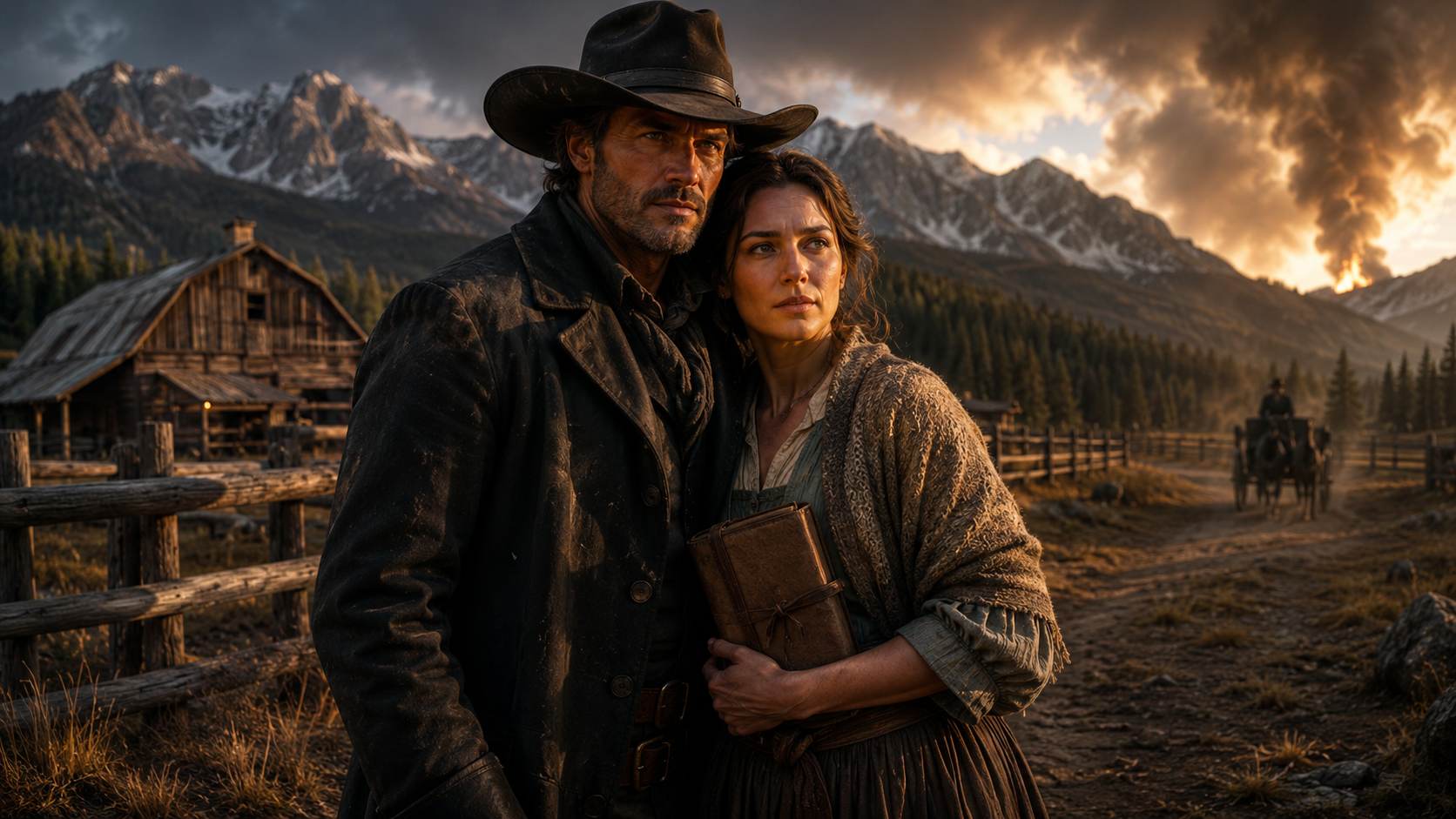
Rowan was repairing a gate hinge when the carriage rolled through the lower road and stopped just beyond the yard. It was the kind of carriage that did not belong near mud, cattle, or honest work. A tall man stepped down wearing a dark wool coat, polished boots, and gloves too clean for the country.
Lila came out of the kitchen carrying a basket of laundry.
The man smiled.
“Miss Celeste Harrow,” he called. “You have made yourself inconveniently difficult to locate.”
The basket slipped from her hands.
Rowan moved before he thought.
He stepped between Lila and the stranger.
“You’ve crossed onto private land,” Rowan said.
The man’s eyes flicked over him with polished contempt. “And you are?”
“The man telling you to leave.”
“Lucian Graves.” The stranger gave a shallow bow. “I represent Meridian Rail and Land. I have business with Miss Harrow.”
“Her name is Lila Mercer.”
“For the moment, perhaps.”
Behind Rowan, Lila’s breathing had changed. He could hear it because he had spent years listening to storms before they broke.
Graves looked past him. “Mr. Thorne remains willing to settle this matter quietly. That generosity has limits.”
Lila said nothing.
Rowan took one step forward. “Whatever matter you think you have with her is finished.”
Graves’ smile thinned. “You own a failing ranch, Mr. Pike. I suggest you do not add another man’s war to your unpaid debts.”
Rowan did not blink.
Graves looked at him a moment longer, measuring whether arrogance would survive contact with bone. Then he put his gloves back on.
“Miss Harrow,” he said, “running does not change ownership.”
Lila flinched.
That was all Rowan needed to see.
He lifted the gate latch and swung it open toward the road. “Get out.”
The riders shifted in their saddles. For one sharp second, the yard seemed to hold its breath.
Then Graves climbed back into the carriage.
Dust swallowed them as they left.
Rowan waited until the wheels disappeared beyond the cottonwoods before he turned.
Lila stood very still, but stillness was not calm. It was discipline. It was a woman holding the pieces of herself together by force.
“I should leave,” she said.
“No.”
Her eyes lifted to his. “You don’t know what you just stepped into.”
“I know enough.”
“You know nothing.”
“Then tell me.”
She looked toward the house, then the bunkhouse, then the long road where Graves had vanished.
Rowan understood.
“Not inside,” he said. “Walk with me.”
They went to the old stone wall above the lower pasture. Open sky stretched over them. The wind came cold off the mountain, smelling of pine sap and distant snow.
Lila wrapped her shawl tighter.
“My name was Celeste Harrow before it was Lila Mercer,” she said. “Before that, it was probably something else in my mother’s mouth, but I don’t remember her well enough to know.”
Rowan leaned one boot on the lower rail and waited.
“I worked at the Arden House in Denver,” she continued. “It belonged to Victor Thorne. Hotels, rail contracts, land offices, newspapers—he had his hands in everything that could make a man rich and invisible. I started in the laundry. Then the kitchen. Then the accounts room because I could read figures better than the men he hired to pretend they understood them.”
She looked down at her hands.
“Women came through that hotel. Young ones. Widows. Immigrants who thought they had been promised work. Some stayed a week. Some only a night. They were moved under freight codes. Service transfers. Domestic placements. False employment contracts.”
Rowan’s jaw tightened.
“I found the second ledger by accident,” she said. “A book no guest was meant to see. Names, routes, payments, land parcels, bribes. I copied what I could. Then I stole the original when I realized the sheriff was already bought.”
“You went to the law?”
“I went to a man wearing a badge.” Her mouth hardened. “That was not the same thing.”
“How long have you been running?”
“Nearly three years.”
The wind pulled a strand of hair loose from her braid. She tucked it back with fingers that did not shake.
“I cooked in mining camps, boarding houses, rail crews, and one widow’s inn where I slept in the pantry because the owner’s son watched doors too closely. I used different names. I stayed nowhere long enough to be remembered. I thought Stonefall was far enough from Denver.”
“Graves found you.”
“Yes.”
“What does he want?”
“The ledger.”
“Where is it?”
Her silence stretched.
Rowan did not push. Trust given too quickly was often fear in disguise.
At last she said, “In my satchel.”
He almost laughed, but nothing about her face allowed it.
“You carried evidence against a rail baron into my kitchen?”
“I carried it everywhere. Wrapped in butcher paper, tucked inside a flour sack, under dried bay leaves. Men rarely search a woman’s kitchen things unless they understand women, and most dangerous men don’t.”