He smiled. “You won’t shoot.”
Jonah sank to one knee.
I cocked the hammer.
Harrow’s smile faded.
He dropped the knife.
Outside, voices rose below the pass.
Not Harrow’s men.
Town voices.
The preacher. The blacksmith. The woman who had dropped her washing. Mae had not stayed waiting with a shotgun after all. She had sent the blacksmith’s boy to Briarfall with Bram’s confession, then shamed half the town into riding through the storm.
By dawn, Victor Harrow and Harlen Pike were tied over saddles, Bram Lyle was weeping, and the old map was safe inside Mae’s reclaimed Bible.
But Jonah was bleeding.
Badly.
We could not ride fast.
We could not wait.
The doctor in Briarfall had shaking hands but clear eyes when it mattered. He stitched Jonah on Mae’s kitchen table while I stood at Jonah’s head and refused to let go of his hand.
“You stubborn mountain fool,” Mae whispered, crying openly now. “Do not die after carrying me all the way up that ridge. I will be furious.”
Jonah’s eyes opened.
“Mara?”
“I’m here.”
“Map?”
“Safe.”
“You?”
“Safe.”
He tried to smile. “Then stop looking like I’m already buried.”
I bent over him, tears falling despite every effort to hold them back.
“You told me you did not know how to fight smart when someone you loved was threatened,” I whispered. “So listen carefully. Living is the smart fight. Do you understand me?”
His fingers tightened around mine.
“Yes, ma’am,” he breathed.
He lived.
The truth, once freed, moved through Briarfall like floodwater.
Silas Rowe had discovered the old survey map while settling a distant estate. He had sent the deed, the map, and the Bible west with Mae because he believed no one would suspect two women of carrying proof that Victor Harrow’s silver claim was partly stolen.
Harrow learned of it through Harlen Pike and arranged the ambush.
Thomas Blackwood had not died because Jonah abandoned him.
He had been shot by Harrow’s men near Raven Pass seven years earlier and left in the snow. Jonah, wounded and half-mad with grief, had carried his brother’s body home through the storm. Harrow turned that terrible act into a rumor: Jonah Blackwood had murdered his brother and dragged him back from the mountain.
Briarfall had believed the lie because believing cost less than resisting.
That changed.
Not all at once. Shame is slow when it has lived too long as habit. But the blacksmith came first, hat in hand, to apologize. Then the preacher. Then the woman who had dropped her washing, whose little daughter had survived fever years earlier because two Blackwood brothers had tried to bring medicine through a storm.
Jonah accepted no grand speeches.
He only nodded and kept healing.
I stayed beside him through fever, anger, nightmares, and the strange quiet that came after justice finally arrived. Sometimes he woke reaching for a rifle. Sometimes he wept without sound. Sometimes he asked whether I was certain I wanted a man with ghosts.
Each time, I answered the same way.
“I do not love you because you have no wounds. I love you because you kept your heart alive despite them.”
Winter came early that year.
By then, the Holloway cabin had a sound roof, real windows, stacked firewood, and curtains Mae had sewn from flour sacks and pride. The Denver surveyor confirmed the map. Mae and I owned enough of the silver claim to live securely, though I refused to let the land become only a mine.
“This place has seen too much greed,” I said. “It should grow something kinder.”
So in spring, we planted apple trees.
Jonah came every morning until Mae finally lost patience.
“You cross two miles before breakfast to drink coffee in our kitchen,” she told him. “You mend fences that are already mended. You chop wood we already chopped. You look at my granddaughter as if she hung the moon, then ride home alone like a tragic poem. I am too old to endure this much nonsense.”
Jonah looked at me.
I looked at him.
Mae sighed. “Ask her.”
Jonah stood so quickly his chair scraped the floor.
“Mara Vale,” he said, voice rough, “I have no fine house, no polished manners, and more history than any woman should have to carry. But I love you. I will love you with everything good left in me and everything good you helped me find again. Will you marry me?”
I crossed the kitchen and took his face in both hands.
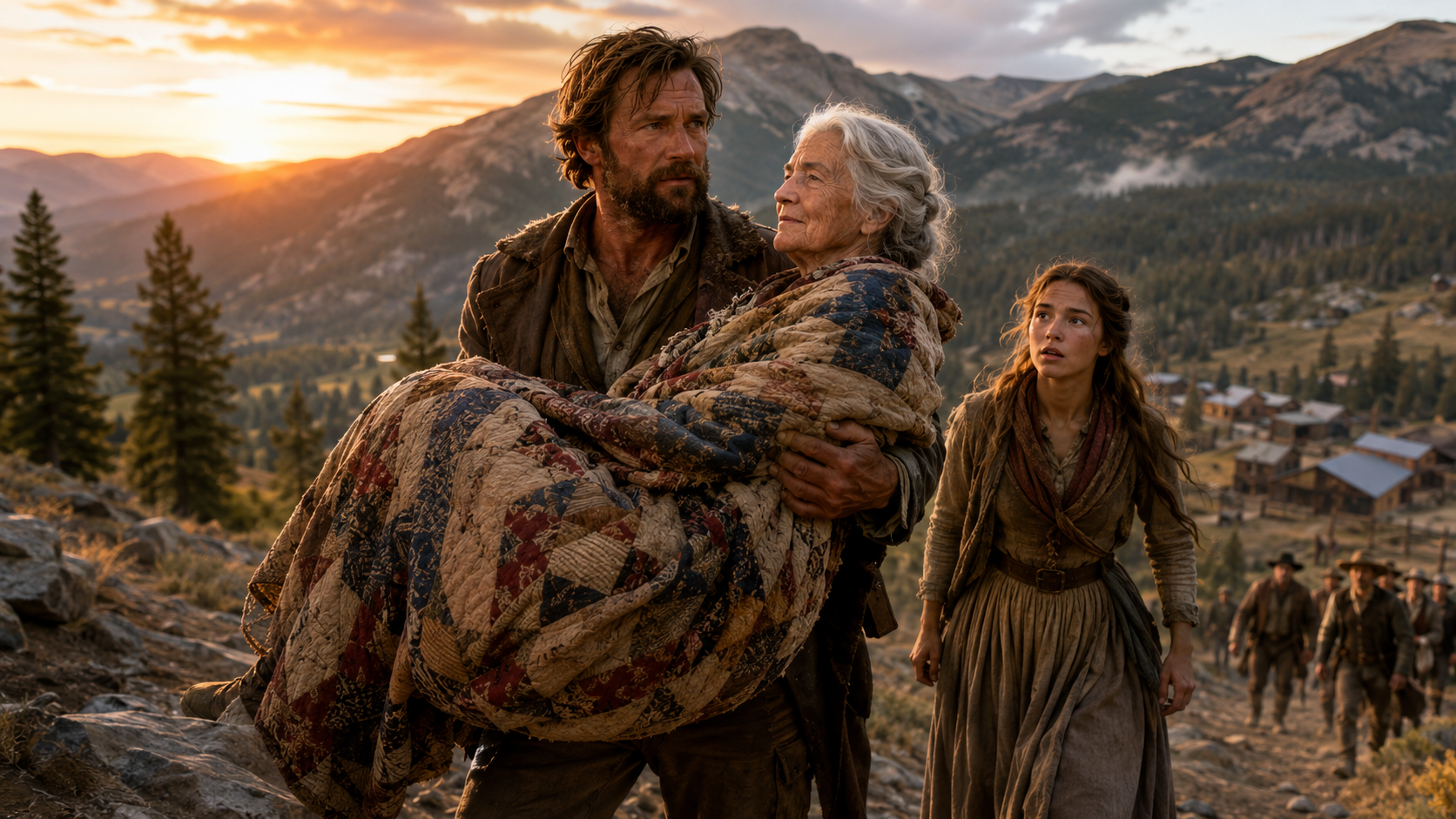
“Jonah Blackwood,” I said, “you carried my grandmother up a mountain path when she could not take another step. You carried the truth when a whole town wanted it buried. You carried grief without letting it make you cruel. But you do not have to carry life alone anymore.”
His eyes shone.
“Is that a yes?”
“That is a yes.”
Mae clapped once. “Finally.”
We married beneath the aspens in June, one year after the bullet struck our wagon wheel.