Briarfall came. Some out of love, some out of guilt, and some because people will always attend a wedding if there is cake. Mae wore blue. Jonah wore his brother’s watch chain. I carried wildflowers and a page from Mae’s Bible tucked into my glove. Not Scripture, but the blank family page where she had written that morning:
Mara Vale married Jonah Blackwood, a good man wrongly judged, on the day she stopped merely surviving and began to live.
Years later, when people told the story, they liked to begin with the gunshot, the storm at Raven Pass, or the silver map hidden in an old woman’s Bible.
I always began elsewhere.
I began with the mountain path.
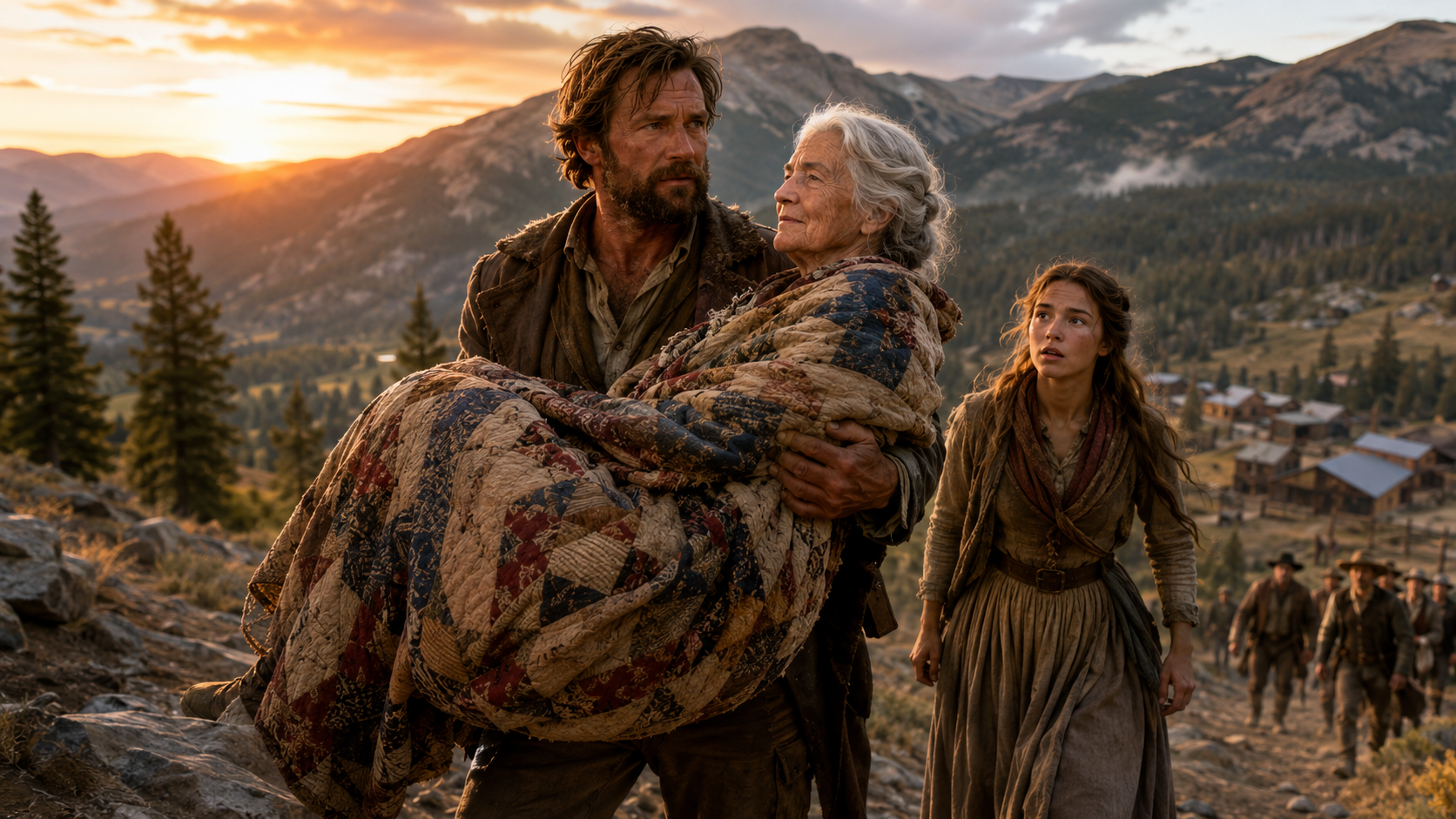
With Mae too weak to walk.
With Jonah lifting her carefully, not as a burden, but as a trust.
With the moment I followed behind him and understood that strength was not the same as violence, and tenderness was not the opposite of courage.
Mae lived to see three great-grandchildren born in the cabin beneath the ridge.
On her last spring morning, when apple blossoms opened white against the mountains, she held my hand and watched Jonah teaching our oldest boy how to plant straight rows.
“I knew,” she whispered.
“Knew what?”
“That he would carry you through.”
I looked at my husband, who was laughing as our son spilled seeds into the dirt.
“He did,” I said softly. “But I carried him too.”
Mae’s eyes filled with peace.
“That,” she whispered, “is the better love.”
She died before sunset, with apple blossoms at the window and my hand in hers.
We buried her on the hillside above the cabin, where she could see the ridge, the orchard, the town that had learned shame and then courage, and the path where a feared mountain man had once carried her toward safety.
Years passed.
Briarfall changed. The silver vein ran thin, but the orchard grew strong. Our children grew tall, loud, stubborn, and kind. Jonah’s beard silvered. My hands roughened from work. Our love lost its first astonishment and gained something deeper: the quiet certainty of two people who had chosen each other through fear, winter, grief, birth, harvest, and ordinary mornings.
Sometimes, at dusk, Jonah and I walked the old trail together.
He would stop where the first bullet had struck the wagon wheel, touch the scar still visible in the old pine beside the road, and shake his head.
“I nearly missed that shot,” he admitted once.
I laughed. “You told those men you would take their fingers.”
“I was trying to sound confident.”
“You were terrifying.”
“I was terrified.”
I looked at him, surprised.
He took my hand.
“I saw you on that wagon,” he said, “standing between a rifle and your grandmother with a pistol shaking in your hand, and I thought, there is the bravest woman I will ever know.”
I leaned against him.
“You carried her up the mountain,” I said.
Jonah kissed my hair.
“And you carried me down from it.”
Below us, the cabin windows glowed gold. Apple trees moved in the wind. Children’s voices rose from the yard, bright and alive. The mountain still held shadows, but it no longer felt lonely.
Mae had been right.
Love was not one person carrying the other forever.
It was two people learning when to lift, when to lean, when to stand, and when to walk beside each other into whatever came next.
And on that wild ridge where lies had once ruled and bullets had once flown, Jonah and I built a life strong enough to outlast every rumor.