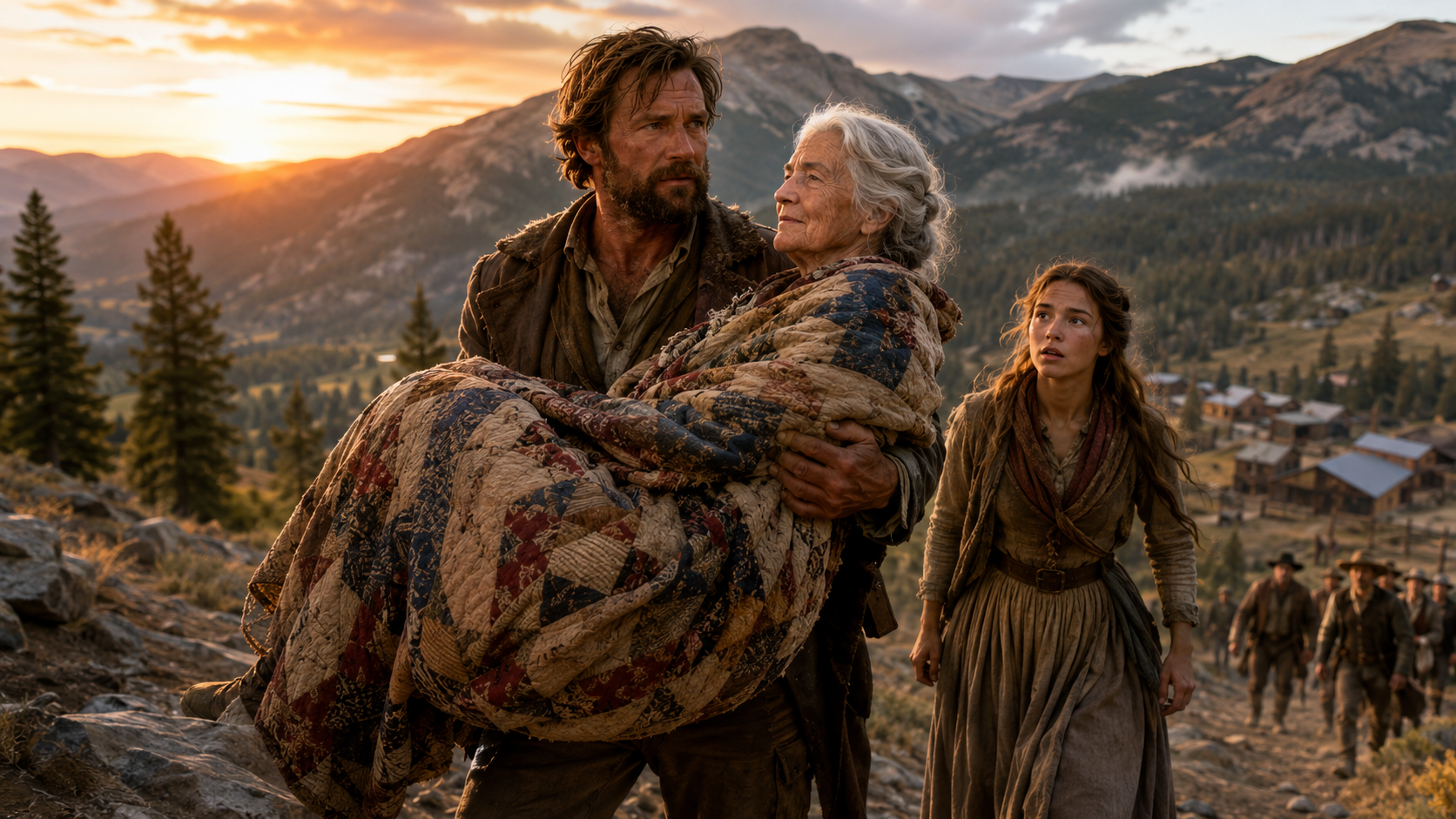
Only then did I notice Jonah had gone.
I found him outside near the broken wheel. He had dragged it up with rope and sheer stubbornness and was already working by lamplight, sleeves rolled to the elbow, hands moving with calm precision.
“The men knew my name,” I said.
He did not look up. “I heard.”
“They knew about the deed.”
“I heard that too.”
“Then tell me what I have walked into.”
He set down the tool.
For a long moment, he looked toward the trail, where the trees had swallowed the last of the light.
“The Holloway claim isn’t just a poor cabin and stubborn dirt,” he said at last. “It sits against an old boundary line people have argued over since before the war. There’s silver under the north ridge. Not enough to make a kingdom, but enough to make honest men forget themselves and dishonest men sharpen knives.”
My mouth went dry. “And my grandmother inherited the land that proves where the boundary lies?”
“Maybe.”
“From a man she barely knew?”
“Silas Rowe was your grandmother’s cousin, wasn’t he?”
I nodded.
“Then maybe he had no one else left. Maybe he thought two women from the plains could arrive quietly.”
“But someone found out.”
Jonah’s expression darkened. “Someone always does.”
“Who?”
“The man behind most trouble here is Victor Harrow. He owns the mill, half the store, and enough frightened men to pretend he owns the rest. The rider with the scar was Bram Lyle. The nervous one was probably Neddie Cross. I didn’t see the third clearly.”
“And the man at the stage stop who warned us about you?”
Jonah went still.
“What did he say?”
“That you killed your brother.”
The spoke in Jonah’s hand snapped.
For the first time, I saw something raw beneath his silence.
“My brother’s name was Thomas,” he said. “He was twenty-four. He laughed too loud, trusted too fast, and believed every person could be improved by bread and music.”
I said nothing.
“Seven years ago, we found the silver line before Harrow did. We had a claim. We had a survey. We had proof. Then Thomas died in a storm near Raven Pass.”
“I’m sorry.”
Jonah’s face hardened, but his voice stayed low.
“The town needed a villain. Harrow gave them one. Said I led Thomas out there to steal his share. Said I came back alone because I killed him. Said the claim papers disappeared because I hid them.”
“Did no one defend you?”
“My brother’s sweetheart tried at first.” He looked away. “Then her father threatened to throw her out. The preacher said grief confused people. The storekeeper said peace mattered more than truth. Everyone decided it was easier to fear one man than stand against Harrow.”
“Why didn’t you fight them?”
He looked at me then, and the pain in his eyes was not wild. It was old. It had made a home inside him.
“I was tired.”
I understood that too well to answer quickly.
Inside, Mae coughed.
I turned.
“Go,” Jonah said. “I’ll finish here.”
“You saved us today,” I said. “You carried her. You’re repairing our wheel. You have told me more truth in one evening than anyone in this county was willing to give us. I do not know how to repay it.”
He picked up the tool again.
“Don’t believe Briarfall too soon. That will be payment enough.”
The next day, I had to enter Briarfall whether I believed it or not.
Mae needed more medicine. We needed flour, salt, lamp oil, nails, window glass, and a courage I could not purchase. Jonah rode beside the repaired wagon with his rifle within reach. Mae sat wrapped in quilts, watching the town as if she were the judge and every porch held a defendant.
Briarfall was smaller than its fear.
A general store. A blacksmith shed. A church with a crooked bell. A row of houses pressed against the mud road. Chickens scattered as we entered, and every human voice died.
Faces appeared in windows.
A woman dropped a basket of washing.
An old man muttered, “Blackwood.”
Jonah ignored them.
I did not.
Fear I could understand. Hatred too. But shame was different. Shame looked away.
The storekeeper, Harlen Pike, greeted us with a smile that seemed practiced before a mirror.
“Miss Vale,” he said to me. “We heard you had trouble on the road. A terrible welcome. This country can be hard on newcomers.”
“Yes,” I said. “Especially when the country knows they are coming.”
His smile did not change. “News travels.”
“So do bullets.”
Behind me, Jonah made a quiet sound that might have been amusement.
Harlen glanced at him, then back at me. “You’ll be wanting to see the Holloway place.”
“Yes.”
“I can send a boy to guide you.”
“I know the way,” Jonah said.
Harlen’s jaw tightened.
I noticed.
The Holloway cabin sat two miles beyond town, tucked under a slope of aspens. At first sight, my hope fell through me.
The porch had collapsed. The roof sagged over one corner. One window was shattered, another boarded from inside. Weeds had swallowed the path. The barn leaned like a drunk against the wind.