Mae looked at it from the wagon and whispered, “Oh, child.”
“It’s all right,” I lied.
Jonah walked the property in silence. He checked the well, the chimney, the barn doors, the foundation stones. Then he came back.
“The bones are good.”
“The bones?” I stared at the ruin. “Mr. Blackwood, I am not a carpenter. I am not a miner. I am not even useful with chickens. I brought my grandmother across half the country because a letter promised us a chance to survive, and now men are ready to kill us over land I barely understand.”
My voice broke.
I turned away, ashamed.
Jonah did not crowd me. He stood beside me and looked at the ruined cabin as if it were not a disaster, but a task.
“First, we make one room safe,” he said. “Then the roof. Then the stove. Then winter stores. You do not have to solve a whole life before supper.”
“I don’t know where to start.”
“I do.”
I looked up at him.
There it was again. That steadiness. Not handsome in a polished way. Not charming. Better than charming. Real.
“Why?” I asked. “Why help us this much?”
His face changed.
For the first time since I had met him, Jonah Blackwood looked uncertain.
“Because your grandmother looked at me as if I were still a man,” he said. “Not a story. Not a warning. Not the creature Briarfall invented so it could sleep at night.”
My throat tightened.
“And me?” I asked before I could stop myself.
His eyes held mine.
“I’m trying not to answer that too quickly.”
Before I could breathe, Mae called from the wagon, “If you two are finished pretending to discuss roof beams, I have opinions.”
“Grandmother.”
“I am elderly, Mara, not blind.” She pointed at Jonah. “You will help us make this place livable. We will pay what we can. You will eat supper here when there is a table to serve it on. And until then, if you offer shelter, we will accept it, because pride makes a poor blanket.”
Jonah’s expression warmed.
“Yes, ma’am.”
Mae leaned back, satisfied. “Good. Now someone tell me if this house has snakes.”
It did.
Three.
Jonah removed them before I decided whether to scream, faint, or sell the property immediately.
For the next eleven days, our lives became a rhythm of labor.
At dawn, Jonah came down from his cabin with tools over his shoulder. I met him with coffee. Mae sat under an aspen tree sewing curtains from old flour sacks and giving orders like a general defending a fort.
Jonah taught me how to pry out rotted boards, set nails straight, patch chinks between logs, and tell whether a beam would hold.
He did not laugh when I hit my thumb.
He did not scold when I measured wrong.
He did not treat me as fragile.
That unsettled me more than his strength.
Men in our old town had praised me for endurance while quietly expecting me to endure alone. Jonah simply handed me the right tool and stood near enough to catch what fell.
One afternoon, rain came hard over the ridge. We ran for the cabin, laughing despite ourselves, soaked before we reached shelter. My boot slipped in the mud. Jonah caught me around the waist.
For a moment, the whole world narrowed to his hands, my breath, and rain beating against a roof we had repaired together.
“Mara,” he said, voice rough.
I should have stepped back.
I did not.
He bent slowly, giving me every chance to refuse.
I rose to meet him.
Our first kiss tasted of rain, woodsmoke, and all the words both of us had been too careful to say. It was gentle at first, almost reverent. Then my hand touched his jaw, and Jonah made a low sound like a man coming home after years in the cold.
Mae knocked a spoon against a tin cup from the next room.
“I may be old,” she called, “but I am not deaf, and that kiss sounded legally significant.”
I jumped back, mortified.
Jonah laughed.
It was the first full laugh I had heard from him. It changed his whole face. The haunted lines eased, and for one bright second I saw the man he might have been before grief and rumor drove him into the mountains.
But happiness made our enemies restless.
Three nights later, someone set fire to the barn.
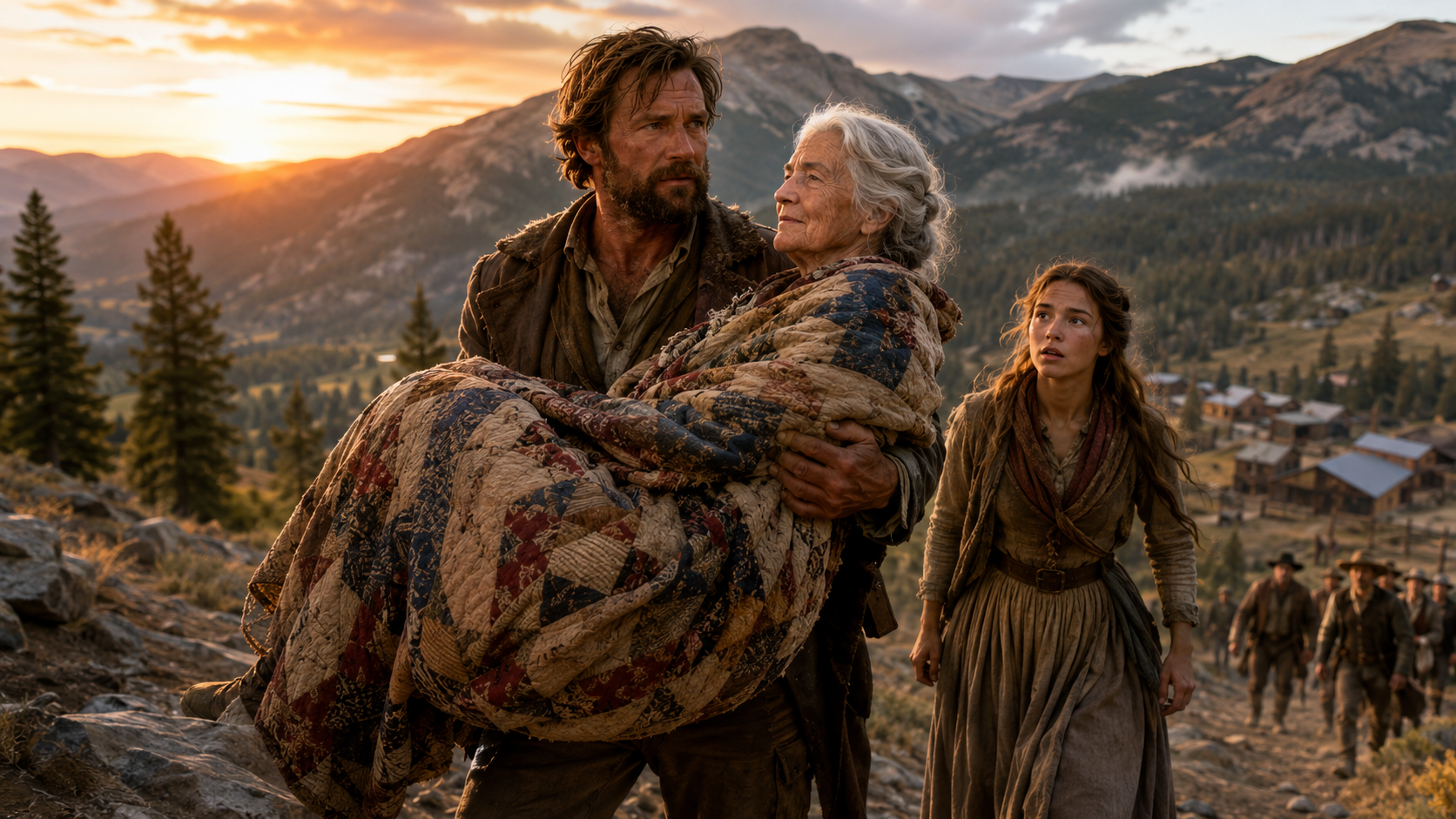
Jonah saw the glow from his cabin and arrived before the roof collapsed. He and I formed a desperate line from the well, passing buckets until our arms shook. Mae sat near the cabin door wrapped in a quilt, coughing from smoke and refusing to be carried farther away.
By midnight, half the barn was gone.
In the ashes, Jonah found a strip of green cloth caught on a nail.
Bram Lyle wore a green neck scarf.
“They’re warning us,” I said.
“No.” Jonah’s voice had gone flat in a way that frightened me more than anger would have. “They’re testing how alone you are.”
The next morning, Harlen Pike arrived with two townsmen and Reverend Cole. Harlen removed his hat with theatrical sorrow.
“Miss Vale, this is unfortunate. Deeply unfortunate. It proves what I feared. This property attracts danger. A woman in your position should not remain here.”