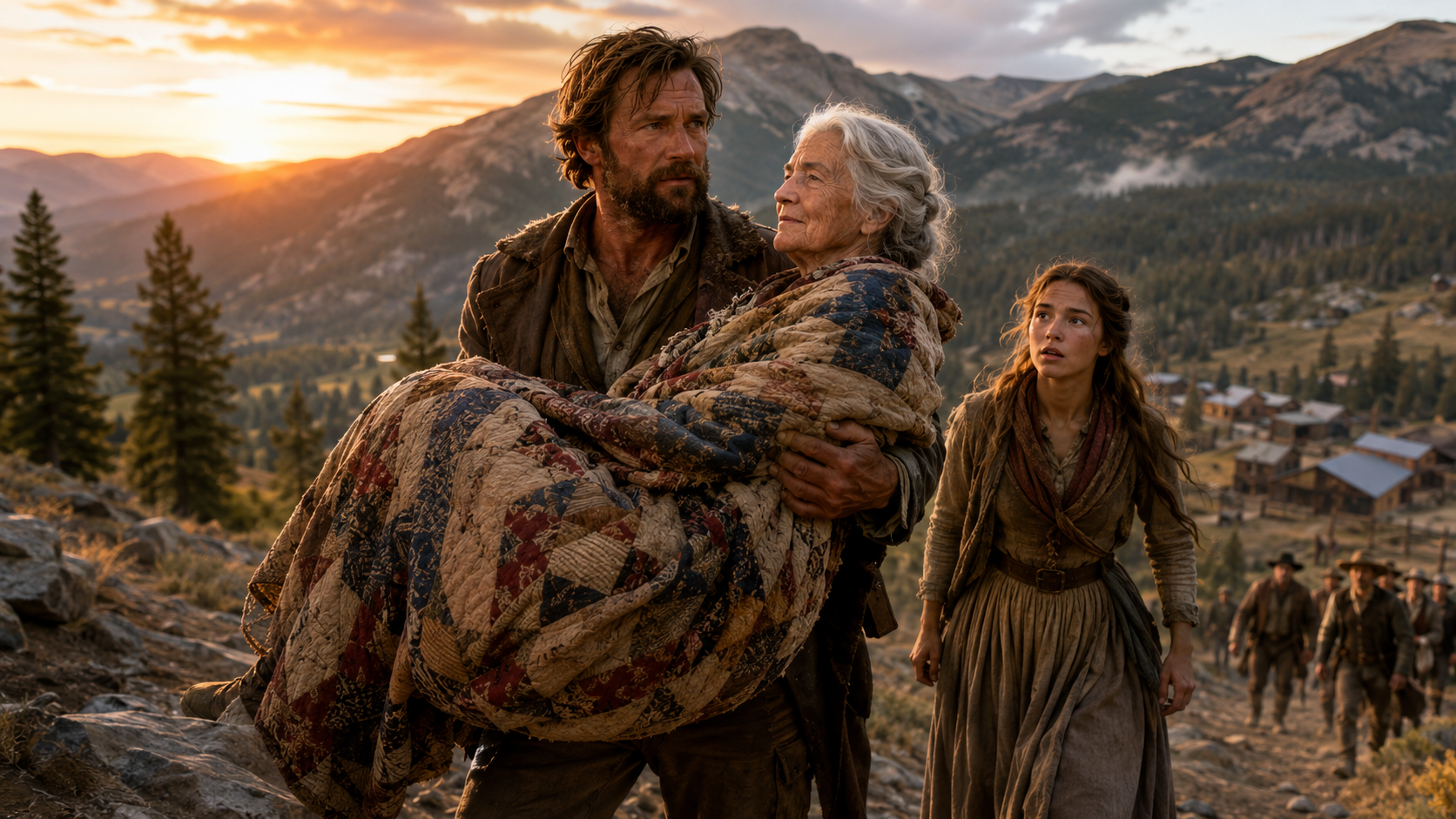
The mountain man came down the slope with quiet steps. Up close, he seemed less like a brute and more like a storm that had learned manners.
He looked first at my grandmother.
“Ma’am, are you hurt?”
Mae swallowed. “Only my pride. And perhaps my opinion of scenic travel.”
Something moved at the corner of his mouth.
Then his gaze turned to me.
“You can lower the pistol.”
Heat rushed to my face. I lowered it at once. “I’m sorry.”
“Don’t be,” he said. “A frightened woman with a pistol is still wiser than a confident fool with empty hands.”
He crouched beside the ruined wheel. I watched him examine the broken spokes, the cracked rim, the axle bent just enough to make my stomach sink.
“This wagon won’t reach Briarfall,” he said.
“It has to.” I hated the desperation in my voice. “My grandmother needs rest. The claim cabin is supposed to be near town.”
His eyes moved to Mae again, and something changed in him. The hard watchfulness softened. Not much, but enough that I noticed.
“She needs warmth, water, and a bed that isn’t bouncing over rock,” he said. “Town doctor, too, if old Merrick is sober before supper.”
“We can pay you.”
“I didn’t ask for money.”
I stiffened. “Mr. Blackwood, I appreciate what you did, but we do not know you.”
“No,” he said. “But those men do. And they’ll come back.”
That silenced me.
He looked up the narrow trail cutting between the pines. “My cabin is above the ridge. Less than a mile if you’re walking. Farther if you’re carrying fear. The horses can make the lower bend, but the wagon can’t. I’ll take what supplies you need and fix the wheel by morning.”
Mae shifted beneath her quilt and grimaced. Pain drew the color out of her lips.
“Grandmother?”
She did not answer me. She was looking at him.
“You are the terrible Jonah Blackwood?” she asked.
His jaw tightened. “Depends who is telling it.”
“Did you murder your brother?”
“No, ma’am.”
“Did you rob miners?”
“No.”
“Did you ever strike a woman?”
His eyes flicked to mine, then away. “Never.”
Mae studied him the way she studied a seam before deciding whether it would hold. Then she nodded.
“Well,” she said, “that is sufficient for now. Help me down before my dignity outruns my bones.”
I moved toward her, but Jonah was faster. He stepped to the wagon, reached up, and lifted my grandmother as if she weighed no more than a folded blanket.
Mae gasped and clutched his shirt.
“I’ve got you,” he murmured. “You’re safe.”
I stood frozen.
I had expected strength.
I had not expected gentleness.
Jonah Blackwood, the monster of Briarfall, adjusted the quilt around Mae’s legs with a care that made my throat tighten. He held her not like a burden, not like an inconvenience, but like something precious entrusted to him by God and weather.
“I’ll carry her up,” he said.
“The path is steep,” I warned.
His eyes met mine.
“Then I’ll climb slow.”
And he did.
The trail rose cruelly. It twisted between wet stones and roots thick as old rope. Even with only my satchel over my shoulder and my father’s pistol in my pocket, I was breathless before we reached the first bend. Jonah moved with steady patience, pausing when Mae coughed, shifting her higher when the trail narrowed, warning her before every uneven step.
“Tell me if I hurt you,” he said.
“You do not,” Mae whispered. “My late husband carried feed sacks with less tenderness, and he claimed to love me.”
This time Jonah actually smiled.
I followed behind them, watching this feared man carry my grandmother toward the mountaintop, and something inside me cracked in a place I had not known was sealed.
All my life, I had carried people.
My father through fever.
My mother through grief.
My grandmother through age.
Myself through everything else.
No one had ever turned to me and said, Let me take this part.
Jonah Blackwood did not say it either.
He simply did it.
By the time his cabin appeared through the trees, I knew two things.
The men on the road had not been ordinary thieves.
And whatever Briarfall believed about Jonah Blackwood, it was not the whole truth.
His cabin stood in a clearing above a creek, stronger and cleaner than I expected. There was wood stacked beneath the eaves, herbs drying beside the door, and mountain flowers growing in a rough stone border. Inside, the place smelled of pine smoke, coffee, leather, and stew. Books lined one wall. Tools hung neatly from pegs. A narrow bed stood beneath a window facing the ridge.
Jonah set Mae down and tucked the quilt around her.
“I’ll bring water.”
“I can do that,” I said.
“You can sit before you fall.”
“I’m not going to fall.”
“You’re shaking.”
“I was shot at.”
“That explains it.”
His tone was dry, not unkind. Somehow that steadied me more than pity would have.
He brought water, then broth, then a little tin of medicine from a shelf above the stove. Mae drank what she could. Within the hour, she slept.