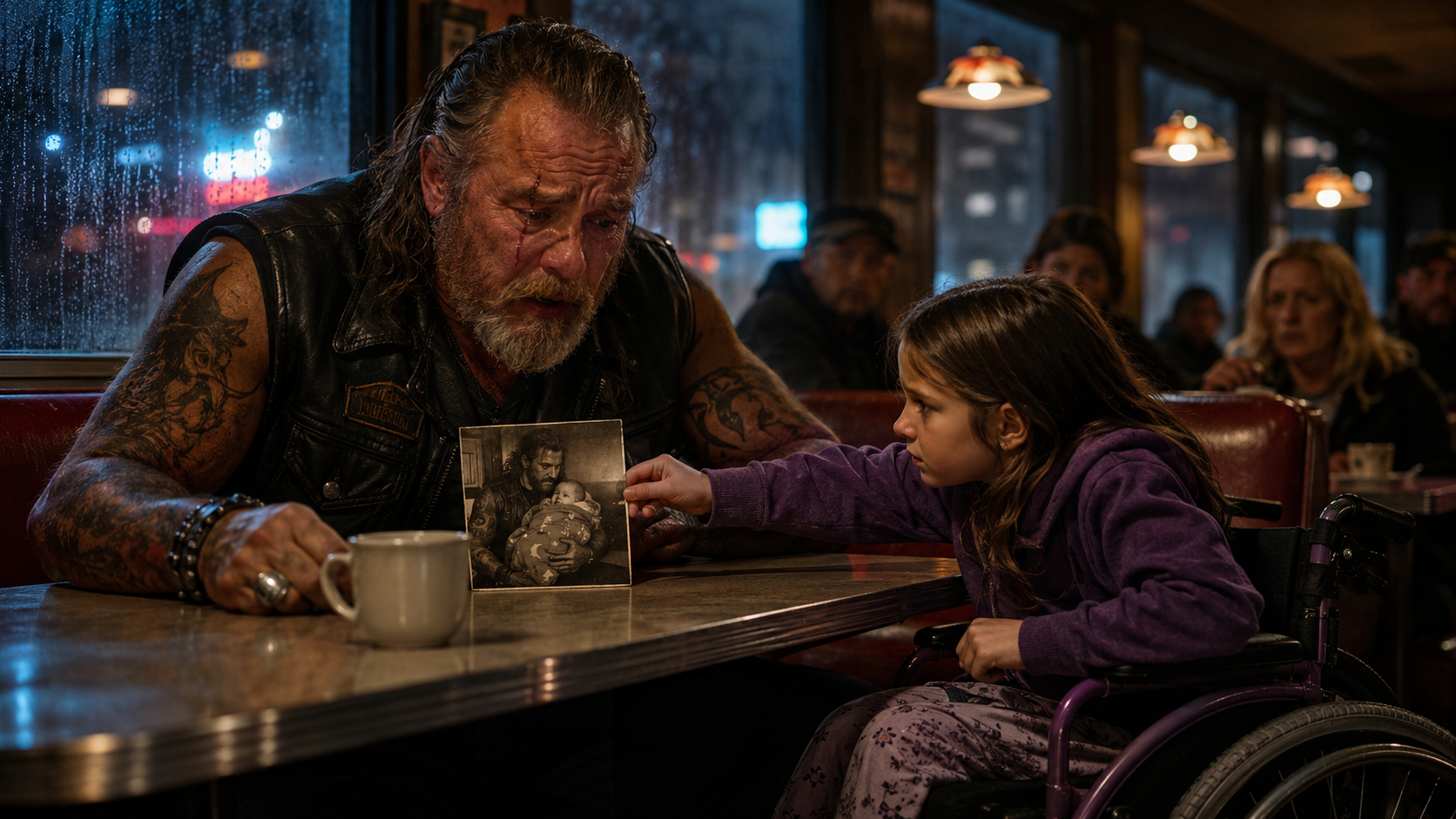
That was when you knew.
Real love cries in the wrong places.
Fake love cries exactly on cue.
Then Ryder stood.
He did not tell a beautiful story.
He told an ugly one.
He was twenty-two when his daughter was born. His wife Maeve had nearly died in delivery. Beatrice Wynn, who worked in hospital records and had once known Ryder’s family, helped with paperwork.
Three days later, the baby was gone.
The hospital said complications.
There was a sealed casket.
There was a funeral.
There were signatures Ryder barely remembered giving because grief had made him blind.
But Maeve never believed the baby was inside that box.
So Ryder searched.
For months.
Then years.
He asked questions.
He knocked on doors.
He made enemies.
No one listened.
Because Ryder wore leather.
Because Beatrice wore pearls.
Because some people can steal a child more easily when they look respectable.
Deputy Hank testified next.
He admitted the investigation had been rushed.
He admitted Ryder and Maeve had been dismissed because of the motorcycle club.
He admitted Beatrice had access to records she should never have been able to change.
Beatrice stopped crying.
Your mother’s letter was given to the judge.
Then the photograph.
Then hospital records.
Then the emergency DNA test Ryder had taken that morning after Judge Calder made one phone call and the entire county suddenly moved faster than it had in twenty-eight years.
The result was preliminary.
But clear enough.
Biological relation.
Grandfather.
The courtroom blurred.
Not because you were sad.
Because your mother had been right.
The man with the scar was real.
The lie was real.
And now the truth had paperwork.
Judge Calder looked at you.
“Lila,” he said gently, “do you understand what we’re discussing?”
“Some.”
“Do you want to say anything?”
Beatrice turned toward you with wet eyes.
“Sweetheart, remember what your mother would have wanted.”
You looked at her.
“My mom wrote what she wanted.”
The courtroom went silent.
Ryder lowered his head. His hand shook beside his leg.
You took a breath.
“She told me if I found him, I should show him the photograph. She said he wasn’t bad the way people said. She said someone stole her from him. She said if he looked at me like I was a burden, I should leave.”
You looked at Ryder.
His face looked like breathing hurt.
“He didn’t.”
Beatrice whispered your name.
You kept going.
“I don’t want to live with someone who lied to my mom.”
There it was.
The whole truth in one child’s sentence.
Beatrice sat back like you had slapped her.
Judge Calder granted temporary guardianship to Mrs. Porter for seven days, with Ryder allowed daily supervised visits while the final DNA report and background checks were completed.
Ryder’s jaw tightened.
You knew he wanted to argue.
But he looked at you first.
You shook your head a tiny bit.
Not because you did not want him.
Because you were tired.
Because seven days felt survivable.
Because your mother had taught you that winning too fast sometimes made dangerous people run.
Ryder understood.
He nodded.
He accepted.
Outside the courthouse, the rain had stopped.
The bikers were still there.
When Ryder came out beside you, they stood straighter.
A woman with silver braids knelt in front of your chair.
“I’m Cora,” she said. “Your grandmother Maeve was my best friend.”
Your chest tightened.
“You knew her?”
Cora smiled sadly.
“I loved her.”
You looked at Ryder.
He nodded.
“Cora was there when Elise was born.”
Cora reached into her coat pocket and pulled out something tiny.
A knitted yellow hat.
Faded.
Soft.
“This was hers,” Cora said. “Maeve made it to match the blanket.”
You took it carefully.
It fit in your palm.
You had never owned anything from Maeve before.
Now you had a hat, a blanket, a grandfather, and a hallway full of people looking at you like you were not a problem to solve.
You were someone returned.
The next seven days were strange.
Ryder visited every afternoon at Mrs. Porter’s small yellow house.
He brought things.
Not expensive things.
Careful things.
A ramp for the porch.
A stuffed fox wearing a tiny leather vest.
A photo album of Maeve.
A music box that had belonged to your mother for three days before she was taken.
When the music box played, Ryder cried again.
This time he did not hide it.
One evening, you sat with him on Mrs. Porter’s porch while the sky turned orange.
“Did you love my mom?” you asked.
He looked at you like the answer was too large for words.
“I loved her before I knew her name.”
“But you didn’t know her.”
“No,” he said. “And that will hurt until the day I die.”
You thought about that.
Then you put your hand on his.
“My mom liked pancakes.”
He looked at you.