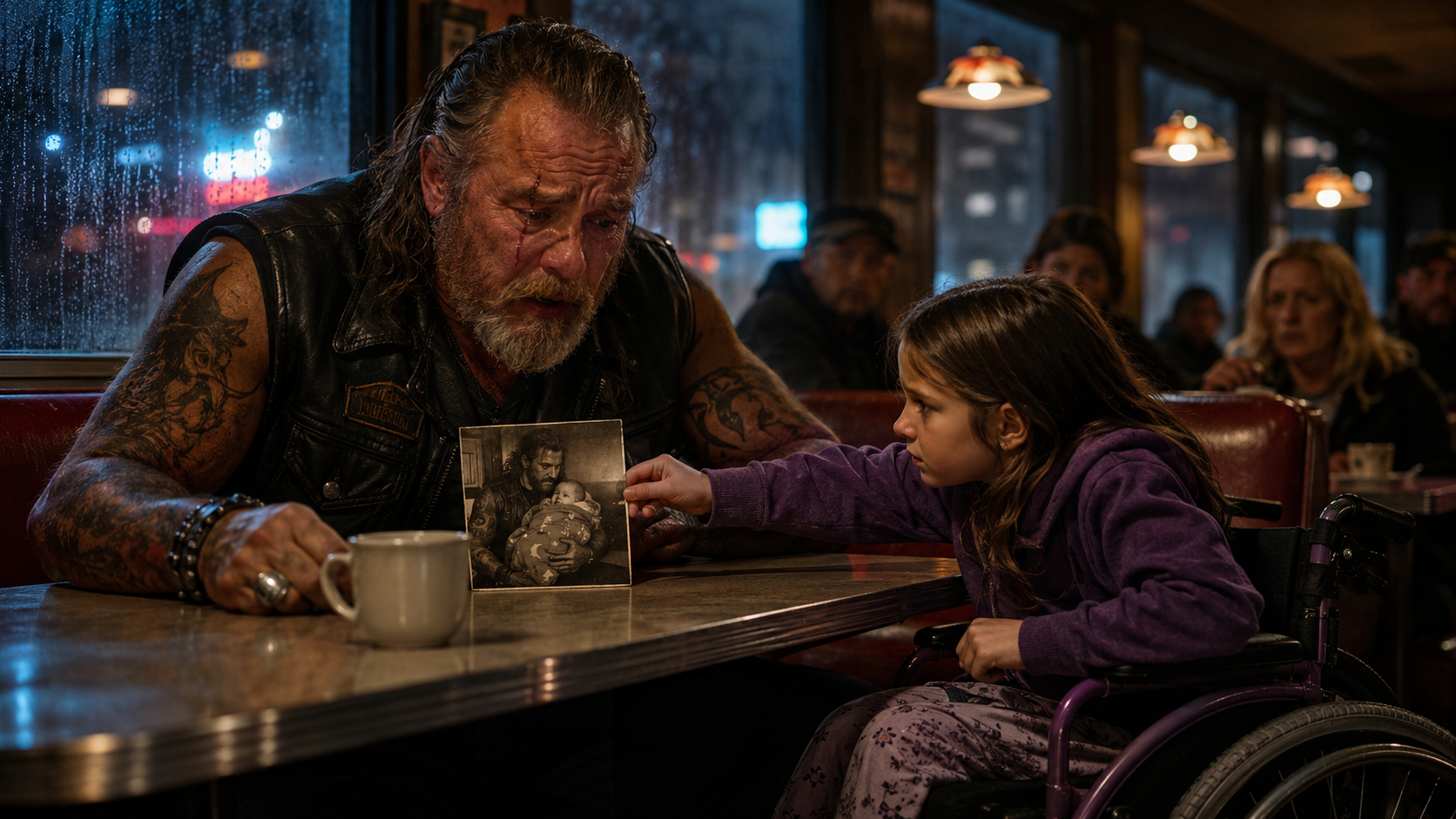
In the center stood Ryder.
He held two paper cups and a white takeout bag.
When he saw you at the window, he lifted the bag a little.
You looked at Mrs. Porter.
“What is it?”
She smiled, tired and amazed.
“I think your grandfather brought breakfast.”
Your grandfather.
The words felt too big.
Too new.
Too warm.
A minute later, Ryder knocked.
Mrs. Porter checked through the peephole before opening the door.
He stood there soaked from the rain, holding a box of pancakes.
“I didn’t know what you liked,” he said.
“I like pancakes.”
His shoulders lowered, as if you had just forgiven him for something.
“Good.”
He set the food on the little motel table, then stepped back to give you room.
That was the first thing you noticed about him in daylight.
He was large, but he made himself smaller around you.
He looked dangerous, but he never pointed that danger in your direction.
He looked at your wheelchair once, then quickly back at your face, like he did not want you to think the chair was the first thing he saw.
“My legs don’t work right,” you said.
Mrs. Porter murmured your name softly, but you kept your eyes on Ryder.
You were tired of adults whispering about your body like your chair was a sad ending.
Ryder nodded.
“Mine don’t work great when it rains.”
You blinked.
Then you laughed.
It surprised you.
It surprised him too.
A small smile appeared under his beard.
It changed his whole face.
The scar was still there.
The tattoos.
The heavy vest.
The tired eyes.
But suddenly you could see the young man from the photograph. The one holding your mother like he had been handed the sun.
After breakfast, Judge Calder and Deputy Hank arrived.
Words filled the motel room.
Emergency placement.
Temporary guardianship.
Background checks.
Medical documentation.
DNA testing.
Custody hearing.
Adults said them as if you were not listening.
But children who have lived around sickrooms, social workers, and whispered phone calls always listen.
You knew which words meant danger.
Custody.
Placement.
Petition.
Evaluation.
Next of kin.
Ryder noticed your face.
“She can hear you,” he said.
The room went quiet.
Judge Calder looked embarrassed.
“You’re right. I’m sorry.”
Ryder turned to you.
“Little moon, people are going to talk today about where you stay while the court sorts this out. You don’t have to answer anything you don’t want to. But if they ask what you want, tell the truth.”
You gripped your blanket.
“What if they don’t like my truth?”
His eyes darkened.
“Then they’ll have to survive it.”
That afternoon, you went to the courthouse.
You had never been in one before.
It smelled like paper, floor polish, old coffee, and grown-up fear.
The ramp outside was steep. Ryder stood behind your chair but did not touch it.
“Can I help?”
You nodded.
His hands closed carefully around the handles.
Outside the courtroom, the bikers waited in the hall.
They were not loud.
They were not threatening.
They were simply there.
People stared.
A woman carrying files nearly walked into a wall.
You whispered, “Are they your friends?”
Ryder looked at the line of leather, gray hair, tattoos, and rain-soaked boots.
“Family.”
You thought about that.
Then you asked, “Are they my family too?”
He stopped pushing the chair.
For a moment, something complicated passed over his face.
Then he bent so he could look you in the eye.
“If you want them to be.”
No one had ever told you family could wait for your permission.
You carried that sentence into the courtroom like armor.
Beatrice Wynn arrived ten minutes late.
You knew her before anyone said her name.
She wore cream from collar to shoes, the way some people wear innocence like a costume. Her silver hair was shaped into a perfect helmet. Her mouth had already arranged itself into sadness.
The last time you had seen her, she had stood beside your mother’s hospital bed and said, “A child needs stability, Elise. Not motorcycle ghosts and old fantasies.”
Your mother had squeezed your hand so hard it hurt.
Now Beatrice opened her arms.
“Lila, darling.”
You did not roll toward her.
You did not lift your hands.
Her face flickered.
Then she saw Ryder.
For the first time in your life, fear cracked through Beatrice Wynn’s polished face.
“Ryder,” she said.
Ryder said nothing.
That seemed to scare her more.
In court, Beatrice told a beautiful story.
She said she had rescued your mother from unfortunate circumstances.
She said Elise had always been fragile.
She said grief and illness had confused her at the end.
She said motorcycle clubs were no place for children.
She said Ryder was violent, unstable, and unfit.
She cried when she talked about protecting you.
But she did not cry when your mother’s letter was read.