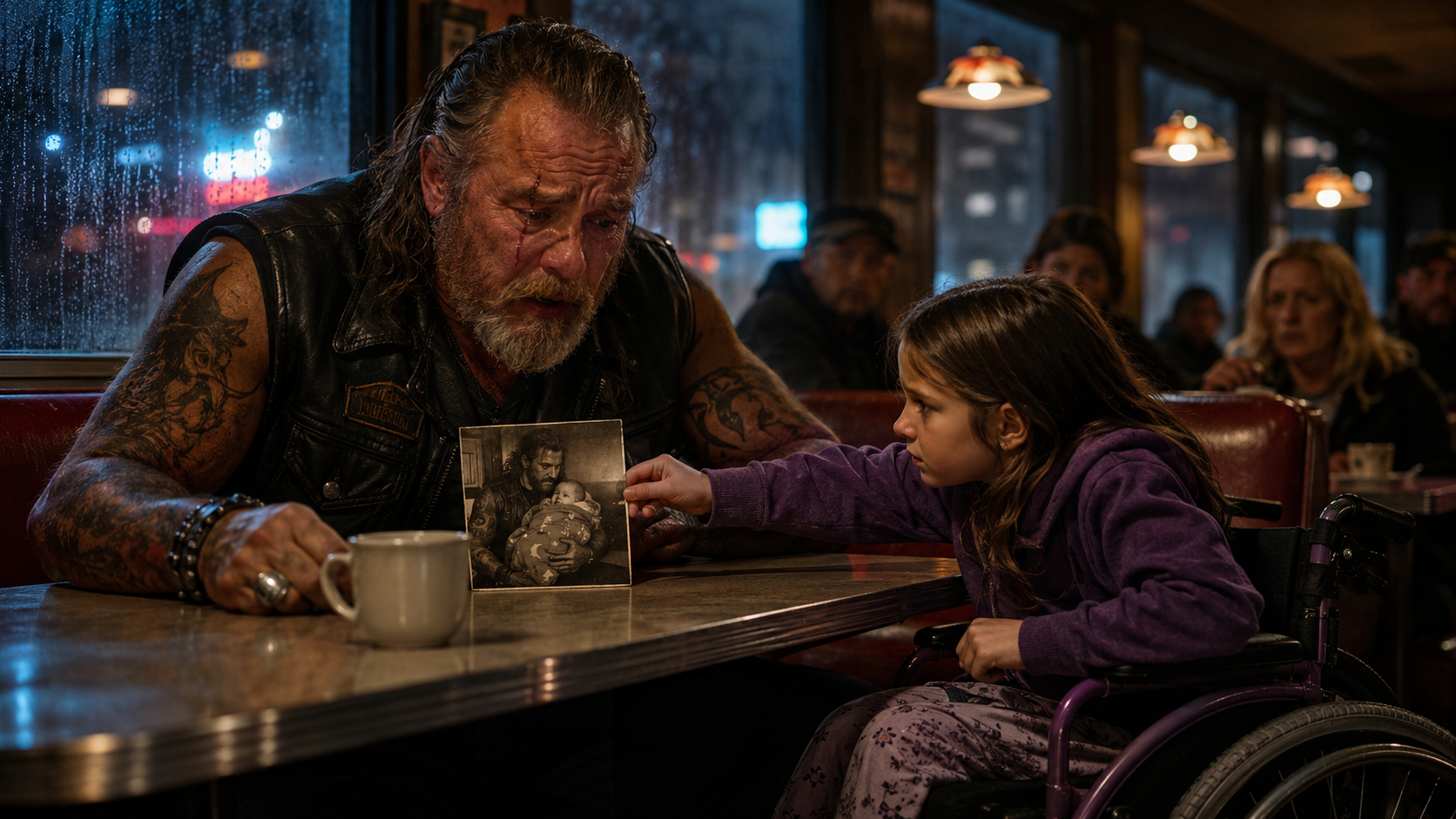
Ryder read the document once.
Then twice.
Then a third time, like the words might change if he blinked.
Finally, he looked at you.
“Elise wanted me to take care of you?”
You nodded.
“She said if you were mean, I should leave with Mrs. Porter.”
A sound escaped him.
Not quite a laugh.
Not quite a sob.
“And if I wasn’t mean?”
You pulled the blanket from your lap and held up one corner.
“She said to show you the moons.”
Ryder stared at the blanket.
His face went pale.
“My wife made that.”
“Your wife?”
“Maeve,” he said, and his voice softened around her name. “Your grandmother. Your real grandmother.”
You looked at the faded fabric in your hands.
Your real grandmother.
That made the room tilt in a strange way.
You had grown up with your mother, her photographs, her cough medicine, her careful smiles, and her secrets. You had known Beatrice as a cold woman who visited twice a year and smelled like perfume and church candles.
But you had never had a grandfather.
Never had a grandmother.
Never had a family that felt like it reached backward farther than your mother’s hospital bed.
Ryder reached toward the blanket, then stopped.
“May I?”
You nodded.
He touched the corner with two fingers.
So gently.
Like it might vanish if he pressed too hard.
“Maeve sewed this the week before Elise was born,” he whispered. “She said every child needed something to recognize the sky.”
You blinked fast.
Your mother had said that too.
Ryder looked at you.
“No child should have had to carry this alone.”
That was the moment your fear loosened.
Not all the way.
Fear does not leave just because someone says the right thing.
But enough.
Enough to know your mother had not sent you to a stranger.
She had sent you to someone who had been waiting without knowing he was waiting.
Deputy Hank stepped closer.
“Iron, listen to me. You can’t just take her. If Beatrice has already filed, this has to go through court.”
Ryder turned his head.
The diner got cold again.
“She committed a crime.”
“I know.”
“You helped close the file.”
Hank flinched.
“I was twenty-three and stupid and I believed what the hospital gave us.”
“My wife begged you to look deeper.”
“I know.”
Ryder stood.
Every person in the diner tensed.
He folded your mother’s letter and the documents carefully, then placed them inside his vest pocket like they were sacred.
“Call Judge Calder,” he said.
Hank exhaled.
“It’s almost midnight.”
“Then wake him.”
“Iron—”
“My daughter died thinking I abandoned her. My granddaughter is in a motel room while the woman who stole my child is asking a court to hand her another one.” Ryder’s voice dropped lower. “Wake him.”
Hank nodded once and took out his phone.
That was how everything began.
Not with a hug.
Not with a miracle.
Not with music or forgiveness.
It began with a dying woman’s letter, a diner full of witnesses, and the most feared biker in town staring at an eight-year-old girl like she was the last living piece of his heart.
Ryder did not take you home that night.
He wanted to.
You could see it in the way his eyes kept returning to you, as if he was afraid you would disappear the moment he looked away.
But Mrs. Porter said rules mattered.
Deputy Hank agreed.
And to your surprise, Ryder listened.
He followed the police cruiser back to the motel on his motorcycle. From the back seat, you watched his headlight in the rain. It followed close, steady and bright, like a storm had decided to guard you instead of hurt you.
At the motel, Ryder stayed outside while Mrs. Porter helped you change into pajamas.
You peeked through the curtain.
He was standing under the broken awning, speaking with Hank and a tired man in a suit who had arrived looking angry until he saw the documents.
Judge Calder.
You knew because adults kept saying his name like it could open locked doors.
Mrs. Porter noticed you watching.
“Come away from the window, honey.”
“Is he leaving?”
“No.”
“Will he leave later?”
Her face softened.
“I don’t think so.”
You did not say anything after that.
But for the first time since your mother died, you slept through the night.
Because someone dangerous was standing outside your door on purpose.
Morning arrived gray and wet.
You woke to engines.
Not one.
Many.
Your eyes opened.
Mrs. Porter hurried to the window and pulled the curtain back just enough to look outside.
“Oh my,” she whispered.
“What?”
She hesitated.
Then she opened the curtain.
The motel parking lot was full of motorcycles.
Dozens of them.
Black bikes shining with rain.
Men with gray beards and folded arms.
Women in boots, denim, leather, and silver jewelry.
Some held coffee.
Some stood under umbrellas.
Some simply watched the road like they expected trouble to come around the corner.