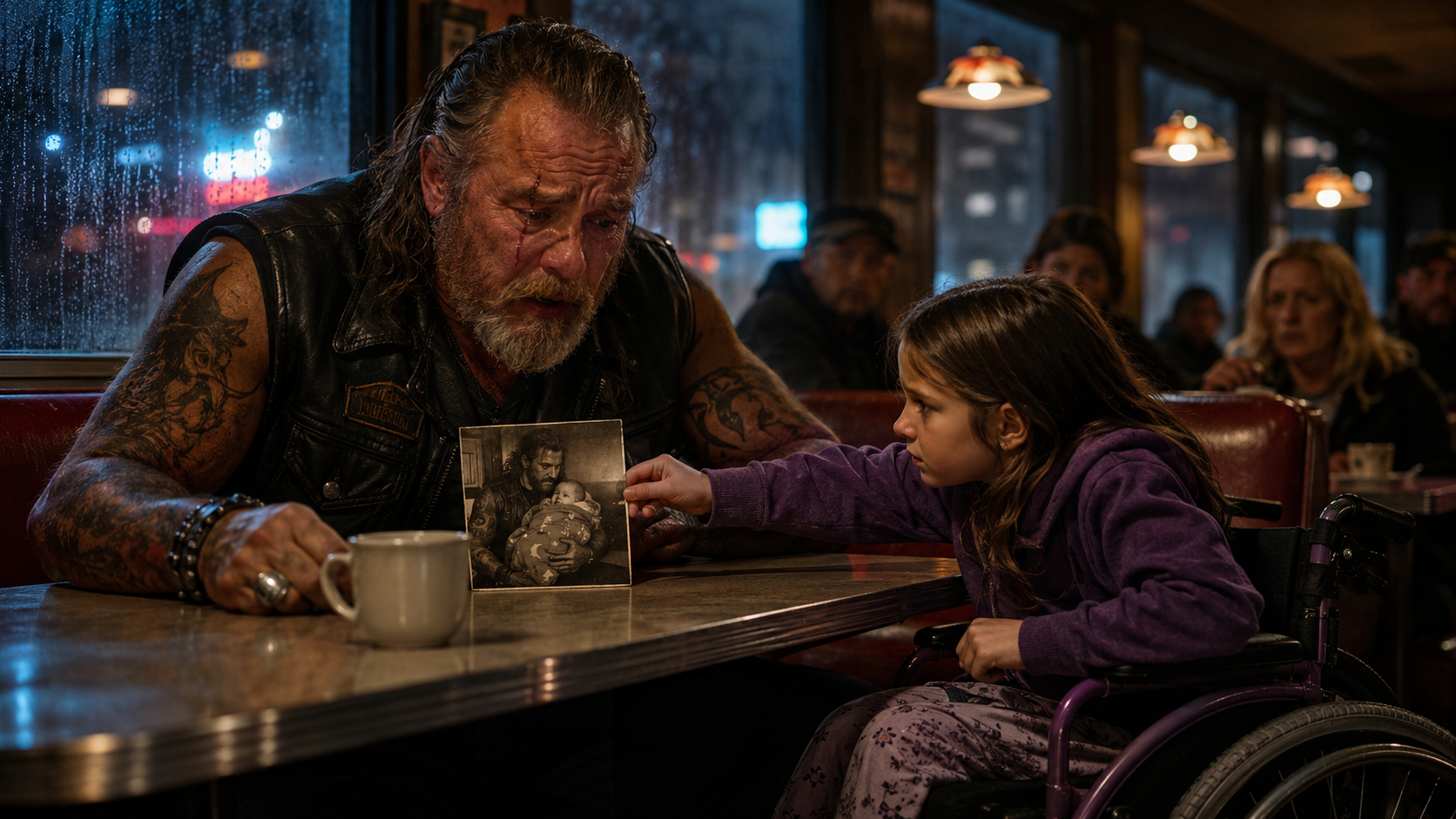
That word did what fists, prison, knives, rumors, and twenty-eight years of rage had never done.
It made Ryder Hale cry.
Not loudly.
Not dramatically.
One tear slipped from his eye and followed the scar down the side of his face.
He wiped it away fast, like he was ashamed.
You were not ashamed of it.
You thought it made him look less like a monster and more like somebody who had lost too much.
Maybe somebody who had lost you before he had even known you existed.
Ryder lowered the letter and stared at the photograph again.
“Elise,” he whispered. “My baby.”
You looked down at your lap.
Your blanket was there, folded under your hands. It was faded from years of washing, but you could still see the yellow moons and white stars.
Your mother had wrapped you in that blanket when she told you the truth.
“She said you didn’t leave her,” you said. “She said somebody made you think she was dead.”
Ryder went very still.
The tearfulness vanished from his face. What replaced it was not anger exactly.
It was older than anger.
Colder.
“Who?” he asked.
Your mouth went dry.
You had practiced the answer all the way here. In Mrs. Porter’s old station wagon. In the motel room. In the diner bathroom while Mrs. Porter wiped your face and told you that you were brave even though your stomach hurt from fear.
“Beatrice Wynn,” you said.
At the name, the whole diner seemed to shrink.
Deputy Hank’s face turned gray.
Ryder’s eyes moved slowly toward him.
“Hank,” Ryder said.
The deputy swallowed.
“Iron.”
“You remember.”
Hank took off his hat.
That scared you more than Ryder’s scar.
Adults only removed hats when something had become too serious for pretending.
“Yes,” Hank said quietly. “I remember.”
“Tell her.”
The deputy looked at you, and suddenly he did not look like an officer. He looked like an old man carrying a secret that had grown too heavy.
“Your mother was born in County Mercy Hospital twenty-eight years ago,” he said. “Ryder and his wife Maeve were told she died three days later. There was paperwork. There was a sealed casket. There was a funeral.”
You stared at him.
“A funeral?”
Hank nodded.
“For an empty casket,” Ryder said.
His voice did not break this time.
It was worse because it did not.
You looked at the photograph. The baby in it had been your mother. Alive. Wrapped in stars. Held by a father who had believed he buried her.
No eight-year-old should have to understand that kind of cruelty.
So you said the only thing you could.
“Mom didn’t know either.”
Ryder closed his eyes.
“I know, little moon.”
The nickname made your chest ache.
Your mother had called you that when the nights were bad.
Little moon.
You whispered, “She called me that too.”
Ryder covered his mouth with one hand.
For a moment, there was no diner.
No bikers.
No deputy.
No whispering customers.
Only you, an old photograph, a dying woman’s letter, and a man who had lost his daughter twice.
First to a lie.
Then to death.
Mrs. Porter cleared her throat softly.
“Lila needs rest,” she said.
Ryder looked at her.
“Who are you?”
She stood a little straighter.
“Naomi Porter. I lived next door to Elise for six years. She asked me to bring Lila here when the time came.”
His jaw tightened.
“Why didn’t she call me herself?”
Mrs. Porter’s eyes filled.
“Because she was afraid Beatrice would find out. Elise said Beatrice had spent years making sure you never came near her. She thought if Beatrice knew she had found you, she might take Lila before Elise could stop her.”
Ryder leaned back slowly.
“Beatrice is still alive?”
You nodded.
“She came to the hospital after Mom got worse. She told the social worker she was my only family.”
Ryder’s hand curled into a fist.
The silverware beside his plate jumped when his knuckles touched the table.
Not hard.
Not enough to frighten you.
Just enough to remind the room that the man in front of you had not survived this long by being harmless.
“She stole my daughter,” he said.
Hank said nothing.
“She let my wife die believing our baby was in the ground.”
Still, Hank said nothing.
“And now she wants my granddaughter.”
This time Hank looked down.
You reached into your pouch again.
“There’s more.”
Ryder’s eyes came back to you instantly.
You pulled out another paper.
This one was new.
Official.
Folded around your hospital bracelet from the night your mother died.
Ryder took it from you.
He read the first page.
Your birth certificate.
Mother: Elise Marlow.
Father: Unknown.
Then he saw the second page.
A notarized emergency guardianship request.
Your mother had signed it twelve days before she died. In it, she wrote that if anything happened to her, Ryder Hale was to be located and given the chance to claim biological kinship before custody was granted to Beatrice Wynn.