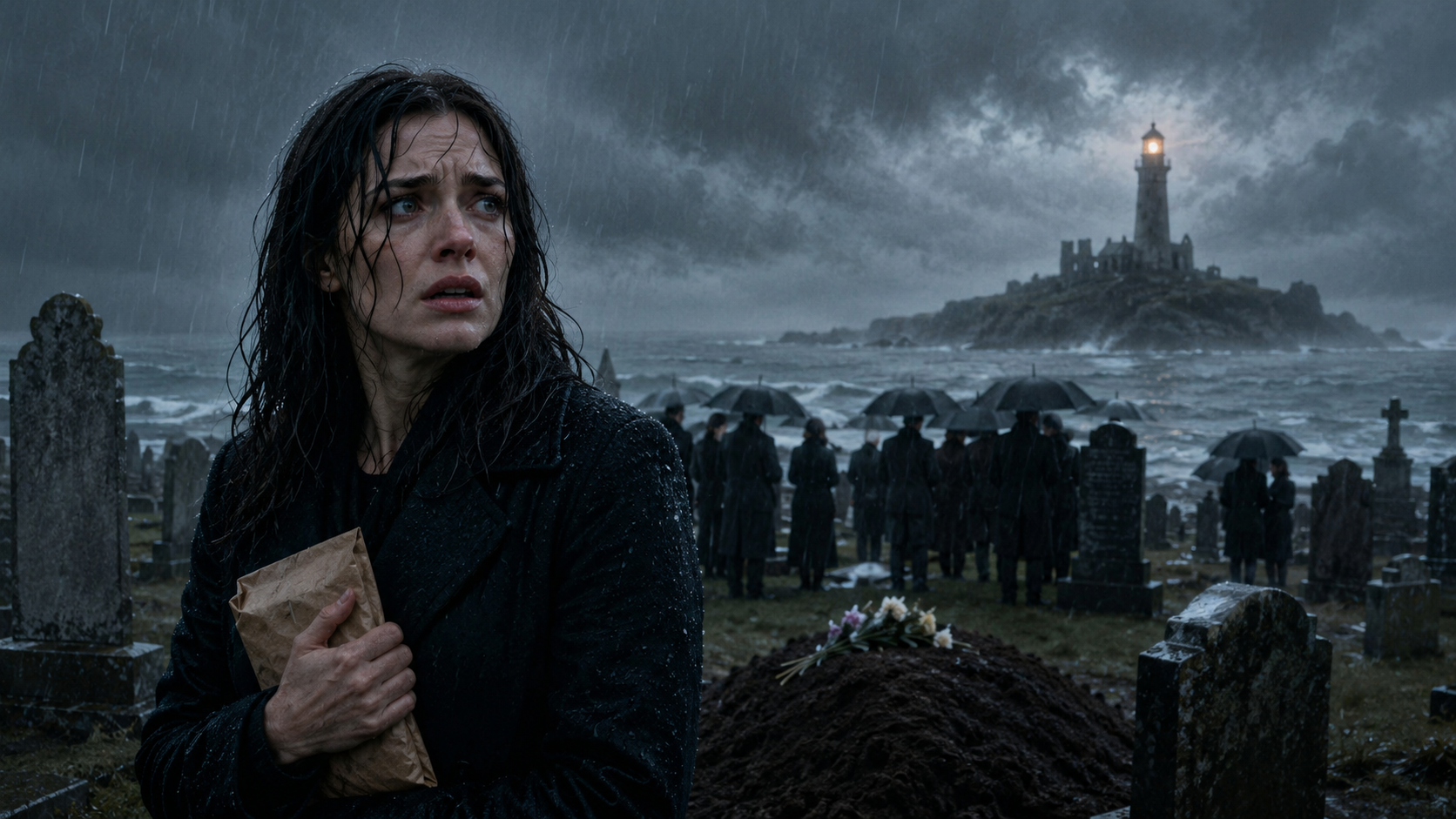
Rain had been falling over Blackwater Bay since dawn.
Not hard enough to chase people away, but steadily enough to turn the cemetery paths into dark ribbons of mud and make every black umbrella look like part of the same enormous shadow.
I stood beside my father’s grave with one hand wrapped around my mother’s arm.
Her name was Evelyn Vale.
She had been married to my father for thirty-eight years.
And she had not cried once.
That should have bothered me.
At the time, it didn’t.
People grieve differently.
That was what I kept telling myself.
My husband, Daniel, stood behind me with his hand resting lightly against my shoulder. Our daughter had stayed with his sister in Boston. I had decided that seven years old was too young to watch a grandfather disappear into the ground.
Now I wasn’t sure anyone should have watched it.
The minister finished his prayer.
Someone whispered amen.
The ropes beneath the coffin groaned.
And slowly, my father descended into the earth.
Arthur Vale.
Sixty-seven years old.
Former harbor engineer.
Collector of terrible jazz records.
The man who taught me to drive, taught me to swim, and taught me never to believe someone just because they were speaking confidently.
He had died four nights earlier in his workshop.
A heart attack, according to the doctor.
Sudden.
Massive.
Final.
I had seen the body at the funeral home.
I had kissed his cold forehead.
I had watched them close the coffin.
There was nothing left to question.
At least, that was what I believed when the first bell rang.
DONG.
Everyone looked toward the old chapel.
The funeral had ended.
No one should have been ringing the bell.
DONG.
A second time.
My mother suddenly tightened her grip on my arm.
I looked at her.
“Mom?”
Her face had changed.
Not sadness.
Fear.
DONG.
The third bell echoed across the cemetery.
Then silence.
The funeral director approached us.
He was a tall man named Warren Pike, with silver hair and the solemn expression of someone who had spent forty years learning exactly how much emotion to show around grieving families.
“Mrs. Vale,” he said.
My mother stared at him.
Warren looked uncomfortable.
Then he turned to me.
“Ms. Vale, could I speak with you privately?”
Daniel frowned.
“Is something wrong?”
Warren hesitated.
“I’m afraid I was given very specific instructions.”
My mother stepped forward.
“No.”
Warren looked at her.
“Mrs. Vale—”
“No.”
Her voice was sharper now.
Several relatives turned toward us.
I stared at her.
“Mom, what is happening?”
She released my arm.
For the first time all day, she looked directly at me.
“Claire, go home.”
“What?”
“Go home with Daniel.”
“Why?”
“Because your father is dead.”
The words sounded strange.
Not sad.
Not broken.
Defensive.
I glanced at Warren.
“What did my father tell you?”
My mother’s face went pale.
Warren slowly reached inside his coat.
He removed a small package wrapped in brown paper.
My name was written across it.
CLAIRE.
I knew the handwriting immediately.
My father’s.
A cold sensation moved through my chest.
“When did he give you this?”
Warren looked toward my mother before answering.
“Nine years ago.”
I almost laughed.
Not because it was funny.
Because my brain had rejected the sentence completely.
“Nine years?”
“He paid for his funeral arrangements in advance. He also left instructions concerning this package.”
“What instructions?”
Warren swallowed.
“If three bells rang after his burial, I was to give it to you.”
I stared toward the chapel.
“Who rang them?”
Warren’s expression became even more uncomfortable.
“No one.”
Daniel stepped closer.
“What do you mean, no one?”
“The bell hasn’t been connected to the rope in twelve years.”
Nobody spoke.
Rain tapped against the umbrellas.
My mother suddenly grabbed the package.
I pulled it away.
“Mom.”
“Give me that.”
“Why?”
“Because Arthur had become paranoid.”
“Paranoid about what?”
“Claire.”
“About what?”
She looked at me for several seconds.
Then at Daniel.
Then toward the grave.
Finally she whispered, “Some things should remain buried.”
That was when I knew.
My father had not simply died.
Something had happened before he died.
And my mother knew about it.
I stepped away from her.
“Daniel, take Mom home.”
“Claire—”
“Please.”
My mother shook her head.
“Don’t open it.”
That frightened me more than anything Warren had said.
I walked to our car alone.
Locked the doors.
Then tore through the brown paper.
Inside were three things.
A brass compass.
A photograph.
And an old digital voice recorder.
The photograph showed a lighthouse standing on a rocky island.
I recognized it immediately.
Greyhaven Light.
It had been abandoned since I was a teenager.
My father used to take me there in his small fishing boat.
On the back of the photograph, he had written four words.
WHEN THE LIGHT RETURNS, LISTEN.
I picked up the recorder.
There was only one audio file.
My hand trembled as I pressed play.
Static filled the car.
Then my father’s voice.
“Claire.”
I stopped breathing.
The recording was clear.
Too clear.
For a fraction of a second, grief vanished and I was eight years old again, hearing him call me downstairs for breakfast.
“If you’re hearing this,” he continued, “the funeral happened exactly as I expected.”
I gripped the recorder.
“You are going to be told that I became confused near the end. You may be told I was frightened of imaginary enemies. You may even be told that whatever you discover next was caused by illness.”
A pause.
“None of that is true.”
My pulse quickened.
“Do not confront your mother.”
I looked through the rain-covered windshield.
Mom was still standing near the grave.
“She knows part of the truth. Not all of it.”
Another pause.
Then his voice became quieter.
“Go to Greyhaven before midnight. Take the compass. Come alone.”
The recording ended.
No goodbye.
No explanation.
Just silence.
I replayed it twice.
Daniel called me.
I ignored him.
My mother called.
I ignored her too.
At 6:20 that evening, I drove toward the harbor.
Greyhaven Island sat three miles from shore.
The ferry had stopped running there years ago.
But my father still owned a sixteen-foot fishing boat.
I found it exactly where it had always been, tied behind the old marina.
The fuel tank was full.
A waterproof jacket lay across the driver’s seat.
Someone had prepared the boat.
I nearly turned around.
Instead, I started the engine.
The sun disappeared behind the clouds as I crossed the bay.
Waves struck the hull.
The abandoned lighthouse grew larger.
Grey stone.
Broken windows.
Rust around the old metal railing.
Nothing had lived there for years.
Or so I thought.
When I reached the dock, I saw a light flash from the tower.
Once.
Then darkness.
I froze.
The lighthouse had no electricity.
A second flash appeared.
Then a third.
My father’s words returned.
When the light returns, listen.
I climbed onto the dock.
“Hello?”
Only the ocean answered.
I entered the lighthouse.
The smell of wet stone and rust filled the narrow corridor.
Then I heard footsteps above me.
“Who’s there?”
The footsteps stopped.
A woman spoke from the darkness.
“You’re late.”
I almost ran.
Instead, I raised my phone flashlight.
A woman in her early sixties stood halfway up the spiral staircase.
Short white hair.
Dark coat.
A scar running from her left eyebrow to her temple.
“Who are you?”
“My name is Ruth Calder.”
“I don’t know you.”
“No. But your father did.”
My throat tightened.
“Where is he?”
She stared at me.
That tiny hesitation was enough.
“You know something.”
“I know many things about Arthur Vale.”
“Then tell me why I’m here.”
Ruth descended the stairs.
“He discovered something fifteen years ago while inspecting the harbor expansion.”
“What?”
“A shipping channel that wasn’t supposed to exist.”
I frowned.
She continued.
“Your father found records showing that certain cargo vessels were entering Blackwater Bay without appearing on official harbor logs.”
“Smuggling?”
“At first, that’s what he thought.”
“What was really happening?”
Ruth looked toward the entrance.
“People were disappearing.”
The room suddenly seemed colder.
“Workers. Witnesses. Accountants. Anyone who discovered how much money was moving through the port.”
“You’re saying my father uncovered a criminal operation?”
“I’m saying your father spent fifteen years collecting enough evidence to destroy it.”
“Why didn’t he go to the police?”
Ruth gave me a bitter smile.
“He did.”
I understood the answer before she said it.
“They were involved.”
“Some of them.”
“My mother?”
“No.”
Relief rushed through me.
Then Ruth added, “But your uncle was.”
My father’s younger brother.
Thomas Vale.
The man who had delivered the eulogy that morning.
The man who had stood beside me while my father’s coffin entered the ground.
“No.”
Ruth said nothing.
“He owns an accounting firm.”
“He owns six shell companies connected to the port.”
I stared at her.
“Where is my father?”
“Claire—”
“Tell me.”
Ruth reached inside her coat.
Instead of a weapon, she removed a small tablet.
She placed it on a wooden table.
A security-camera recording appeared.
The date was four days earlier.
My father’s workshop.
I watched him enter.
Alive.
He checked the windows.
Locked the door.
Then another man appeared.
Thomas.
My uncle.
There was no sound.
They argued.
My father pointed toward something off camera.
Thomas grabbed him.
They struggled.
Then the image froze.
“What happened?”
“Your father had already disabled the main camera.”
“Why?”
“Because he knew Thomas was coming.”
Ruth changed the video.
A second angle appeared.
Hidden behind a shelf.
My father stepped backward.
Then deliberately fell.
Thomas rushed toward him.
My father remained motionless.
Thomas checked his pulse.
Then made a phone call.
“He faked the heart attack?”
“Part of it.”
“What do you mean, part of it?”
Ruth looked at me carefully.
“Your father had been planning his disappearance for almost a decade.”
My legs felt weak.
“You said disappearance.”
“Yes.”
“Not death.”
Ruth said nothing.
I stepped closer.
“Where is my father?”
Suddenly a radio crackled somewhere above us.
A man’s voice filled the tower.
“Ruth?”
Every muscle in my body locked.
I knew that voice.
Ruth slowly looked toward the staircase.
“She’s here,” she said.
Static.
Then—
“Claire?”
I couldn’t speak.
The radio was sitting on the landing above us.
I ran.
Nearly slipped on the iron stairs.
Grabbed the radio.
“Dad?”
Silence.
“Dad!”
“I’m here.”
My knees nearly collapsed.
I pressed myself against the wall.
“You were buried this morning.”
“I know.”
“I saw you.”
“No. You saw what Thomas needed you to believe.”
Tears finally came.
Angry tears.
Confused tears.
“You let me think you were dead.”
“I’m sorry.”
“You let Mom think you were dead.”
Silence.
“Dad?”
“Your mother knows I’m alive.”
I closed my eyes.
Everything rearranged itself at once.
Her dry eyes.
Her fear when Warren approached.
Her insistence that I go home.
“You both lied to me.”
“We were trying to keep you outside this.”
“You gave me a recording telling me to come here!”
“Because something changed.”
Ruth suddenly moved toward the window.
Headlights had appeared on the water.
A boat.
Coming fast.
“Dad,” I whispered, “where are you?”
His voice crackled through the radio.
“Claire, listen carefully. Thomas knows the funeral was staged.”
Ruth’s face tightened.
The boat was getting closer.
“He knows about Greyhaven,” my father continued. “And if he’s coming for you, it means he believes I gave you the ledger.”
“What ledger?”
Ruth turned toward me.
“Oh God.”
“I don’t have any ledger.”
My father went silent.
Then he asked one strange question.
“Did you bring the compass?”
I looked down.
The brass compass was still inside my coat pocket.
“Yes.”
“Open the back.”
I turned it over.
There was a tiny groove near the edge.
My fingernail caught it.
The metal plate clicked open.
Inside was a memory card no larger than my thumbnail.
Ruth stared at it.
“That’s everything,” she whispered.
The approaching boat reached the dock.
A door slammed below us.
Footsteps entered the lighthouse.
Slow.
Heavy.
Then my uncle’s voice echoed upward.
“Claire?”
I stopped breathing.
“Claire, I know you’re here.”
Ruth switched off the flashlight.
Darkness swallowed us.
The radio crackled again.
My father whispered one final instruction.
“Whatever happens, don’t let Thomas leave the island.”
Footsteps began climbing the staircase.
I closed my fist around the compass.
For the first time since the funeral, I understood something clearly.
My father had not staged his death because he was running away.
He had staged it because he needed his enemies to believe the only man who could expose them was already underground.
And somehow, without knowing it, I had become the person carrying the evidence.
Thomas reached the next landing.
“Claire?”
I could hear him breathing now.
Ruth leaned close to my ear.
“When I turn on the light,” she whispered, “get behind the wall.”
“What are you going to do?”
She removed something from her pocket.
Not a gun.
A flare.
She smiled.
“Finish your father’s funeral.”
Thomas stepped around the corner.
The flare ignited.
Red light exploded through the tower.
He shouted.
I ran.
Outside, another sound rose above the wind.
Engines.
More than one.
Boats surrounded the island.
Blue emergency lights flashed across the water.
Thomas looked through the broken window.
His face went white.
Ruth laughed.
“You really thought Arthur Vale spent fifteen years planning this and forgot to invite witnesses?”
Coast Guard officers flooded the dock.
Then federal agents.
Thomas turned toward me.
For one second, I saw the man I had known my entire life.
My uncle.
Christmas dinners.
Birthday cards.
Fishing trips.
Then I saw something else.
Fear.
He looked at my closed fist.
“The compass,” he said.
I stepped backward.
He moved toward me.
Ruth blocked him.
By the time the officers reached the top of the tower, Thomas Vale was on his knees.
My hand was still wrapped around the memory card.
At 2:13 the next morning, I finally spoke to my father again.
He couldn’t tell me where he was.
Not yet.
There would be arrests.
Investigations.
Trials.
My father’s death would remain official for a little longer.
For his protection.
For ours.
Before ending the call, he became quiet.
“Claire?”
“Yes?”
“I’m sorry you had to stand beside that grave.”
I looked out across Blackwater Bay.
The storm had passed.
For the first time all day, the water was completely still.
“You owe me one explanation.”
“I owe you several hundred.”
“No.”
I smiled through tears.
“Just one.”
“What?”
“When you finally come home…”
I looked toward the distant lights of the mainland.
“…you can explain how a dead man managed to ring three church bells.”
For several seconds, there was silence.
Then my father laughed.
It was the same laugh I had heard my entire life.
Warm.
Impossible.
Alive.
And suddenly I understood.
That morning, I had watched my father disappear into a grave.
But I had not attended his funeral.
I had attended the opening move of a plan fifteen years in the making.

