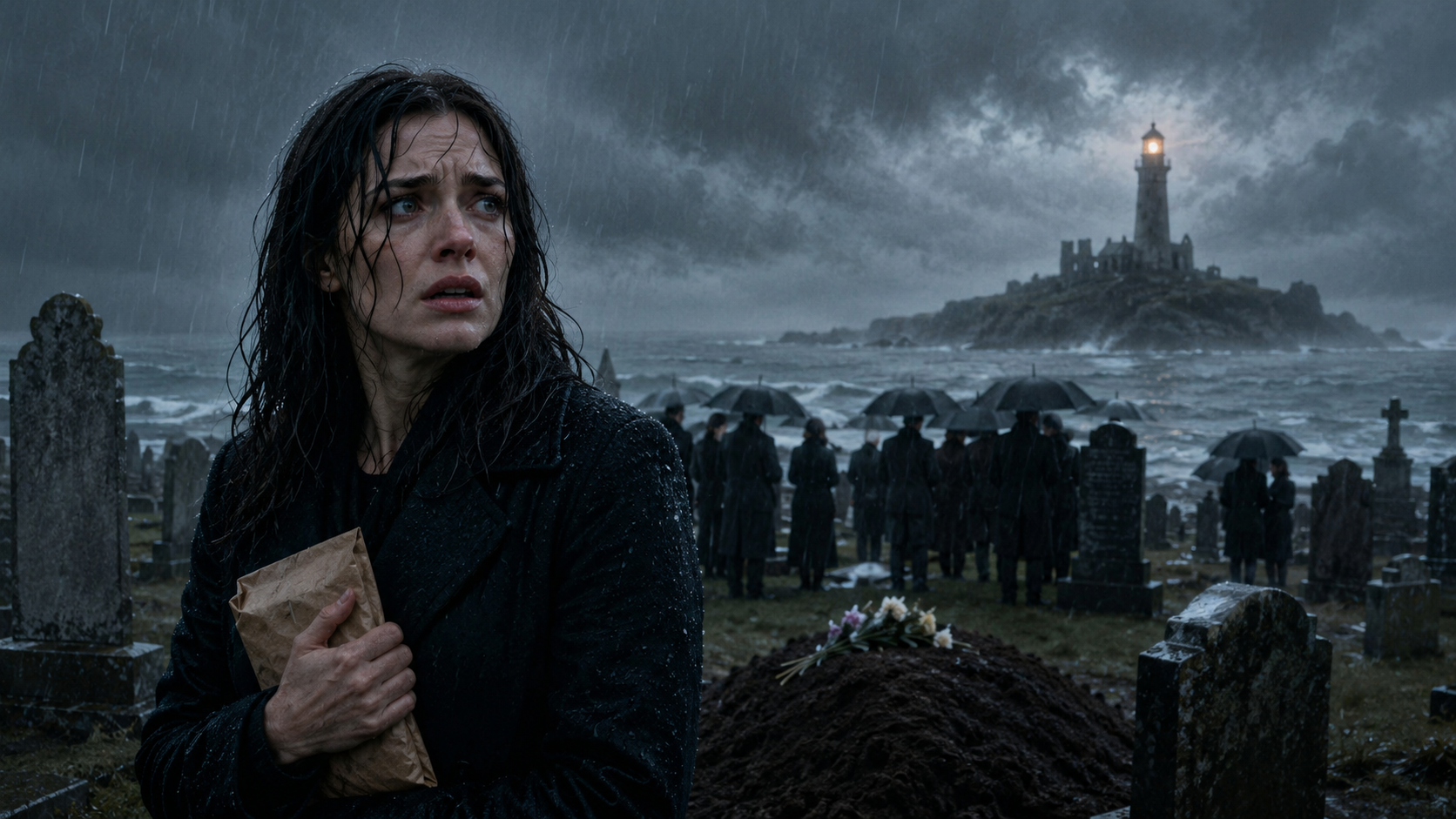
Greyhaven Light.
It had been abandoned since I was a teenager.
My father used to take me there in his small fishing boat.
On the back of the photograph, he had written four words.
WHEN THE LIGHT RETURNS, LISTEN.
I picked up the recorder.
There was only one audio file.
My hand trembled as I pressed play.
Static filled the car.
Then my father’s voice.
“Claire.”
I stopped breathing.
The recording was clear.
Too clear.
For a fraction of a second, grief vanished and I was eight years old again, hearing him call me downstairs for breakfast.
“If you’re hearing this,” he continued, “the funeral happened exactly as I expected.”
I gripped the recorder.
“You are going to be told that I became confused near the end. You may be told I was frightened of imaginary enemies. You may even be told that whatever you discover next was caused by illness.”
A pause.
“None of that is true.”
My pulse quickened.
“Do not confront your mother.”
I looked through the rain-covered windshield.
Mom was still standing near the grave.
“She knows part of the truth. Not all of it.”
Another pause.
Then his voice became quieter.
“Go to Greyhaven before midnight. Take the compass. Come alone.”
The recording ended.
No goodbye.
No explanation.
Just silence.
I replayed it twice.
Daniel called me.
I ignored him.
My mother called.
I ignored her too.
At 6:20 that evening, I drove toward the harbor.
Greyhaven Island sat three miles from shore.
The ferry had stopped running there years ago.
But my father still owned a sixteen-foot fishing boat.
I found it exactly where it had always been, tied behind the old marina.
The fuel tank was full.
A waterproof jacket lay across the driver’s seat.
Someone had prepared the boat.
I nearly turned around.
Instead, I started the engine.
The sun disappeared behind the clouds as I crossed the bay.
Waves struck the hull.
The abandoned lighthouse grew larger.
Grey stone.
Broken windows.
Rust around the old metal railing.
Nothing had lived there for years.
Or so I thought.
When I reached the dock, I saw a light flash from the tower.
Once.
Then darkness.
I froze.
The lighthouse had no electricity.
A second flash appeared.
Then a third.
My father’s words returned.
When the light returns, listen.
I climbed onto the dock.
“Hello?”
Only the ocean answered.
I entered the lighthouse.
The smell of wet stone and rust filled the narrow corridor.
Then I heard footsteps above me.
“Who’s there?”
The footsteps stopped.
A woman spoke from the darkness.
“You’re late.”
I almost ran.
Instead, I raised my phone flashlight.
A woman in her early sixties stood halfway up the spiral staircase.
Short white hair.
Dark coat.
A scar running from her left eyebrow to her temple.
“Who are you?”
“My name is Ruth Calder.”
“I don’t know you.”
“No. But your father did.”
My throat tightened.
“Where is he?”
She stared at me.
That tiny hesitation was enough.
“You know something.”
“I know many things about Arthur Vale.”
“Then tell me why I’m here.”
Ruth descended the stairs.
“He discovered something fifteen years ago while inspecting the harbor expansion.”
“What?”
“A shipping channel that wasn’t supposed to exist.”
I frowned.
She continued.
“Your father found records showing that certain cargo vessels were entering Blackwater Bay without appearing on official harbor logs.”
“Smuggling?”
“At first, that’s what he thought.”
“What was really happening?”
Ruth looked toward the entrance.
“People were disappearing.”
The room suddenly seemed colder.
“Workers. Witnesses. Accountants. Anyone who discovered how much money was moving through the port.”
“You’re saying my father uncovered a criminal operation?”
“I’m saying your father spent fifteen years collecting enough evidence to destroy it.”
“Why didn’t he go to the police?”
Ruth gave me a bitter smile.
“He did.”
I understood the answer before she said it.
“They were involved.”
“Some of them.”
“My mother?”
“No.”
Relief rushed through me.
Then Ruth added, “But your uncle was.”
My father’s younger brother.
Thomas Vale.
The man who had delivered the eulogy that morning.
The man who had stood beside me while my father’s coffin entered the ground.
“No.”
Ruth said nothing.
“He owns an accounting firm.”
“He owns six shell companies connected to the port.”
I stared at her.
“Where is my father?”
“Claire—”
“Tell me.”
Ruth reached inside her coat.
Instead of a weapon, she removed a small tablet.
She placed it on a wooden table.
A security-camera recording appeared.
The date was four days earlier.
My father’s workshop.
I watched him enter.
Alive.
He checked the windows.
Locked the door.
Then another man appeared.