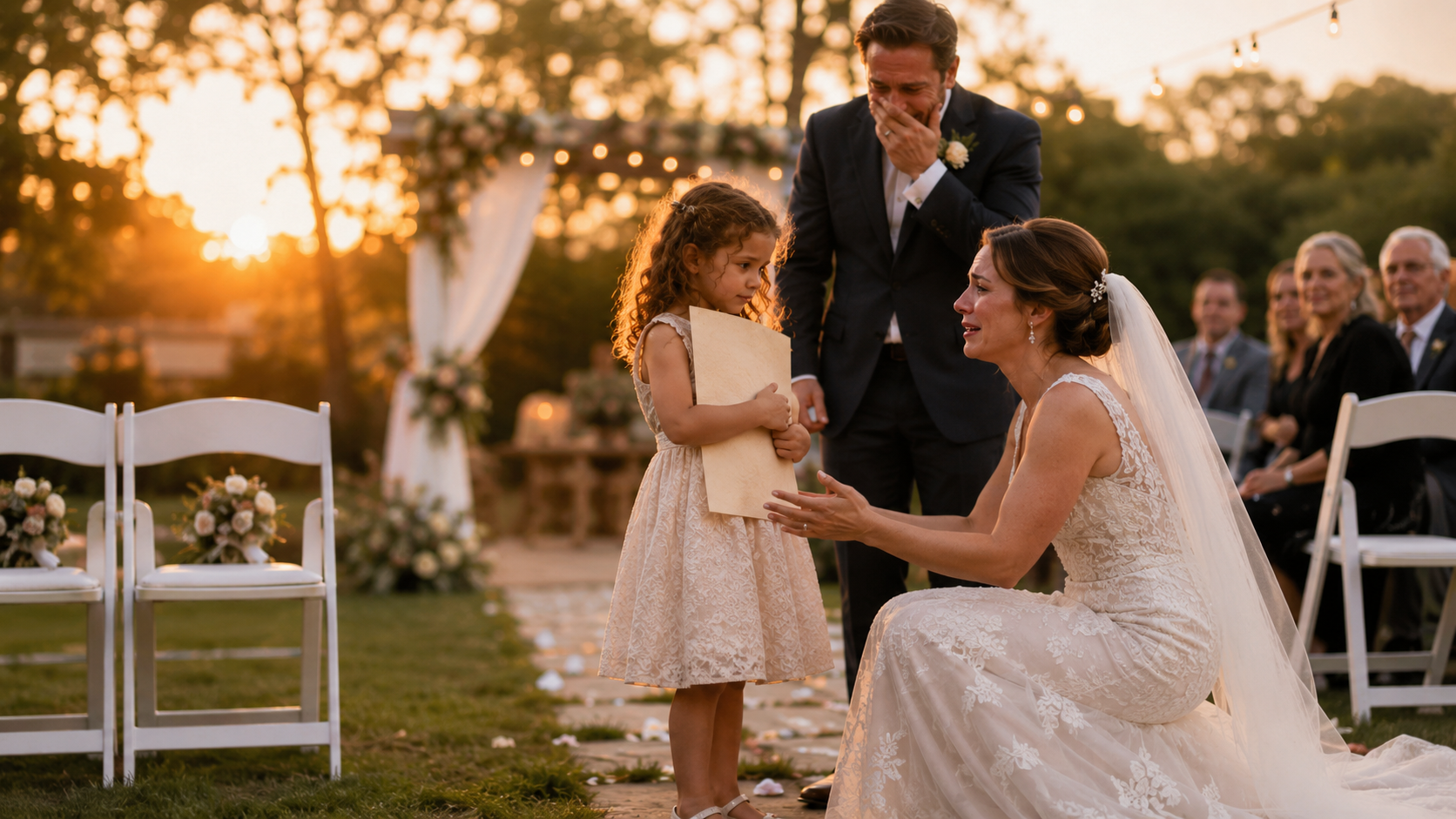
Just three sentences.
You have won. Your father is humiliated. I hope your new family was worth it.
Nora stared at the last sentence for a long time.
Then she typed back only two words.
They are.
Marlene did not reply.
For a while, Nora thought that was the end.
But endings rarely arrive honestly.
They usually come dressed as one more test.
Three months after the wedding, Nora received a call from the hospital.
Her father had collapsed during a private meeting with the church board.
Minor heart attack.
Stable condition.
Room 318.
Her first feeling was not compassion.
It was exhaustion.
Then came guilt, because daughters are trained to feel guilty even when fathers build the cages themselves.
Caleb found her standing in the hallway with the phone in her hand.
“What happened?”
She told him.
He did not tell her to go.
He did not tell her not to.
He only asked, “What do you need?”
That question almost made her cry.
No command.
No pressure.
No sermon.
Just choice.
“I don’t know,” she said.
Maisie peeked around the corner.
“Is Grandpa Church sick?”
Nora swallowed.
“Yes.”
Maisie came closer.
“Are you sad?”
Nora looked at that small face and realized she could not lie to a child who had already been hurt by adult dishonesty.
“I’m confused.”
Maisie nodded like that made perfect sense.
“When I’m confused,” she said, “Daddy says I can be kind and still have rules.”
Caleb turned away, crying silently.
Nora laughed softly.
“Daddy is right.”
She went to the hospital alone.
Not because Caleb would not come.
Because she needed to know who she was without anyone standing between her and the people who raised her.
Marlene was waiting outside room 318, pearls on her neck, lipstick perfect, posture sharp.
But she looked older.
That startled Nora.
For the first time, her mother did not look untouchable.
She looked like a woman who had spent her whole life polishing a glass house and was shocked that people could see through it.
“Nora,” Marlene said.
“Mom.”
Marlene looked behind her.
“You came alone.”
“Yes.”
“No husband?”
“No.”
“No child?”
Nora held her gaze.
“My daughter’s name is Maisie.”
Marlene’s mouth tightened.
“Your father is resting.”
“Then why did you call me?”
Marlene looked toward the closed door.
For one second, her face trembled.
Then the mask returned.
“He asked for you.”
Nora entered the room.
Her father looked smaller in the hospital bed. Without the stage, the microphone, the suit, and the applause of hundreds of people, Gideon Hale looked like an aging man with wires taped to his chest.
His eyes opened when she approached.
“Nora.”
His voice was weak.
She stood beside the bed.
“Dad.”
He looked at her for a long time.
Then his eyes filled.
Nora braced herself.
For the speech.
For the explanation.
For the twist that would somehow make his pain her responsibility.
But he only said, “I watched the whole video.”
Nora’s throat tightened.
She did not answer.
“I watched her hold that sign,” he whispered. “I watched you kneel. I watched Caleb cry.”
A tear slipped down his temple.
“I watched it without thinking about the church. Without thinking about the comments. Without thinking about myself.”
Nora gripped the strap of her purse.
Her father closed his eyes.
“And I saw what I had done.”
The room blurred.
Nora hated that she wanted those words.
She hated that they still mattered.
“I called a child a responsibility,” he said. “Like she was a debt. Like she was a warning. I did it from a pulpit and called it wisdom.”
His breath shook.
“I was cruel.”
Nora looked at the man who had taught thousands of people to repent.
For once, repentance looked like something that cost him.
“I need to say it to her,” he whispered.
Nora went still.
“No.”
He opened his eyes.
“Nora—”
“No,” she said again. “You do not get access to Maisie just because guilt finally reached you.”
He flinched.
“She deserves an apology.”
“She deserves safety more.”
Gideon swallowed.
Nora’s voice stayed steady.
“If you want to apologize, write a letter. Caleb and I will read it first. Her therapist can help us decide if and when she hears it. You do not get to make your guilt her responsibility.”
Her father stared at her.
Then he nodded.
Not happily.
Not easily.
But he nodded.
That was the first miracle Nora had ever seen him perform.
Not healing.
Not prophecy.
Not a church full of raised hands.
Just a powerful man accepting the word no.
Marlene was waiting in the hallway when Nora came out.
“Well?”
“He wants to write Maisie a letter.”
Marlene’s eyes flashed.
“You are making him beg to a child?”
Nora was tired.
So tired.
But she was also free.
“No,” she said. “I am making sure a child does not have to carry an adult’s shame.”