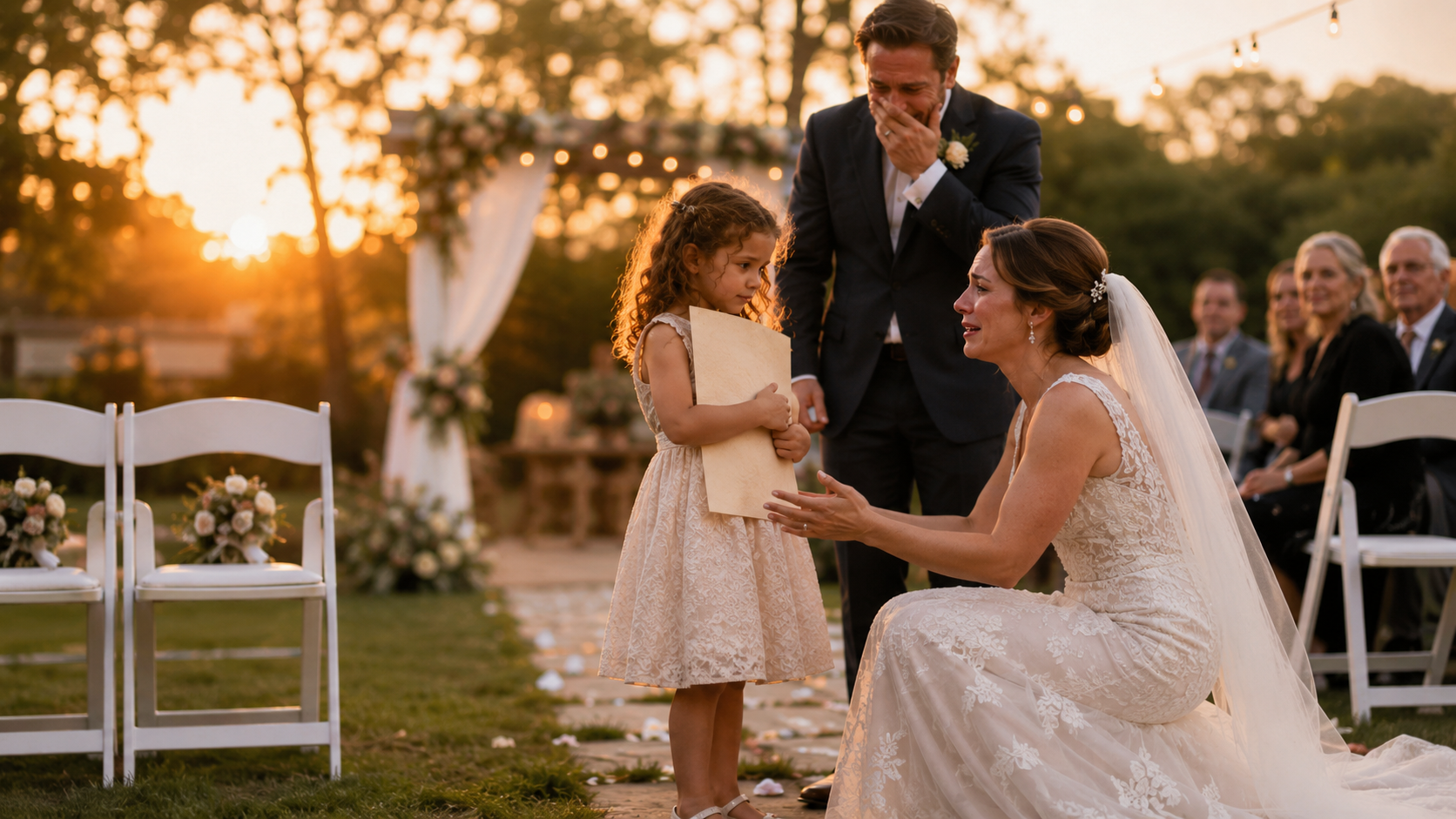
Marlene stared at her like she did not recognize her.
Maybe she didn’t.
Maybe that was the point.
The adoption hearing happened six months after the wedding.
It was a rainy Thursday morning.
Maisie wore a blue dress and carried Captain Waffles, whose left ear had become permanently bent. Caleb wore a tie covered in tiny stars because Maisie said court needed “happy space energy.”
Nora wore a pair of earrings Elena’s mother had mailed her with a handwritten note.
Elena would have loved you for loving them.
Nora had cried for twenty minutes after reading it.
In court, the judge was kind.
She asked Maisie if she understood why everyone was there.
Maisie nodded seriously.
“Yes. Nora is my home mom, and Mommy Elena is my sky mom, and Daddy says families can get bigger without anybody disappearing.”
The judge blinked fast.
“So this is what you want?”
Maisie looked at Nora.
Then at Caleb.
Then back at the judge.
“Yes. Because she stayed when I was scared.”
Nora’s hand shook in Caleb’s.
The judge signed the order.
Just like that, the child Gideon Hale had treated like an unfinished burden became legally, publicly, permanently Nora’s daughter.
Outside the courthouse, there were no reporters.
No viral cameras.
No shouting crowd.
Just rain, a few pigeons, and Mrs. Benitez waiting with balloons because apparently nothing on earth could stop that woman from becoming family.
Maisie held up a new sign for one picture.
This one said:
Officially staying.
Nora posted that photo herself.
Not for revenge.
Not for views.
For every child who had ever wondered if they were too hard to love.
It reached millions.
But this time, the number did not matter most.
What mattered was Maisie dancing in the kitchen that night with frosting on her nose.
What mattered was Caleb pulling Nora close after their daughter fell asleep and whispering, “Thank you for staying.”
What mattered was Nora answering, “Thank you for letting me choose.”
Gideon’s letter arrived two weeks later.
It was five pages long.
No excuses.
No scripture used as a shield.
No careful phrases like “if I hurt you.”
He wrote Maisie’s name over and over.
He said she was never too much.
He said he was wrong.
He said adults sometimes make fear sound holy because they are too proud to admit they are afraid.
Nora and Caleb read it with the therapist first.
Then, one quiet evening, Nora asked Maisie if she wanted to hear a letter from Grandpa Church.
Maisie thought about it.
“Is it mean?”
“No.”
“Is he still mad?”
“No.”
“Do I have to forgive him?”
Nora sat beside her on the couch.
“No, baby. Forgiveness is not homework.”
Maisie leaned against her.
“Okay. You can read it.”
Nora did.
Maisie listened silently, holding Nora’s hand.
At the end, she asked, “Can I draw him something?”
Caleb’s face softened.
“If you want.”
Maisie drew three houses.
One with stars above it.
One with flowers.
One with a big crooked heart on the roof.
Then she wrote, with help spelling the words:
I am not too much. I am Maisie.
They mailed it the next day.
Gideon framed it.
Marlene did not come around for a long time.
That hurt less than Nora expected.
Some doors stay closed because opening them would let the storm back in.
Nora stopped waiting outside them.
A year after the wedding, they stood in Caleb’s backyard again.
The same yard.
The same patch of grass.
But everything looked different.
There were string lights overhead, folding tables covered with food, children running through sprinklers, and a cake that leaned slightly to the left because Caleb insisted on baking it himself again.
It was Maisie’s seventh birthday.
She wore a paper crown and announced to everyone that she had “one sky mom, one home mom, one dad, three grandmas, and a neighbor who is basically the boss of everyone.”
Mrs. Benitez raised her lemonade.
“That is correct.”
Everyone laughed.
Then the gate opened.
Gideon stood there.
Not Reverend Hale.
Not the man from the stage.
Just Gideon.
He held one wrapped gift and looked like he might turn around if anyone breathed too loudly.
Nora had invited him after months of letters, therapy advice, and careful boundaries.
Marlene had refused to come.
That was her choice.
Nora did not chase her.
Maisie saw him.
The yard went quiet in that subtle way adults do when they are trying not to stare.
Gideon knelt before Maisie reached him.
Smart man.
He did not tower over her.
He did not open his arms.
He did not assume.
“Happy birthday, Maisie,” he said softly.
Maisie studied him.
“Are you still learning?”
Gideon’s eyes filled.
“Yes.”
She nodded.
“Okay.”
Then she took the gift.
That was all.
No dramatic hug.
No instant healing.
No perfect ending for people who wanted forgiveness to look pretty.
Just okay.
Sometimes okay is holy enough.
Later, after cake, Maisie ran across the yard holding another sign.
Nora groaned.
“Maisie Reed, what did you make now?”
Maisie grinned.
This sign had glitter, stickers, and letters so large they barely fit.
Love does not replace people. It makes more room.
Caleb put his arm around Nora.
Gideon stood near the fence, crying quietly.
Mrs. Benitez shouted, “Somebody record that baby!”
Everyone laughed.
But Nora did not reach for her phone right away.
For once, she wanted the moment to belong only to the people living it.
She looked at her husband.
She looked at her daughter.
She looked at the yard where her wedding had almost broken her heart and somehow built her life.
Then she looked at the two front-row chairs from the ceremony, now pulled near the birthday table and covered in frosting, juice boxes, and children’s drawings.
They were not empty anymore.
Not because everyone came back.
But because Nora had stopped saving seats for people who only knew how to love with conditions.
She had built a bigger table.
And at the center of it sat a little girl once told she was too much, laughing under string lights like the whole world had finally learned her name.