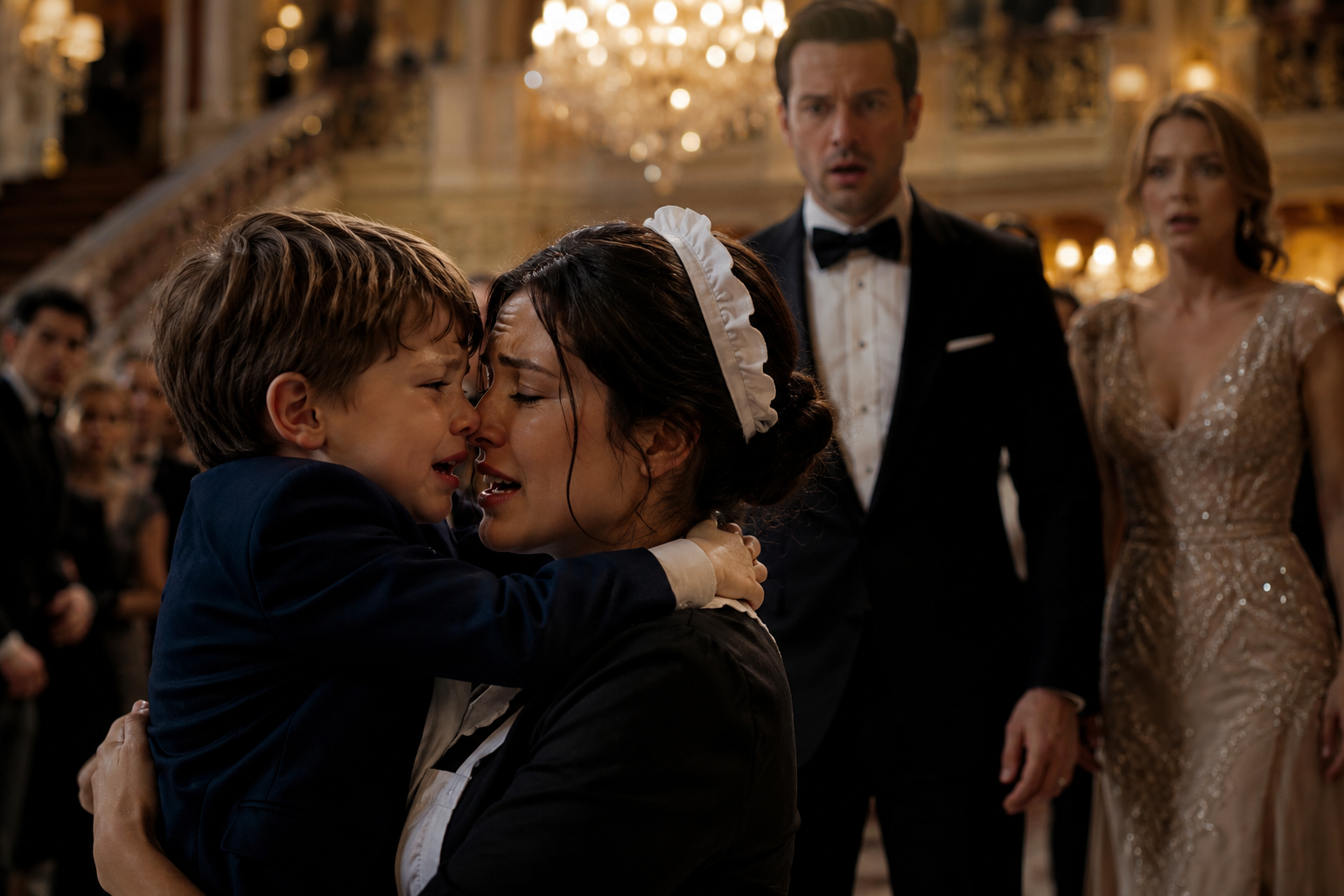
Beatrice locked the door behind them.
Theo refused to leave the woman’s arms.
Jonathan stood several feet away, unable to decide whether he wanted to embrace her or demand answers she could not give.
“What do you remember?” he asked.
“Pieces.”
“Of me?”
She studied his face.
“A train platform. You were wearing a gray coat. You had snow in your hair.”
Jonathan closed his eyes.
The memory belonged to the first night they met.
He had missed the final train to London. Lydia had laughed at him for carrying an umbrella while standing beneath a covered platform. They had spent two hours drinking terrible coffee from a vending machine.
“What else?”
“A little house near water.”
“Our cottage.”
“Yellow curtains.”
“You chose them. I hated them.”
For the first time, the edge of a smile appeared on her face.
“I think I knew that.”
Theo lifted his head.
“We still have them.”
The smile vanished into tears.
Jonathan stepped forward but stopped before touching her.
“May I?”
She hesitated.
Then nodded.
He placed one hand against her cheek.
The warmth of her skin nearly destroyed him.
For three years he had lived with absence. He had imagined her final minutes so often that the invented scene had become a memory: Lydia alone in freezing rain, calling his name where no one could hear.
Now she stood before him, alive and frightened.
“I searched,” he said. “I need you to know that.”
“I believe you.”
“I should have continued.”
“You had a child who needed you.”
“He needed both of us.”
Theo placed his small hand over Jonathan’s.
For one fragile moment, they stood together like a family reconstructed from broken glass.
Then a bell rang somewhere beneath the floor.
Beatrice went still.
“What is that?” Jonathan asked.
She crossed the cellar and pulled an old map from behind a loose brick.
“The chapel alarm.”
“Ashcombe Chapel hasn’t been used in decades.”
“Not officially.”
She unfolded the map across a barrel.
The estate had once included a small stone chapel near the northern woods. It had been closed after a roof collapse, and Malcolm had refused every proposal to restore it.
A red circle had been drawn beneath the chapel foundations.
Beatrice pointed to it.
“My father left this map. He wrote one sentence on the back.”
Jonathan turned it over.
THE RECORDS ARE KEPT BELOW THE BELLS.
A heavy impact shook the cellar door.
Malcolm’s men had found the passage.
Beatrice switched off the flashlight.
“There is another exit.”
She led them behind a rack of empty bottles. A steep staircase climbed toward a metal hatch.
The pounding behind them grew louder.
Jonathan lifted the hatch and emerged inside the estate’s abandoned orangery. Rain beat against broken panes of glass. Vines had swallowed the stone walls, and water covered the tiled floor.
A dark car waited beyond the trees.
A woman stepped from behind the wheel.
She was in her sixties, wrapped in a long brown coat. Her white hair had been cut short, and she leaned on a cane.
Jonathan recognized her as Dr. Miriam Rowe, the physician who had delivered Theo.
“You,” he said.
Miriam lowered her eyes.
“I owe your family the truth.”
Theo’s mother became rigid.
“You were in the green room.”
Miriam looked at her.
“Yes.”
“What did you do to me?”
“I kept you alive.”
The cellar hatch rattled behind them.
Beatrice opened the car door.
“Explanations while we move.”
They climbed inside.
Miriam drove without headlights along a service road hidden by trees. Ashcombe House disappeared behind them, its ballroom windows glowing through the rain.
Jonathan looked back.
“My guests are trapped in there.”
“Malcolm won’t harm them,” Miriam said. “Witnesses are useful to him.”
“You sound very certain.”
“I worked for him for twenty-eight years.”
The woman beside Theo stared at her.
“My name is Lydia, isn’t it?”
Miriam gripped the steering wheel.
“Yes.”
“Where was I for three years?”
“In a neurological clinic on the coast.”
“Why?”
“Because you discovered what Malcolm had built beneath the chapel.”
Jonathan leaned forward.
“What was it?”
“A registry.”
“Of stolen money?”
“Of stolen lives.”
The car fell silent except for the rain striking the roof.
Miriam explained that the Ashcombe Trust had begun with legitimate hospitals and orphanages. Decades earlier, however, Malcolm had discovered that desperate wealthy families would pay enormous sums to alter inheritances, conceal births, manufacture guardianships, and remove inconvenient relatives from legal records.
Doctors were bribed.
Birth certificates were replaced.
Patients without close families were declared dead and transferred under new identities.
Children from unstable homes were redirected into private adoptions arranged for powerful clients.