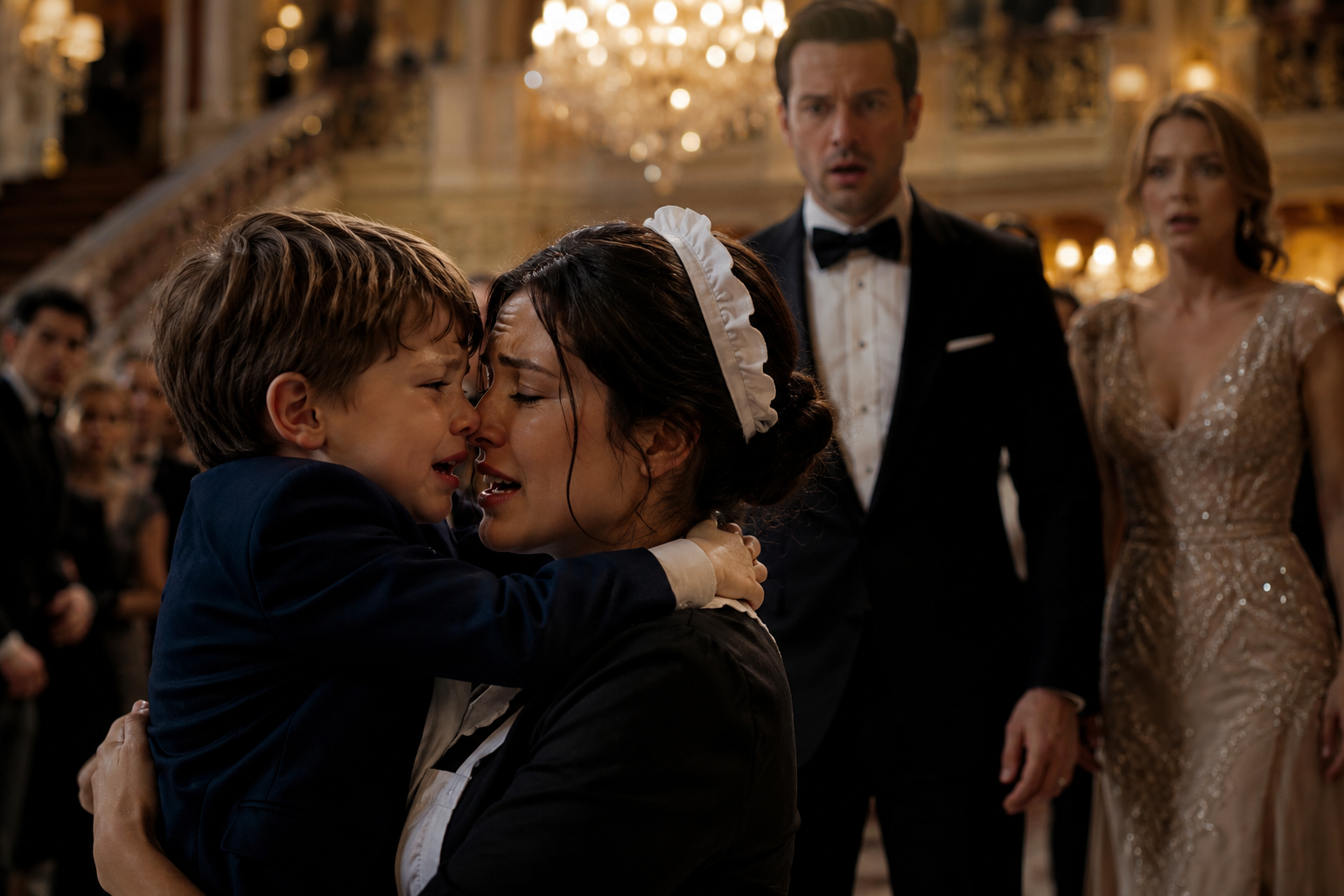
Adults who threatened the operation were sent to clinics where memory problems could be blamed on illness, accidents, or emotional collapse.
“Lydia found the registry while researching the trust’s spending,” Miriam said. “She copied part of it.”
Jonathan looked at his wife.
“Why didn’t you come to me?”
“She was going to,” Miriam answered. “But someone intercepted her before she reached London.”
Lydia closed her eyes.
A memory returned.
Rain on a railway platform.
A man in a station uniform directing her toward a side exit.
A cloth pressed near her face.
A voice saying, “Mrs. Carrow has suffered an accident.”
She opened her eyes sharply.
“My car never crashed.”
“No,” Miriam said. “It was placed near the flooded tunnel afterward. The blood came from a stored medical sample. Malcolm wanted the world to believe you were dead.”
“And you helped him?”
Miriam’s eyes filled with shame.
“I signed the admission papers. I prescribed the drugs that kept your memories confused.”
Theo held his mother’s hand.
“Why did you stop?”
“Because she continued saying your name, even when she could no longer remember her own.”
Miriam glanced at him in the mirror.
“Every night she asked whether Theo was safe.”
Lydia covered her mouth.
“I remember a blue door.”
“The clinic.”
“And birds painted on the ceiling.”
“Yes.”
“A man came to my room.”
Miriam’s expression changed.
“What man?”
“He wore a ring shaped like a lion.”
Jonathan looked at Beatrice.
Malcolm wore the Carrow family crest on his right hand: a crowned lion.
Lydia’s breathing became shallow.
“He told me Jonathan had remarried. He said Theo called another woman his mother. He said returning would only hurt them.”
Jonathan felt sick.
“He came to you himself.”
Miriam nodded.
“He needed to know how much she remembered.”
The car left the service road and entered the northern woods.
Ashcombe Chapel appeared through the rain.
Its tower leaned slightly, and ivy covered the narrow windows. The doors had been reinforced with new steel despite the building’s abandoned appearance.
Beatrice took a key from her bag.
“Your grandmother gave me this.”
Jonathan stared at it.
“Why would she trust you?”
“Because she knew my father was investigating Malcolm. She also knew she was dying.”
They approached the chapel.
The door opened before Beatrice inserted the key.
A young man stood inside.
He was perhaps thirty, with dark hair and a pale line across his chin. He wore a caretaker’s jacket and held an old lantern.
Lydia stopped.
The man looked at her as though he had spent years preparing for this moment and had discovered preparation was useless.
“Hello, Lydia.”
Jonathan stepped in front of her.
“Who are you?”
“My name is Elias North.”
Beatrice’s face tightened.
“That is not your real name.”
“No.”
He looked at Miriam.
“You should have told them before bringing them here.”
Miriam lowered her gaze.
Lydia studied the stranger.
“I’ve seen you.”
“You were eleven.”
A memory moved behind her eyes.
A teenage boy waiting outside her father’s study.
A bruise on his cheek.
Her grandmother giving him food in the kitchen.
“You lived here,” Lydia whispered.
Elias nodded.
“My mother worked in one of the trust’s clinics. When she tried to report what she had seen, Malcolm erased us both. She was declared unfit and confined. I was given a different surname and sent away.”
Theo peered around Jonathan.
“Are you bad?”
Elias looked at the child.
“No. But I have done things I’m not proud of while trying to reach this room.”
He lifted the lantern and led them through the chapel.
Dust covered the pews, yet the floor near the altar had recently been cleaned. Behind the wooden pulpit stood a stone figure of an angel holding a bell.
Elias pressed the bell downward.
The altar moved.
A staircase descended into darkness.
For one second, the hidden room beneath the chapel did not feel like an archive.
It felt like a place built to bury the truth.
Metal cabinets lined the walls. Old computers hummed beside shelves filled with boxes. Photographs, legal files, hospital bracelets, passports, and recording tapes had been catalogued by year.
At the center stood a large oak table.
Lydia approached it slowly.
A child’s wooden fox rested beneath a glass cover.
Theo pointed.
“I have one like that.”
Jonathan looked at him.
Theo always slept with a carved wooden fox Lydia had bought before his birth. It was one of the few belongings he refused to replace.
Lydia touched the glass.
“I made two.”
She remembered sitting in the cottage, painting tiny black eyes on the wooden faces. One fox had gone into Theo’s nursery.
The other had been intended for someone else.
She turned toward Elias.
“Why is this here?”
He removed the glass cover.