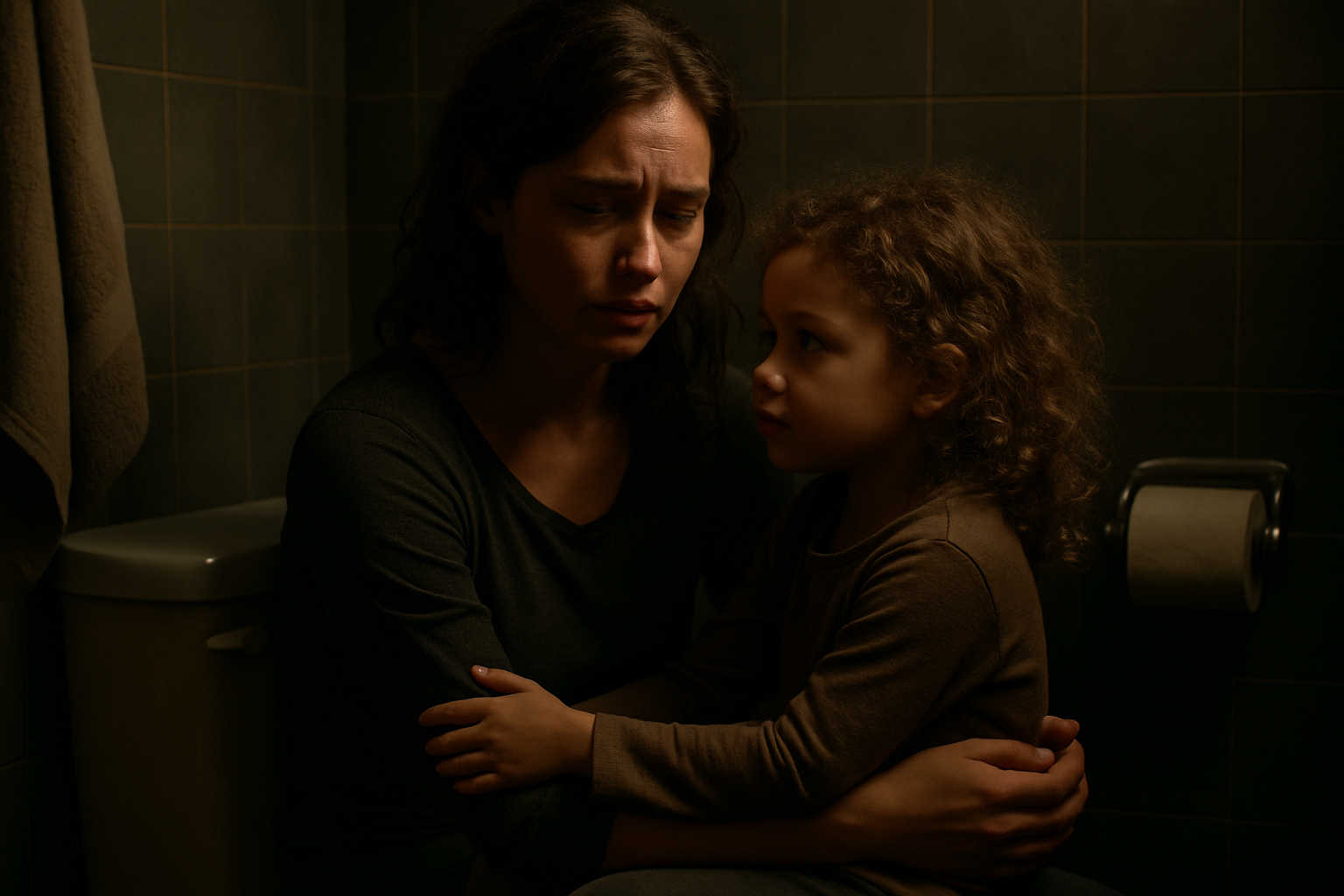
They had been written for clinicians, polished for research, shaped for policy and practice. But now they slipped free of the page and entered her bloodstream. They were no longer only theory. They were Mira standing in a bathroom doorway. Mira asking if the man with her eyes was bad. Mira saying secrets make monsters bigger.
Elara spoke about children who sensed emotional weather before adults named the storm. About how a mother’s flinch could become a child’s map of danger. About how protective lies, even loving ones, could teach a child that truth was something too dangerous to touch.
She spoke about panic disguised as wisdom.
About love that became controlling when driven by fear.
About the way silence could harden inside a family until everyone mistook it for safety.
She avoided looking at Cassian through most of it. If she looked too long, she feared she would see not the billionaire who had broken her heart, but the man who once fell asleep with his hand spread protectively over her stomach before either of them knew Mira existed.
Then the question period began.
Hands rose across the ballroom. A pediatrician asked about screening protocols. A school counselor asked about children resisting disclosure. A hospital director wanted to know how to train staff in rural clinics.
Elara answered each one carefully.
Then Cassian raised his hand.
The moderator glanced down at the seating chart and nodded. “Mr. Thorne.”
Elara gripped the edges of the podium.
Cassian stood.
He did not rush. He did not perform. He merely rose from his seat with the quiet command that had once made entire boardrooms fall silent before he spoke. His voice carried easily through the ballroom, low and controlled, though Elara heard the strain beneath it because she had once known every hidden register of that voice.
“Dr. Vey,” he said, “you spoke about children inheriting adult fear. What would you tell a parent who hid a painful truth to protect a child, only to realize the silence might be hurting that child too?”
The room went utterly still.
It was professional enough to pass.
Personal enough to cut.
Elara met his eyes across the sea of faces, and for the first time in four years, she did not look away.
“I would tell that parent that protection is not the same thing as control,” Nora said.
Her voice did not rise, but the room seemed to quiet around it anyway.
A hundred people sat beneath the chandeliers of the Fairmont ballroom—therapists, teachers, foster parents, donors, social workers, people with pens paused above notebooks and coffee cooling in paper cups. Yet Nora’s answer was not for them anymore.
It was for the man standing near the aisle, asking a question with a voice she had spent four years trying not to remember.
“And I would tell them,” she continued, fingers tightening around the edge of the podium, “that children do not need perfect adults. They need brave ones. Adults who can kneel down, look them in the eye, and say, ‘I was scared. I was wrong. I am trying to tell the truth now.’”
Adrian Ellison stood very still.
For one suspended second, Nora saw not the billionaire in the dark tailored suit, not the man whose name had appeared in business magazines and charity bulletins and headlines she refused to read. She saw the husband who used to fall asleep with case files open on his chest because he wanted to understand her work. The man who had once driven across Boston at midnight because she said she wanted lemon gelato and then acted offended when she called him ridiculous.
Something in his face shifted.
Pain first.
Then hope.
Then restraint, as if he had trained himself not to reach for things he had no right to touch.
“Thank you,” he said.
Two words. Quiet. Ruined.
Then he sat down.
The applause rose around Nora like weather. People stood. Someone wiped their eyes. A woman in the second row pressed both hands over her heart. Nora heard none of it clearly. Her ears were full of her own pulse, full of the impossible fact of Adrian sitting ten rows away from their daughter.
Their daughter.
Maddie, who was twisting a purple ribbon around her finger beside Olivia. Maddie, who had Adrian’s eyes and Nora’s stubborn chin. Maddie, who still believed her father was a story without a name.
When the panel ended, Nora stepped down from the stage, smiling when people touched her arm, accepting praise she could barely process. Faces blurred. Compliments washed past her.
“Powerful talk.”
“Your daughter must be proud.”
“You’ve given so many families language for their pain.”
Language, Nora thought wildly. I have given everyone language except myself.
The crowd began to thin. Chairs scraped. Programs folded. The ballroom emptied in little streams of perfume, wool coats, and murmured conversations.
Nora remained near the stage because her knees did not feel trustworthy.
Then Adrian approached.
Slowly.
Carefully.
As though she were a frightened animal and he knew one wrong movement could send her running again.