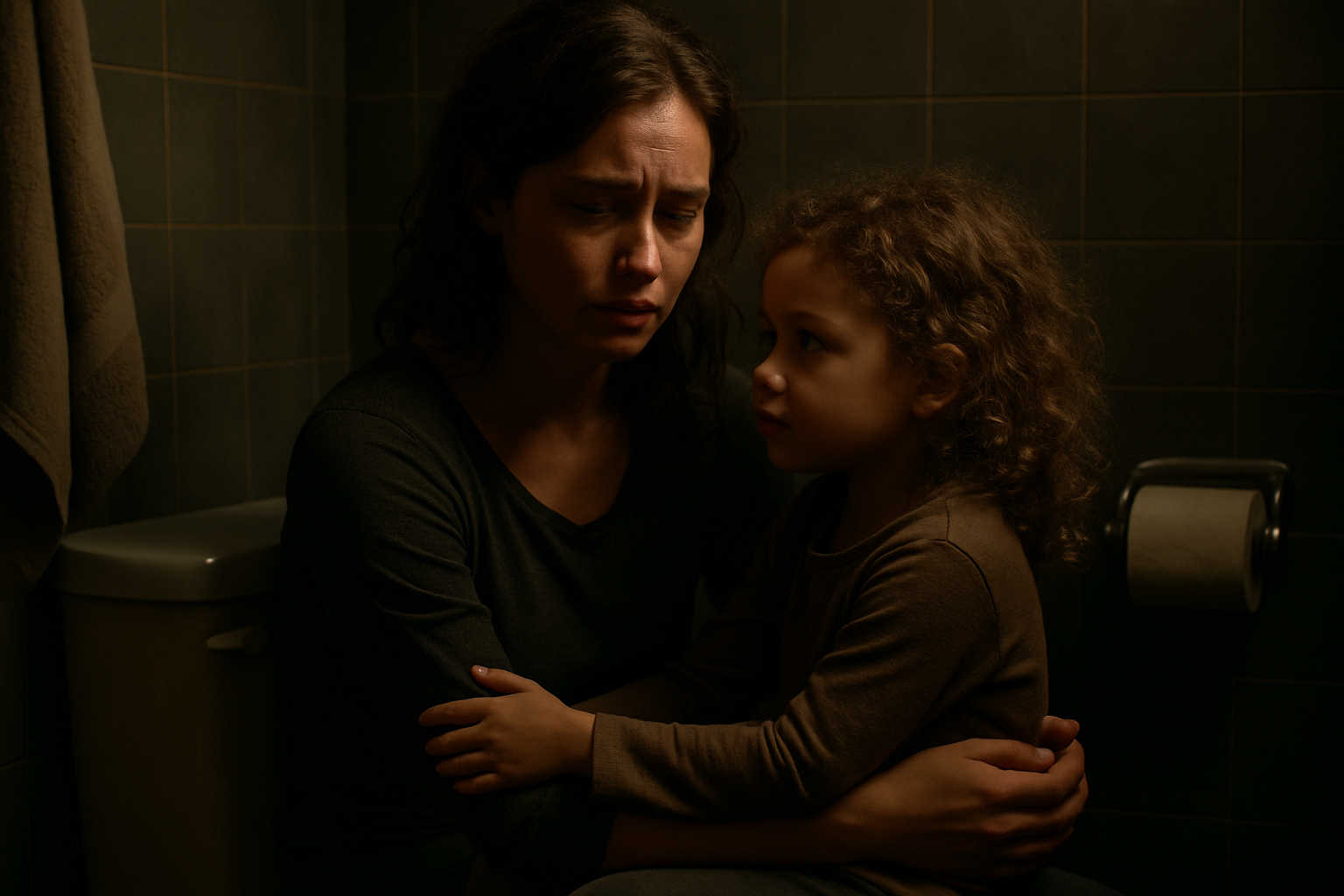
Celeste lingered several yards behind him, near the aisle. Her arms were crossed, but not defensively. Almost deliberately. As if she wanted Nora to see that she was not part of whatever was about to happen. Not an eavesdropper. Not a shield. Not a witness unless invited.
“Nora,” Adrian said.
Her name in his mouth was almost unbearable.
She lifted her chin. “Ten minutes.”
He nodded at once. “Ten minutes.”
“No lawyers.”
“No lawyers.”
“No accusations.”
His throat moved. “Only answers.”
She glanced toward the side door. “Where?”
“There’s a conference room down the hall.”
“No closed rooms.”
“Then the lobby,” he said quickly. “The hallway. Outside. Anywhere you choose.”
Before Nora could answer, a small blur in a yellow cardigan escaped Olivia’s grasp.
“Maddie, wait—” Olivia called.
But Maddie Grace Ellison was already running down the aisle, curls bouncing, Mary Janes tapping against the carpet with decisive little thuds.
“Maddie Grace Ellison,” Nora warned, but her daughter did not slow.
Maddie stopped directly in front of Adrian and tipped her head back.
Nora’s heart stopped with her.
Adrian looked down at the child and went utterly still.
Not startled.
Not politely curious.
Still in the way a man might be if the world had cracked open beneath him and revealed something sacred.
Maddie studied him with the grave intensity of a child solving a puzzle adults had failed to explain.
“Do your eyes crinkle when you smile?” she asked.
The question landed like a glass breaking.
Nora reached them, breathless. “Maddie, sweetheart, this isn’t—”
“It’s important,” Maddie insisted, not looking away from Adrian. “Mine do, and Mommy said I got them from my daddy, but she never said his name.”
Adrian dropped to one knee.
The movement was slow, reverent. He came eye-level with Maddie, and Nora saw his hands tremble once before he folded them carefully in front of him.
“I think they do,” he said.
Maddie narrowed her eyes. “Show me.”
For the first time, Adrian smiled.
It was not the practiced expression Nora had seen on magazine covers. Not the sharp, controlled smile from acquisition interviews. Not the public face of Adrian Ellison, founder, investor, philanthropist, unreachable man of steel and charm.
This smile was broken.
Bright.
Terrified.
Full of wonder.
And at the corners of his eyes, the skin crinkled in the exact soft fan that appeared whenever Maddie grinned too hard.
Maddie gasped.
“Mommy.”
Nora could not move.
Maddie reached out one small hand and touched the corner of Adrian’s eye, as though checking a miracle for seams.
“You are him,” she whispered.
Adrian’s smile collapsed into tears he did not try to hide.
“Yes,” he said, voice unsteady. “I think I am.”
Nora turned away for half a second because the sight was too much. Too beautiful. Too cruel. Too late.
They did not go to a conference room.
They did not go to the lobby.
They went to Adrian’s café.
It stood two blocks from the Fairmont, tucked into the bottom floor of an old brick building on Newbury Street, beneath a black-painted sign with simple white lettering:
AFTER RAIN.
Nora had seen the name before. Of course she had. Boston had talked about it for months.
A billionaire former tech CEO abandoning a corner office to open an independent café and community bookstore? That was the kind of thing people either romanticized or mocked. Business columns called it an “unexpected pivot.” Lifestyle magazines called it “quietly revolutionary.” Social media called it everything from a redemption arc to a tax write-off.
Nora had never clicked the articles.
She had told herself it was vanity. Another rich man polishing his public image with reclaimed wood, fair-trade coffee, and a curated wall of books he had probably never read.
She was wrong.
Money could buy the brick building. The custom shelves. The polished espresso machine. The antique piano near the front windows.
But money alone could not create warmth.
This place had been built by grief. By longing. By hands that wanted to make shelter and did not know for whom.
Bookshelves climbed the exposed brick walls, crowded with novels, memoirs, poetry, children’s books, and worn paperbacks with handwritten staff recommendations tucked beneath them. A long communal table sat under amber lights, scattered with students’ notebooks and half-empty mugs. Children’s drawings had been pinned beside flyers for grief groups, poetry nights, foster family workshops, free tutoring sessions, and a support circle for fathers learning to parent after absence.
Nora saw that flyer and had to look away.
Behind the counter, a man in a Red Sox cap looked up when the bell over the door chimed.
His expression shifted instantly from cheerful to concerned.
“Adrian?”
“Russell,” Adrian said, his voice controlled but thin, “we’ll be upstairs for a little while.”
Russell’s gaze flicked to Nora, then to Maddie, then back to Adrian with the sharp understanding of someone who knew more than a casual employee should.
“Of course.”