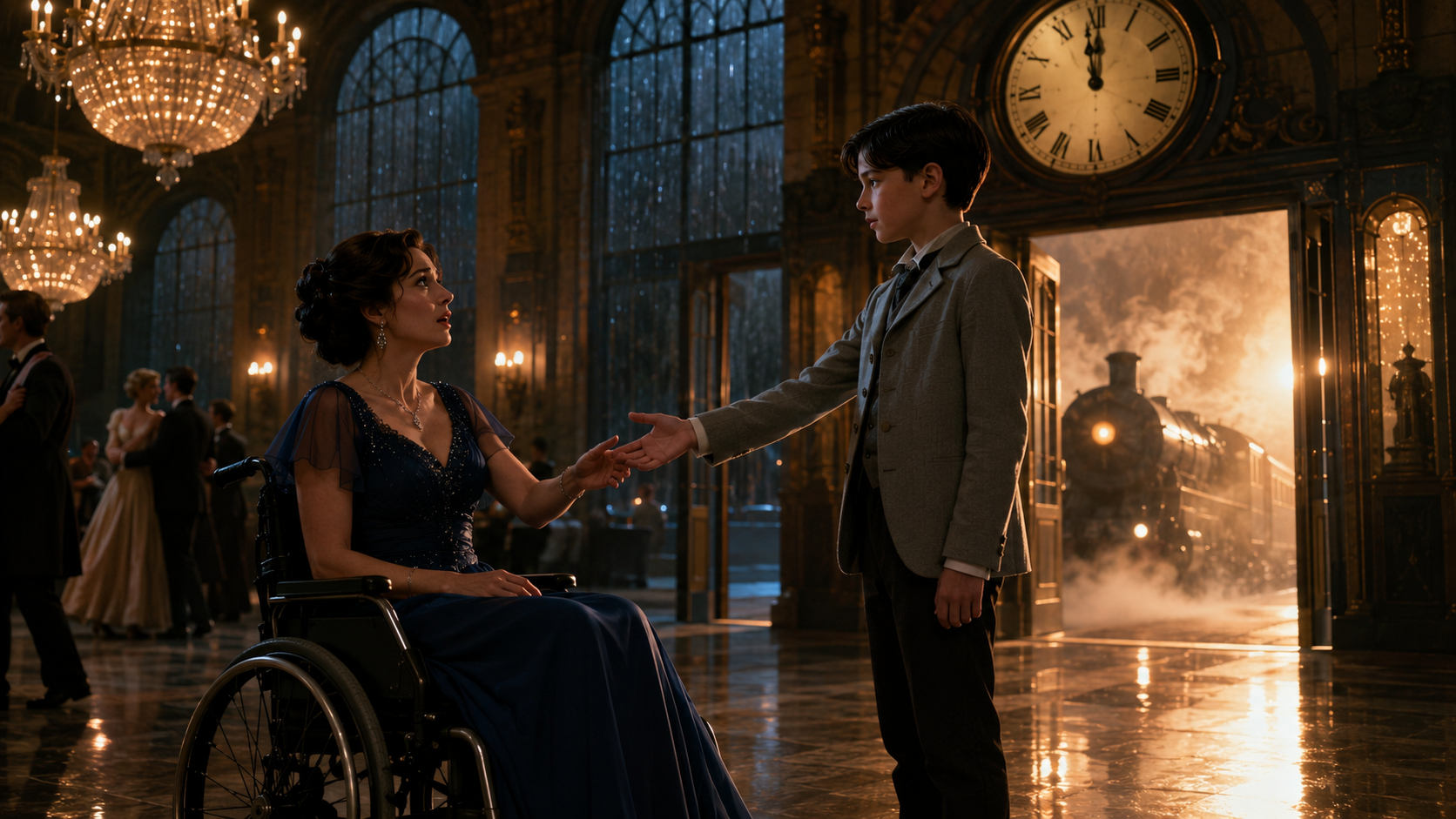
The invitation had been sitting unopened on Claire Ashford’s kitchen table for eleven days.
Heavy cream paper. Silver lettering. A wax seal stamped with the image of an old railway clock.
THE BELLWEATHER RESTORATION GALA
Claire had almost thrown it away.
She had no interest in champagne, orchestras, expensive dresses, or smiling conversations with people who asked how she was doing while carefully avoiding looking at the wheelchair beneath her.
But Bellweather Station was different.
Her father had loved that place.
When Claire was a child, he would bring her there on Sunday mornings, long after passenger trains had stopped using the station. They would stand beneath the enormous iron clock while he told her stories about soldiers returning from war, lovers saying goodbye on the platform, and musicians playing all night in the grand waiting hall.
“Every old building remembers something,” he used to say.
Claire had laughed at him then.
Tonight, twenty-two years later, she found herself remembering those words.
The restored station looked almost unreal.
Hundreds of candles flickered beneath the vaulted glass ceiling. Crystal chandeliers hung between the old steel beams. An orchestra occupied the former ticket balcony, and beneath them, couples moved across the polished floor where generations of travelers had once hurried toward departing trains.
Claire sat near one of the enormous arched windows.
Outside, rain streaked the glass.
Inside, everyone seemed to be dancing.
She adjusted the folds of her dark blue dress over her legs and tried not to notice the empty space people naturally left around her chair.
Three years earlier, Claire had been climbing a mountain road in northern Italy with her younger brother, Daniel, when another vehicle crossed the center line.
She remembered the headlights.
The sound of twisting metal.
Then darkness.
Daniel survived with a broken arm.
Claire woke in a hospital unable to move either leg.
There had been surgeries.
Rehabilitation.
Specialists.
Months of optimism followed by quieter conversations.
Eventually, the doctors stopped talking about recovery and started talking about adaptation.
Claire adapted.
She learned to drive again.
She returned to work.
She moved into an apartment without stairs.
She learned how to smile when strangers called her brave.
But there was one thing she had never learned.
How to stop remembering the person she had been before the crash.
That woman had danced.
Badly, perhaps.
But enthusiastically.
She had danced in kitchens, elevators, parking lots and once on the roof of a hotel during a thunderstorm.
The orchestra began a waltz.
Claire looked away.
“You’re sitting in my mother’s favorite place.”
The voice came from beside her.
Claire turned.
A boy stood near the window.
He looked about eleven or twelve.
He wore dark trousers, polished shoes, and a pale gray jacket that seemed strangely old-fashioned compared with the formal clothes worn by everyone else.
His black hair was neatly combed.
There was something unusual about him.
Not frightening.
Just… misplaced.
As though he belonged in an old photograph.
Claire glanced around for his parents.
“I’m sorry,” she said. “Was someone sitting here?”
The boy shook his head.
“No. A long time ago.”
Claire smiled politely.
“Then I suppose I’m safe.”
The boy studied her chair.
Most children stared.
Claire had become accustomed to it.
But this boy wasn’t staring with curiosity.
He was staring as though he recognized it.
“You don’t like the music,” he said.
“I like the music.”
“You look angry at it.”
Claire gave a small laugh.
“That’s a very strange thing to say to someone you’ve just met.”
“My mother said I said strange things.”
“Your mother sounds perceptive.”
“She was.”
The word made Claire pause.
Was.
Before she could ask what he meant, the boy looked toward the dance floor.
“Do you know this waltz?”
Claire listened.
“Yes.”
“Then dance with me.”
For several seconds, she thought she had misunderstood him.
A nearby couple heard the request and glanced over.
Claire forced another smile.
“I’m afraid you’ve chosen the wrong partner.”
“Why?”
She looked directly at him.
“Because I can’t walk.”
“I didn’t ask you to walk.”
Claire’s smile disappeared.
The boy extended one hand.
“I asked you to dance.”
A few guests were watching now.
Claire felt the familiar heat of embarrassment rise into her face.
“That’s enough.”
The boy did not move.
“You think dancing belongs to your legs.”
“What is your name?”
“Samuel.”
“Samuel, where are your parents?”
Instead of answering, he walked behind her chair.
Claire turned sharply.
“What are you doing?”
“Showing you something.”
His hands settled on the push handles.