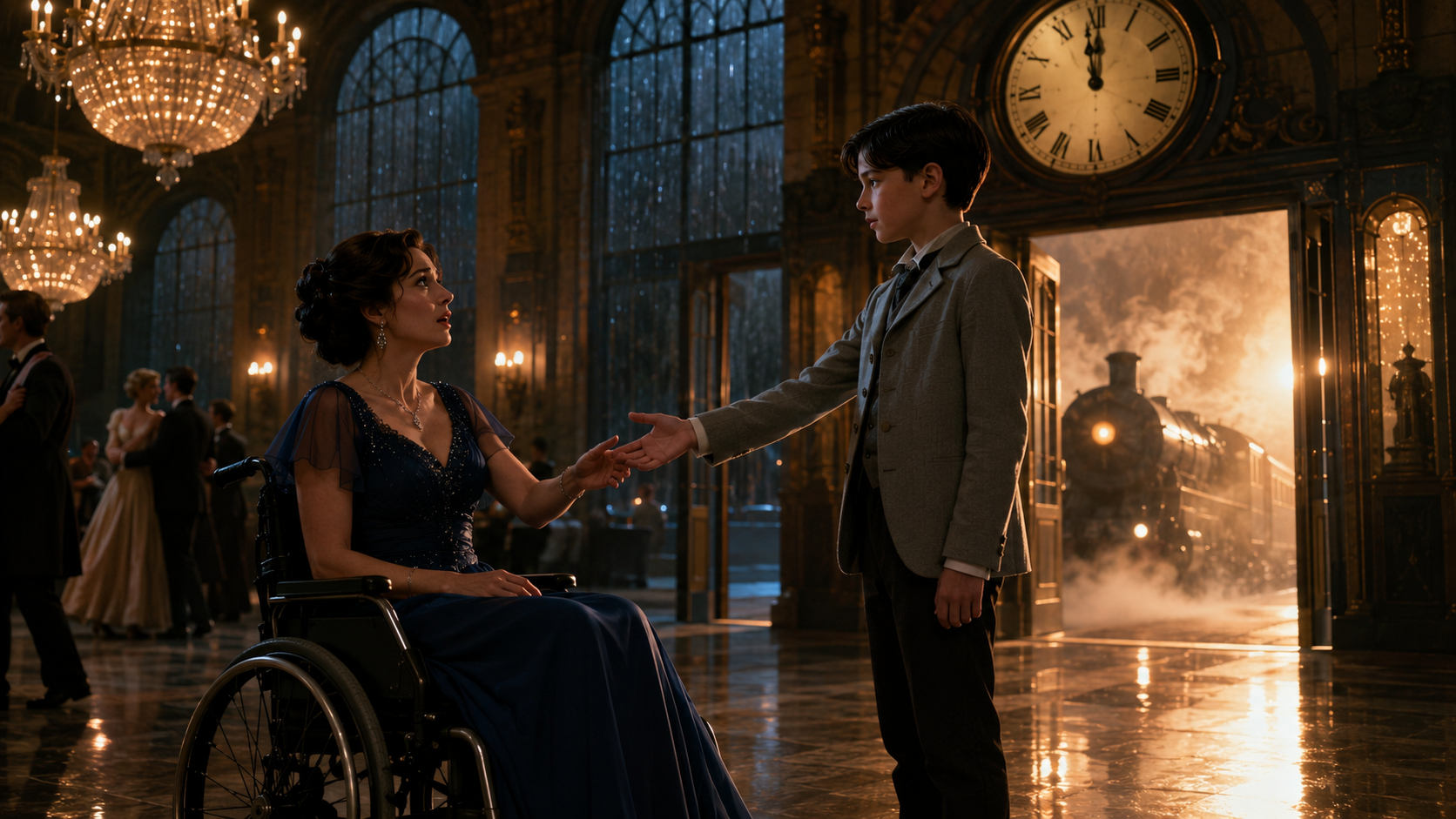
Claire immediately locked both wheels.
“Please don’t touch my chair.”
Samuel stepped back.
“I’m sorry.”
His apology sounded sincere.
Claire relaxed slightly.
Then Samuel pointed toward the floor.
“Look.”
Claire followed his finger.
Her chair moved.
Only a fraction of an inch.
She stared.
The brakes were still locked.
The chair moved again.
Backward.
Claire grabbed the wheels.
“What the hell?”
Several people nearby noticed.
A man carrying a champagne glass stepped closer.
“Everything all right?”
Claire looked under the chair.
Nothing.
The floor was level.
No one was touching her.
“I think so.”
Then the chair turned.
Slowly.
Deliberately.
Claire’s hands flew away from the wheels.
The orchestra continued playing.
Around her, conversations faded.
The wheelchair rotated until Claire was facing the center of the ballroom.
Someone laughed nervously.
Someone else whispered, “Is that motorized?”
It wasn’t.
Claire’s chair was lightweight, manual, and completely ordinary.
“Samuel?”
The boy had walked in front of her again.
He extended his hand.
“Now will you dance?”
Claire stared at him.
“No.”
His expression changed.
For the first time, he looked sad.
“Why not?”
“Because chairs don’t move by themselves.”
“This one does tonight.”
“That doesn’t answer my question.”
Samuel glanced upward toward the enormous clock suspended above the former ticket booths.
It was eleven forty-seven.
“We don’t have much time.”
A chill moved across Claire’s shoulders.
“What happens at midnight?”
Samuel didn’t answer.
The music suddenly stopped.
Not because the conductor had finished the piece.
Every musician froze at exactly the same moment.
A violin bow remained suspended over the strings.
The pianist’s hands hovered above the keys.
Silence filled the station.
Then the lights flickered.
Once.
Twice.
Darkness.
Someone screamed.
A second later, the chandeliers returned.
Samuel was gone.
Claire spun her chair around.
“Samuel?”
People were murmuring throughout the hall.
A woman near the orchestra shouted that there had probably been an electrical problem.
The musicians began talking among themselves.
Claire searched the crowd.
No gray jacket.
No black hair.
No boy.
Then she heard the sound.
A child laughing.
It came from behind one of the old wooden doors beside the ticket counter.
Claire rolled toward it.
The sign above the door read:
EMPLOYEES ONLY
She hesitated.
Then opened it.
A narrow corridor stretched into darkness.
“Samuel?”
No answer.
Claire switched on her phone flashlight.
Old photographs covered the walls.
Bellweather Station in 1902.
Bellweather during the war.
Bellweather beneath three feet of snow.
Bellweather crowded with hundreds of travelers.
Claire moved slowly along the corridor.
At the end stood a large framed photograph.
She stopped.
It showed a Christmas dance inside the station.
Dozens of people smiled at the camera.
Women wore long dresses.
Men wore dark suits.
Children stood near the front.
Claire’s light moved across their faces.
Then stopped.
Samuel.
Same hair.
Same pale gray jacket.
Same serious eyes.
Claire’s breathing became shallow.
A brass plaque beneath the photograph read:
BELLWEATHER WINTER BALL — DECEMBER 19, 1936
Behind her, someone spoke.
“You found him.”
Claire nearly dropped her phone.
An elderly woman stood in the doorway.
She wore a black evening gown and held a silver cane.
“You scared me.”
“I’m sorry.”
Claire pointed toward the photograph.
“That boy. Who is he?”
The woman came closer.
For a moment, she simply stared at the picture.
“Samuel Vale.”
Claire felt cold.
“Is he related to someone here?”
The woman looked at her.
“He died that night.”
Claire said nothing.
“There was a fire shortly before midnight,” the woman continued. “Electrical wiring behind the old stage. Most guests escaped.”
“Most?”
The woman nodded.
“Samuel went back inside looking for his mother.”
Claire looked at the photograph again.
“What happened to her?”
“She survived.”
“How?”
The elderly woman’s eyes shifted toward Claire’s wheelchair.
“Samuel found her.”
Claire waited.
“She had been injured years earlier and used a wheelchair. When the smoke filled the hall, people panicked. Someone knocked her chair over. Samuel went back and dragged her toward the platform doors.”
Claire’s heart began pounding.
“Did he get out?”
The woman shook her head.
“His mother did.”
The clock in the ballroom chimed.
Once.
Claire looked at her phone.
11:55.
The woman touched the photograph gently.
“My grandmother used to tell me the story.”
“Your grandmother?”
The woman smiled.
“Samuel’s mother.”