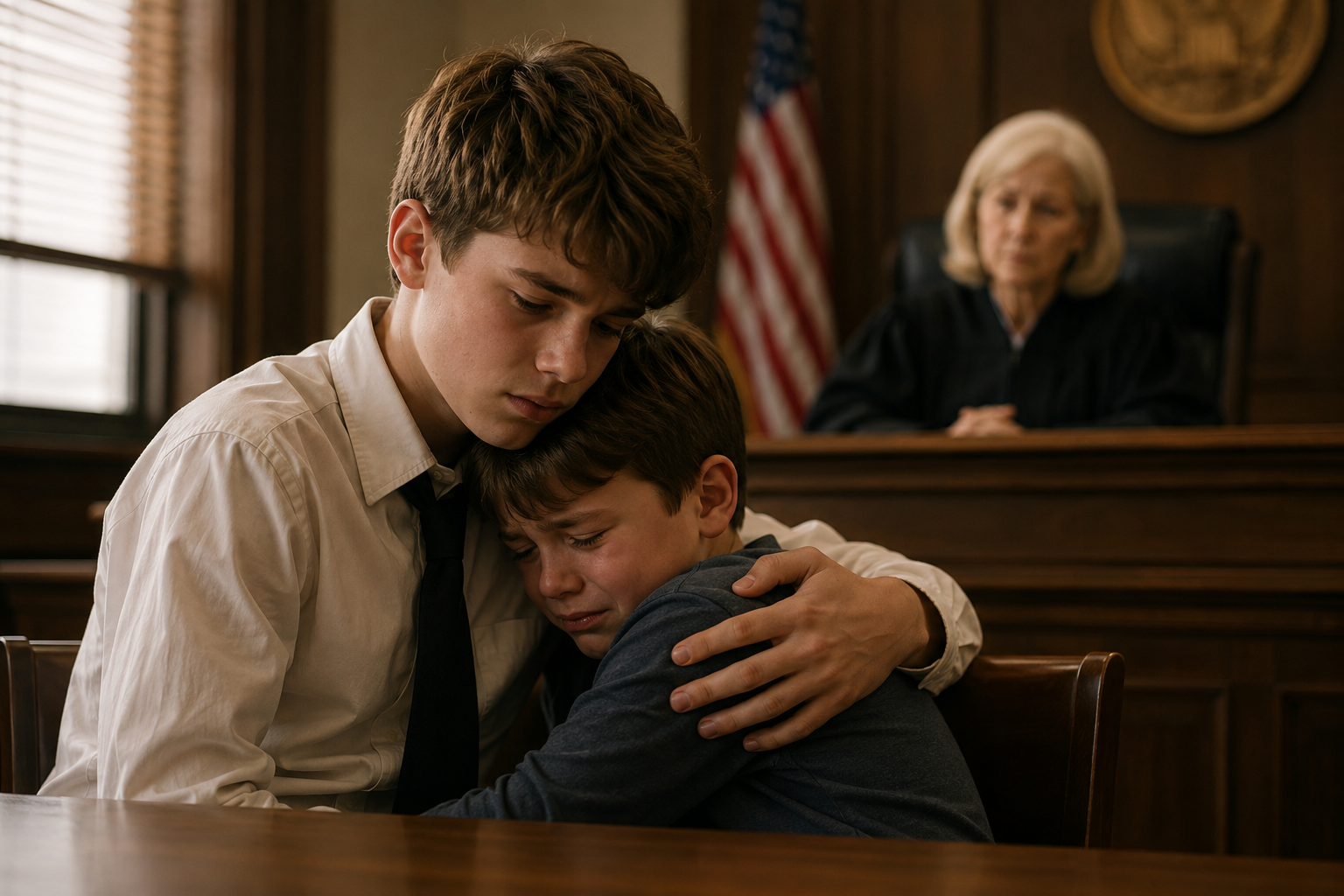
The Judge Was Ready to Separate Two Brothers—Until the Older Boy Revealed the Promise That Had Kept Them Together

The courtroom fell silent when the two brothers entered hand in hand.

Sixteen-year-old Ethan Parker walked first. His white shirt was several sizes too large, the sleeves carefully folded above his wrists. His shoes were worn almost smooth, and exhaustion had carved shadows beneath his eyes that no teenager should have carried.

Beside him was eight-year-old Noah, clutching a faded green backpack against his chest. He stayed so close to Ethan that their shoulders touched with every step.

Noah did not understand most of the words adults had been using that morning—temporary placement, legal guardianship, child welfare assessment.

He understood only one thing.

Someone in that courtroom might decide that he could no longer live with his brother.

Judge Margaret Holloway sat behind the high wooden bench, studying the thick folder open before her. Reports, school records, unpaid bills, medical notes, and social-services recommendations filled its pages.

When she finally looked up, her expression was serious.

“Ethan Parker,” she said, “the records indicate that you have been caring for your younger brother without an adult guardian for nearly two years.”

Ethan tightened his fingers around Noah’s hand.

“Yes, Your Honor.”

“Your mother passed away, and your father has not been located. No relative has been willing or able to accept legal responsibility for either of you.”

Ethan said nothing.

The judge continued.

“You are still a minor. You cannot legally carry full responsibility for another child.”

Noah looked up at Ethan, panic spreading across his small face.

“Are they going to take me away?”

Ethan immediately crouched beside him.

“No one is taking you anywhere without hearing us first.”

He tried to sound confident, but Noah felt the faint trembling in his brother’s hand.

Across the room, social worker Claire Bennett opened another folder.

“A licensed foster family has agreed to provide Noah with a safe home,” she explained gently. “They can offer him regular meals, medical care, stable schooling, and his own bedroom.”

Noah stared at her.

“And Ethan?”

Ms. Bennett hesitated.

“The family is approved to accept one child.”

The answer seemed to change the air in the courtroom.

Noah moved closer to Ethan. Ethan lowered his eyes because he had feared this moment for months.

He had done everything he knew how to do.

He washed their clothes by hand in the bathtub when the washing machine stopped working. He sold candy outside the bus station after school. He learned to stretch a small bag of rice across several meals and make thin soup last for two days.

When there was not enough food, Ethan claimed he had eaten at school.

When the electricity was disconnected, he lit candles and told Noah they were camping.

When rent was late, he asked the landlord for another week and promised to find more work.

He had tried to build a home out of almost nothing.

But now all those efforts seemed powerless against a folder filled with signatures, regulations, and official stamps.

Judge Holloway folded her hands.

“Ethan, no one doubts that you love your brother. But love by itself is not enough to raise a child.”

Ethan slowly lifted his head.

His eyes were wet, but his voice remained steady.

“You’re right, Your Honor. Love wasn’t enough.”

Several people in the courtroom looked at him in surprise.

“That’s why I learned to cook rice without burning it,” Ethan continued. “That’s why I learned which bills had to be paid first. That’s why I walked Noah almost four miles to school when we didn’t have money for the bus.”

Judge Holloway watched him without interrupting.

“When he had a fever, I stayed awake changing the cloth on his forehead. When he cried because he missed our mother, I told him every story about her that I could remember so he wouldn’t forget her voice.”

Noah lowered his face, silently crying.

“When he asked where our father went, I didn’t know what to tell him,” Ethan said. “So I told him that sometimes people become lost, but that doesn’t mean we have to become lost with them.”

Even Ms. Bennett stopped writing.

The judge removed her glasses and placed them on the desk.

“Ethan,” she said quietly, “you were a child yourself when all of this began.”

“I know.”

“Then why didn’t you tell anyone how difficult things had become?”

Ethan looked toward the floor.

“Because every time someone offered help, it sounded like they were preparing to take Noah away.”

“No one wanted you to carry this alone.”

“But no one ever said they would keep us together.”

The judge leaned back.

Ethan’s answer had not sounded angry. That made it even harder to ignore.

Ms. Bennett spoke carefully.

“The foster family can give Noah opportunities that you cannot currently provide.”

Noah suddenly looked at her.

“What opportunities?”

“A safe home, regular meals, clean clothing, medical appointments, and adults who can care for him.”

Noah’s expression tightened.

“And who gives those things to Ethan?”

No one answered.

Noah turned toward the judge.

“If Ethan is also a child, why does everyone only want to save me?”

Ethan gently touched his shoulder.

“Noah, you don’t have to do this.”

“Yes, I do,” Noah replied. “They keep talking about what I need. They don’t talk about what you need.”

He faced the judge again.

“When we didn’t have enough food, Ethan said he had eaten at school. But he hadn’t. He gave me his sandwich.”

Ethan closed his eyes.

“And when he was sick, he didn’t tell anybody because he still had to take me to school. When the lights went out, he said it was a game. He made a tent from blankets and told stories until I fell asleep.”

Noah’s words came faster now, as though he feared someone might stop him.

“When I cried for Mom, he stayed beside me. When I had nightmares, he slept on the floor near my bed. When I asked whether he would leave too, he always said no.”

Ethan covered his face with one hand.

For nearly two years, he had hidden his exhaustion from teachers, neighbors, social workers, and especially Noah.

But Noah had seen everything.

Children often notice far more than adults imagine.

Judge Holloway turned toward Ethan.

“Is what your brother said true?”

Ethan breathed in slowly.

“I didn’t want him to be afraid.”

“That was not my question.”

Ethan remained silent.

His silence answered for him.

The reports had described his missed classes, poor concentration, and constant fatigue. They had presented those facts as evidence that Ethan was irresponsible.

Now the judge saw them differently.

They were evidence of a teenager attempting to perform the work of an entire family.

Judge Holloway looked again at the recommendation before her.

“Ethan, the court cannot ignore the risks in your current situation.”

“I understand.”

“You need an adult guardian. You need reliable income, food, healthcare, schooling, and stability.”

“I understand all of that.”

“Then what are you asking this court to do?”

Ethan reached into his pocket and removed a small bracelet woven from blue and gray thread.

It was faded, uneven, and repaired in several places.

He held it carefully between his fingers.

“The night our mother died, Noah was sitting in the hospital hallway. He kept asking whether he was going to be alone.”

The judge leaned forward slightly.

“I didn’t know what would happen to us,” Ethan continued. “I didn’t know where we would sleep or who would help us. I only knew that he was terrified.”

Ethan glanced at his brother.

“So I tied this bracelet around his wrist and made him a promise.”

“What promise?” Judge Holloway asked.

Ethan’s voice nearly broke, but he continued.

“I promised that even if the whole world forgot us, I would remember where to find him. I promised that no locked door would ever stay between us. And I promised that if anyone tried to separate us, I would tell the truth, even if the truth made everyone see how badly I had failed.”

“You didn’t fail me,” Noah whispered.

Ethan looked at him.

Noah pushed up his sleeve.

Around his wrist was another bracelet made from the same blue and gray thread.

“Ethan said it was an invisible line,” Noah explained. “He said that as long as I wore it, he would always find his way back to me.”

A woman seated in the front row covered her mouth. The court clerk lowered his eyes. Even the officer standing near the doors blinked rapidly before looking away.

Ethan drew a shaky breath.

“I’m not asking the court to let me keep pretending I’m an adult,” he said. “I’m tired. Some nights I’m scared. Sometimes I don’t know how I’ll pay for anything the next day.”

He looked directly at Judge Holloway.

“But if Noah is taken away alone, he’ll believe I broke the only promise that ever made him feel safe.”

Noah rose from his chair and wrapped both arms around Ethan.

“I don’t want a better house if Ethan isn’t there,” he cried. “He isn’t my father, but he is the person who stayed.”

The silence inside the courtroom became almost unbearable.

Judge Holloway looked down at the open folder.

Every document had explained what the brothers lacked.

None had measured what they had given each other.

A system could count bedrooms, income, meals, attendance records, and medical appointments.

It could not easily measure how much courage it took for a sixteen-year-old to create dinner from an almost empty cupboard.

It could not measure how an eight-year-old slept only after hearing his brother breathing nearby.

It could not measure the safety of one small hand holding another.

Judge Holloway closed the folder.

“This court will not separate two brothers who survived by refusing to abandon each other.”

Ethan looked up sharply.

For several seconds, he seemed afraid to breathe.

Noah held him even tighter.

“But,” the judge continued, “this court will also not allow a sixteen-year-old boy to continue carrying responsibilities that should have belonged to adults.”

Ethan’s expression changed.

“What does that mean?”

“It means the current placement recommendation is rejected.”

Ms. Bennett immediately began reviewing her notes.

Judge Holloway continued.

“I am ordering the child-welfare department to locate a foster home or temporary guardian capable of accepting both brothers together. Until that arrangement is approved, neither child will be placed separately.”

Noah stared at the judge.

“I can stay with Ethan?”

“Yes, Noah.”

“Tonight too?”

“Yes.”

“And tomorrow?”

The judge’s expression softened.

“You will remain together while the court finds a safe home for both of you.”

Noah buried his face against Ethan’s shoulder.

Ethan pressed his lips together, but the tears came anyway.

For the first time in years, they were tears of relief.

The judge turned toward Ms. Bennett.

“I also want immediate educational support for Ethan, counseling for both boys, emergency housing assistance, and a review of every local family willing to accept siblings.”

“Yes, Your Honor.”

Then Judge Holloway looked at Ethan again.

“You protected your brother when the adults around you failed. That deserves respect. But from this day forward, your responsibility is not to be his father.”

Ethan swallowed.

“Then what am I supposed to be?”

“His brother.”

The word seemed unfamiliar to him.

The judge continued gently.

“You may love him, guide him, and stand beside him. But you should also attend school, complain about homework, make mistakes, and sleep without wondering whether there will be food in the morning.”

Ethan lowered his eyes.

“I don’t know how to stop worrying.”

“No one is asking you to stop loving him. We are making sure someone finally helps you carry that love.”

Three weeks later, the brothers arrived at a modest house on the edge of town.

Their foster parents, Daniel and Rebecca Hayes, had raised two children of their own and specifically requested that the brothers be placed together.

The house was not enormous. There was no swimming pool, expensive furniture, or perfect garden.

But the kitchen smelled of warm bread. Two clean beds waited in one bedroom, with a small lamp between them. There were books on a shelf, fresh towels in the bathroom, and enough food in the refrigerator that Ethan opened it twice just to make sure.

Noah placed his backpack beside the bed.

“Can I really leave it here?”

Rebecca smiled.

“Of course.”

“No one will move it?”

“No.”

“And Ethan is sleeping here too?”

“Yes.”

“And if I wake up at night?”

“You can call us, knock on our door, or go to Ethan. Whatever helps you feel safe.”

Noah nodded seriously.

At dinner, he asked whether the doors would remain locked, whether anyone would come to take them away, and whether breakfast would still be there in the morning.

Daniel answered every question patiently.

Ethan barely spoke.

When Noah finished eating, Ethan automatically pushed part of his own meal toward him.

Rebecca gently moved the plate back.

“There is more food in the kitchen.”

Ethan glanced toward the stove.

“Enough for everyone?”

“Enough for everyone,” she assured him.

Later that night, after Noah had fallen asleep, Ethan found Daniel washing dishes.

“I can get a job after school,” Ethan said. “I can help pay for groceries.”

Daniel turned off the water.

“Your job is school.”

“I can cook. I can clean. I can take care of Noah.”

“You can help because you are part of this family,” Daniel replied. “But you no longer have to earn your right to stay here.”

Ethan stared at him.

For so long, he had believed that every meal, every room, and every moment of safety had to be purchased through sacrifice.

He had forgotten what it felt like to receive something without being expected to suffer for it first.

“You don’t have to do this,” Ethan whispered.

“I know.”

“It could be difficult.”

“I know that too.”

Ethan tried to say something else, but no words came.

Daniel placed a hand on his shoulder.

“You kept your brother safe for a long time. You can rest now.”

That was when Ethan finally broke down.

He cried quietly, like someone who had spent years believing tears were a luxury he could not afford.

Daniel did not tell him to be strong.

He simply stayed beside him.

Life did not become perfect overnight.

Noah continued waking from nightmares, terrified that Ethan had disappeared. Ethan still checked the locks twice and saved pieces of bread in his backpack.

Whenever food became low on a serving plate, he stopped eating.

Rebecca would notice and bring more from the kitchen.

“In this house,” she reminded him, “everyone gets enough.”

Slowly, the brothers began learning a new kind of life.

Noah learned that he did not have to keep his backpack packed.

Ethan learned that returning home after school did not mean searching for work.

Noah learned that adults could make promises and keep them.

Ethan learned that asking for help did not always lead to losing someone.

Several months later, the brothers returned to Judge Holloway’s courtroom for a review hearing.

This time, Noah still held Ethan’s hand, but he was no longer gripping it in terror.

Ethan still looked older than sixteen, but the deep exhaustion had begun to disappear from his face.

Judge Holloway read the latest reports.

Ethan’s attendance had improved. Noah was meeting regularly with a counselor. The foster placement was stable, and the Hayes family had requested permission to care for the brothers permanently.

The judge looked over her glasses.

“Noah, how are things at your new home?”

Noah thought carefully.

“There is always breakfast.”

A few people smiled.

“And Ethan doesn’t say he already ate when he didn’t.”

The judge glanced at Ethan.

“That sounds like progress.”

“It is,” Ethan said.

“And how are you doing?”

Ethan looked at Noah, then at Daniel and Rebecca sitting behind them.

“I’m learning how to be his brother.”

Judge Holloway smiled.

“That is an excellent thing to learn.”

She approved the permanent placement.

Outside the courthouse, Noah lifted his sleeve and looked at the faded bracelet.

“The invisible line worked,” he said.

Ethan smiled through sudden tears.

“It wasn’t the bracelet, Noah.”

“Then what was it?”

Ethan placed a hand on his brother’s shoulder.

“It was us.”

Noah considered the answer, then shook his head.

“No. It was us—and the people who finally decided to help.”

Ethan laughed softly.

For once, his little brother was right.

They walked down the courthouse steps together, no longer two frightened children trying to survive alone.

The promise between them had not been broken.

It had simply grown strong enough to include a family.

The Judge Was Ready to Separate Two Brothers—Until the Older Boy Revealed the Promise That Had Kept Them Together
Three pregnancies and one truth: a DNA test turned the 70-year-old billionaire’s life upside down