My dearest Rowan,
If you are reading this, grief has found you in the way I feared it might. So I will begin with the only command I have left: do not build a house out of sorrow and call it loyalty.
Milo and I were loved by you. Not perfectly, because no one loves perfectly. But truly. Do not let the day you were absent erase all the days you came home.
If the snow took us, blame the snow. Blame the mountain if you must. Blame God if you need someone large enough to survive your anger. But do not spend your life blaming the man I loved.
Lydia stopped, pressing her lips together.
Rowan’s eyes were wet.
He nodded once.
She continued.
Evelyn Marrow has my honeycake recipe, and I have hidden what she asked me to hide. Her daughter has eyes that look straight through foolishness. If she grows into them, she will be formidable.
If someday that girl stands before you with honey on her hands and courage in her mouth, let her feed you.
Let her dare you.
Come back, Rowan. Not away from us. Back with us carried rightly.
All my love beneath every snow,
Maeve
When Lydia finished, Rowan bowed his head.
This time, he wept openly.
Not like a man destroyed.
Like a man whose broken bones were being set after healing wrong for too long.
Lydia did not tell him to stop. She did not say everything happened for a reason. She had lived enough to know some things happened for no reason at all, and people survived them anyway, not because survival was noble, but because breath kept coming and someone eventually put food in your hand.
So she sat with him.
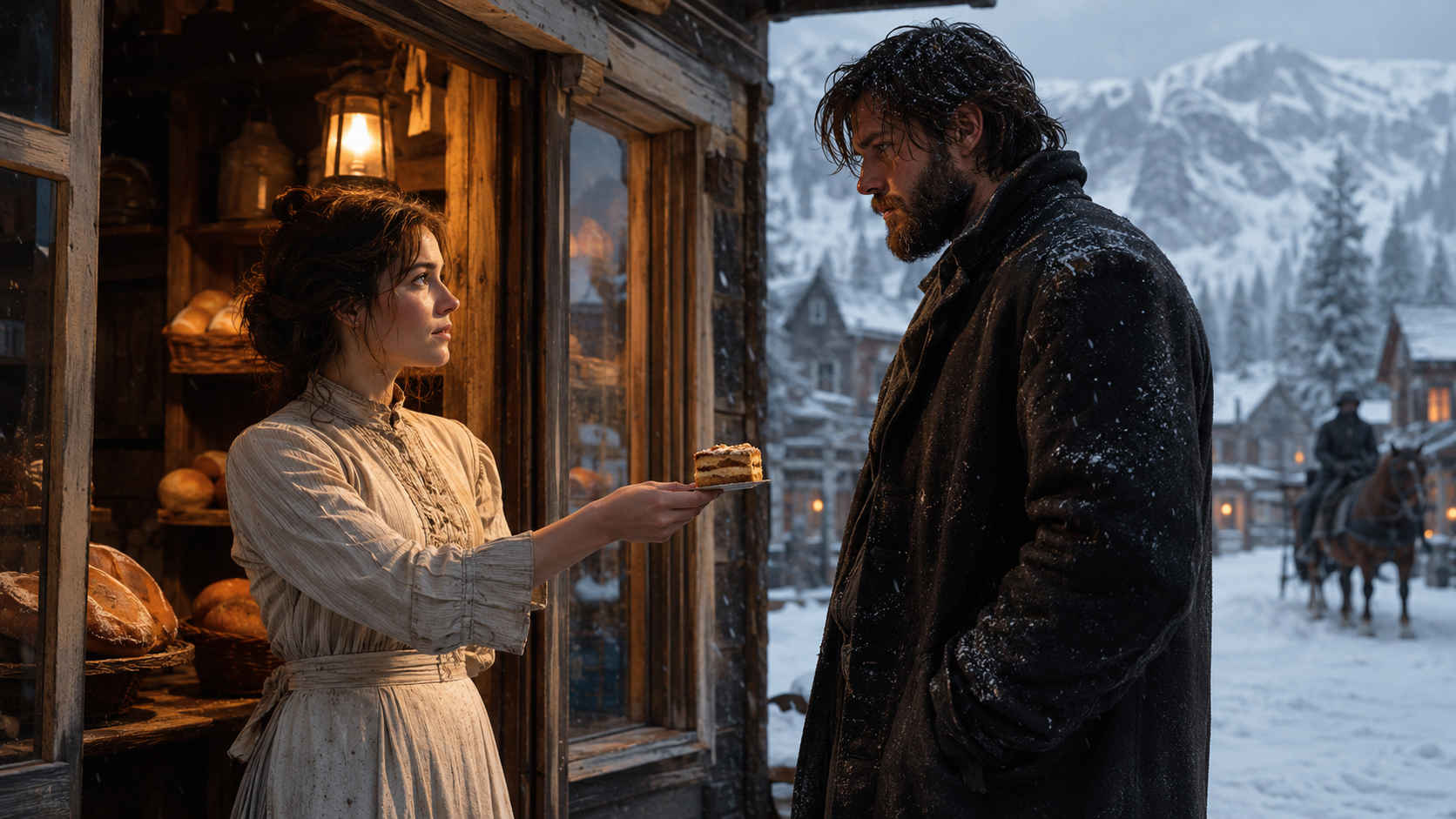
When his tears had passed, she cut two slices of honeycake.
She set one before him.
Rowan looked at it for a long time.
Then he said, rough and quiet, “I dare me.”
Lydia smiled. “That is the strangest grace I’ve ever heard.”
His eyes lifted.
“It was not grace.”
“No?”
“No.” He stood carefully, leaning on the table because his leg was still weak and honesty seemed to require balance. “Lydia Marrow, I have a ruined cabin, a bad leg, a horse with more sense than I have, and a reputation that frightens children and widows. I cannot promise ease. I cannot promise I will never go silent. I cannot promise the dead will not sit with me some mornings.”
Her smile faded into something softer.
“But I can promise,” he continued, “that I will come back from wherever my mind wanders. I will eat what you make, even timid soup. I will fix what breaks. I will listen when you speak. I will never call your strength pride simply because it refuses to kneel. And if you let me, I will spend the rest of my life proving that being loved by you is not rescue. It is honor.”
Lydia tried to answer.
Nothing came out.
Rowan looked suddenly uncertain. “Was that too much?”
She laughed through tears. “For once, too much is exactly right.”
They married in spring, when the snowmelt roared through the creek and mud tried to steal everyone’s boots.
Lydia wore a cream dress with sleeves rolled high enough to work in, because she said any dress that stopped a woman from lifting a flour sack was an enemy. Rowan wore a dark coat and the blue scarf Lydia had knitted badly and dared him to wear. He wore it though one end was longer than the other.
Amos walked Lydia halfway down the aisle beneath the budding apple trees behind the bakehouse.
Then he stopped.
“I don’t deserve the rest,” he whispered.
Lydia looked at the man who had failed her in more ways than she could count.
Then she took his arm again.
“No,” she said. “But I deserve it.”
So he walked her all the way.
When Judge Mercer asked Rowan if he took Lydia as his wife, Rowan looked at her and said, “She fed me when I thought I deserved to starve.”
The judge blinked.
When he asked Lydia, she said, “He ate my honeycake when everyone expected him to choke on hope.”
The judge cleared his throat. “I will accept both as yes.”
The town laughed.
This time, the laughter did not cut.
Victor Cale was taken to trial for fraud, assault, and the theft of county records. His freight depot was sold. His hotel shares vanished into legal fees. Men who once lowered their voices around him discovered courage after it became convenient.
Amos did not become a saint. Life rarely works so neatly. But he became sober for his last winter, and every morning before dawn, he swept the bakehouse floor, washed pans, and apologized in small useful ways.
On the night he died, Lydia sat beside him.
“I gave your mother’s life away one bottle at a time,” he said.
“Yes,” Lydia answered, because forgiveness did not require pretending.
“I looked at you and saw everything I had ruined.”
“I know.”
“You were never too much.”
Her throat closed.
Amos turned his face toward the window, where snow fell softly over Briar Hollow.
“You were the only thing in that house that was enough.”