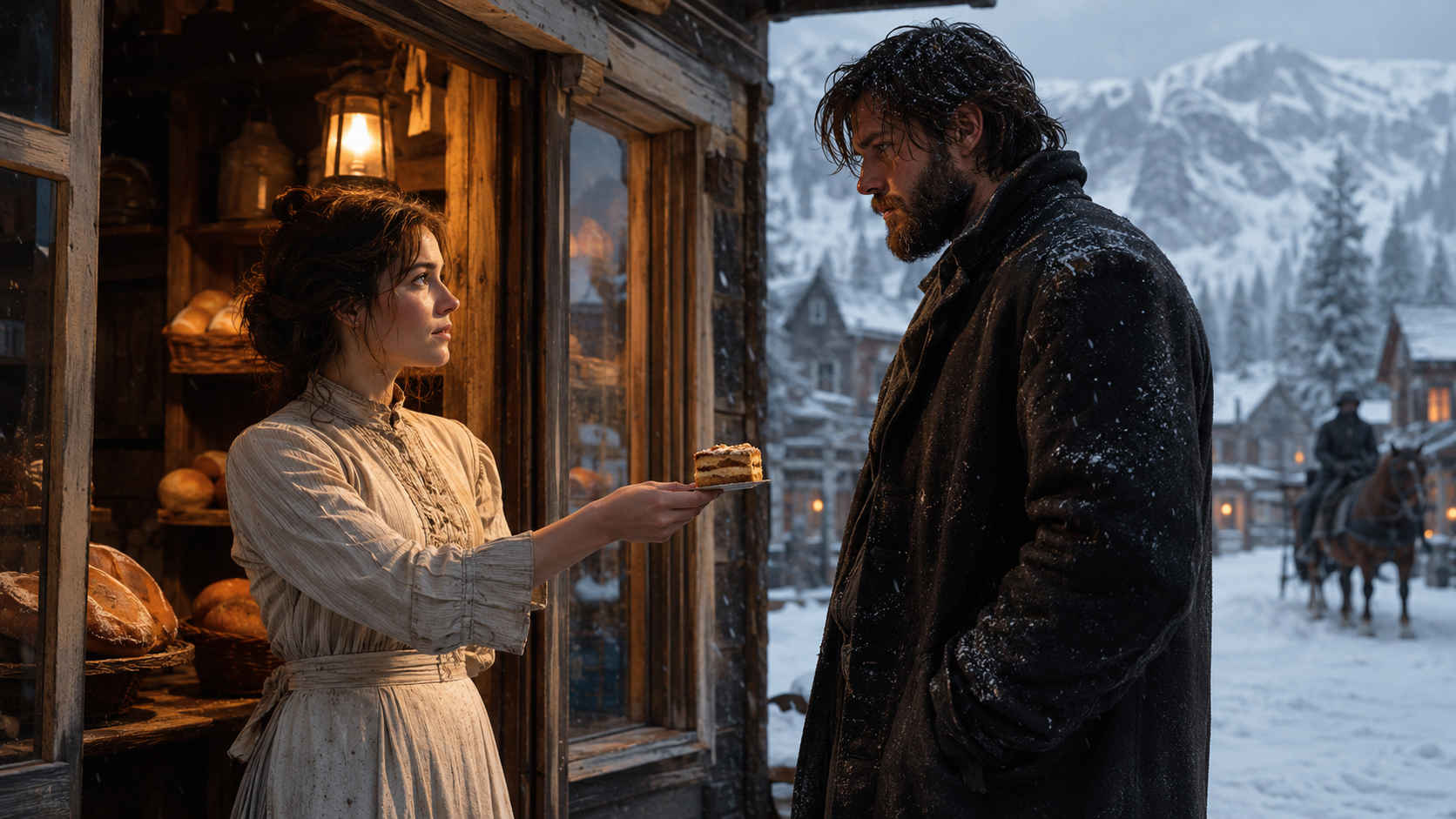
His mouth trembled.
“Under the floor,” he said suddenly.
“What?”
“Loose board. By the hearth.”
“You need rest.”
“Lydia.”
His voice carried a force that stopped her.
“I came here because Victor Cale sent men up the ridge last week. They were looking for something. I found their tracks. Maeve kept a cedar tin under the floor. I thought it held letters. I thought…” He swallowed hard. “I thought I could read them and finally leave this place.”
“And?”
“I found more than letters.”
Lydia moved to the hearth.
The loose board came up with the knife. Beneath it lay a cedar tin wrapped in waxed cloth.
Inside were letters tied with ribbon, a child’s carved button, a lock of pale hair, and a packet of papers sealed in oilskin.
The top paper bore Lydia’s mother’s name.
Evelyn Marrow.
Lydia’s hands went still.
She unfolded it.
The first document was a deed transfer. Half the bakehouse had been purchased years ago by Evelyn Marrow from Amos after his first gambling collapse, witnessed by Maeve Halloway and the old circuit judge.
The second document was Evelyn’s final will.
The bakehouse belonged fully to Lydia.
Her father had never had the right to pledge it.
Victor’s debt note was worthless.
Lydia sat back on her heels, the room tilting around her.
Rowan watched her from the bed.
“Maeve hid them for your mother,” he said. “Evelyn feared Amos would destroy them if he found them. Maeve promised to keep them safe until needed.”
“Victor knew,” Lydia whispered.
“He suspected. That’s why he wanted the ridge searched.”
“And the snare?”
Rowan’s eyes hardened. “Was not meant for deer.”
By morning, the storm had weakened enough to travel.
Rowan had fever, but his mind was clear. Lydia packed the cedar tin, tied it under her coat, and got him onto the gelding. The road down was brutal. Twice he nearly fell. Once she thought his wound had opened again and had to stop beneath a pine to tighten the bandage.
When Briar Hollow came into sight, church bells were ringing noon.
Half the town came into the street.
Victor Cale stood in front of the hotel in a black wool coat, looking almost amused.
“How touching,” he called. “Miss Marrow returns from a night alone in the mountains with a widower. I wonder what price that adds to the debt.”
The town went silent.
Lydia was cold beyond cold. Tired beyond fear. Her hair had come loose. Her skirt was torn. Rowan’s blood stained her sleeves.
But inside her coat lay the truth.
She looked at Victor and smiled.
“My reputation survived the storm,” she said. “Will yours survive the sheriff?”
Victor’s smile tightened.
Rowan lifted his head from the saddle.
“Your men set cable on my ridge.”
Victor laughed. “Fever makes a man dream.”
Lydia reached into her pocket and held up a brass freight tag she had cut from the snare.
Cale Freight.
The sheriff stepped forward.
Victor’s gaze flicked toward Jonas Pike, who stood near the livery doors, pale as milk.
Lydia saw it.
So did everyone else.
Jonas swallowed. “I didn’t know it would catch him. Mr. Cale said Halloway was hiding papers that belonged to him. Said to scare him off the ridge.”
Victor turned on him. “Idiot.”
The word condemned him more cleanly than any confession.
Lydia opened the cedar tin and handed the papers to Judge Mercer, who had pushed through the crowd with his spectacles already on.
He read in silence.
The town waited.
Amos Marrow stood in the bakehouse doorway, shaking so hard he had to hold the frame.
At last, the judge looked up.
“These papers are valid. The bakehouse belongs to Lydia Marrow. Amos Marrow had no legal authority to secure debt against it.”
Victor went white with rage.
“The records—”
“Will be examined,” the judge said. “As will your involvement in their disappearance.”
The sheriff took Victor by the arm.
Victor did not smile again.
Rowan healed in the back room of the bakehouse because Lydia refused to let him return to the ridge and because he had finally learned that arguing with her while feverish was inefficient.
His leg mended slowly. It would always ache in snow. He accepted this better than he accepted broth.
“This soup is timid,” he said one afternoon.
Lydia stared at him over the bowl. “Soup cannot be timid.”
“This one fears salt.”
“It has salt.”
“It has heard rumors of salt.”
She laughed.
Rowan watched her as though laughter were light entering a room he had kept shuttered for six years.
The cedar tin stayed on the worktable for a week before he opened Maeve’s last letter.
Lydia offered to leave.
He caught her wrist.
“Stay.”
So she sat with him while he unfolded the pages.
Maeve’s handwriting was lively, uneven, full of loops that refused to behave.
Rowan read silently at first.
Then his breath caught.
He handed the letter to Lydia.
“Read it,” he said.
Her voice shook, but she read.