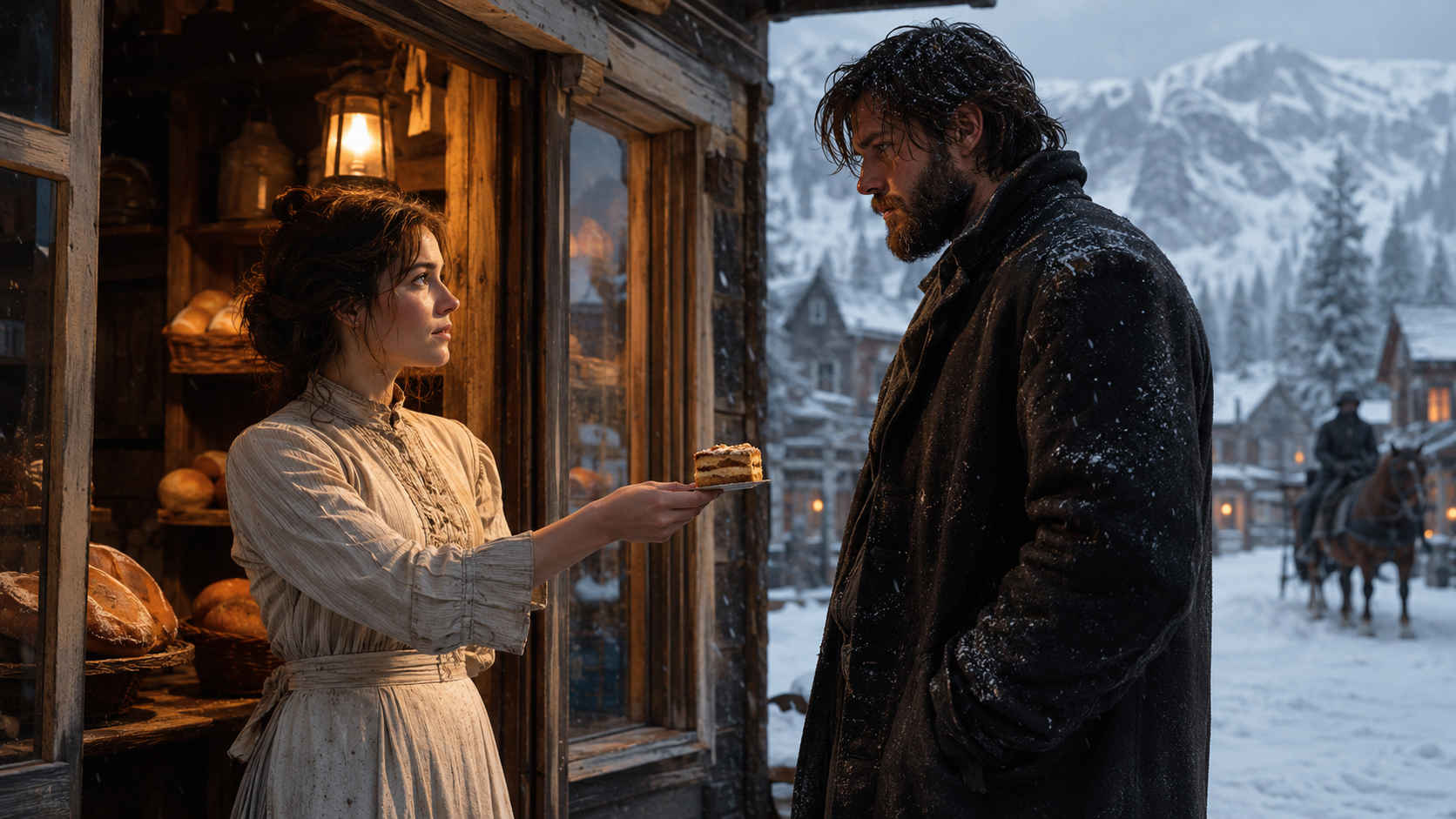
Snow erased the world. The lantern gave her only a trembling circle of white. She let Rowan’s gelding lead because the animal knew the ridge road better than any living person in Briar Hollow.
The wind shoved at her. Ice needled her cheeks. Her fingers went numb inside her gloves.
She spoke to the horses, to her mother, to the dark, and finally to Rowan.
“You miserable, silent, impossible man,” she whispered through chattering teeth. “You do not get to make me worry and then die. I forbid it.”
The gelding stopped near a stand of black pines.
Lydia saw blood on the snow.
Not much.
Enough.
She slid from the saddle and nearly fell to her knees. The lantern swung wild in her hand.
“Rowan!”
The wind answered.
She followed the blood down a shallow slope, past a broken branch, to a hollow beneath a fallen spruce.
Rowan lay there, half-buried in drift, one leg trapped beneath a deadfall and an iron snare twisted cruelly around his boot.
His face was gray.
For one terrible second, Lydia thought she had arrived too late.
Then his eyes opened.
“Lydia?”
“I’m here.”
“You shouldn’t be.”
“I hear that often.”
“Go back.”
“Poor time for jokes. I packed whiskey.”
His mouth moved. It might have been a smile. It might have been pain.
She knelt beside him and saw the snare wire had cut deep above his boot. Not a hunter’s simple wire. This was heavy freight cable, new, oiled, deliberately set low under loose snow where a horse or a man might catch it.
Her blood went cold for a different reason.
“Who set this?”
Rowan closed his eyes.
She slapped his cheek.
His eyes opened again, startled.
“Do not go noble and unconscious on me,” she snapped. “Tell me how to free you.”
“Knife,” he rasped. “Inside coat.”
She found it, cut her gloves twice, and sawed at the wire until her hands shook. When it finally snapped loose, Rowan made a sound so raw Lydia felt it tear through her own chest.
She poured whiskey over the wound while he cursed under his breath.
“So you do know words,” she said, wrapping the bandage tight.
“Not kind ones.”
“I’ll accept variety.”
The old Halloway cabin stood less than half a mile up the ridge, nearly hidden by snow-heavy firs. Lydia could not get him back to town. Not in that storm. Not with him bleeding and half-frozen.
So she did what had to be done.
She dragged, pushed, threatened, and begged until she got him onto the gelding. Then she led both horses through the white dark toward the cabin where his life had ended without killing him.
The door was swollen shut. Lydia kicked it twice, cursed once, and forced it open with Rowan’s knife.
Inside, dust slept beneath the cold.
A table stood near the hearth.
A woman’s blue shawl hung on a peg.
A wooden horse lay beneath a chair, one wheel missing.
Lydia looked away quickly.
She got Rowan down onto a narrow bed, built a fire with shaking hands, and wrapped him in every blanket she could find. His body shook so hard the bed frame knocked against the wall.
“Stay awake,” she said.
“Trying.”
“Try louder.”
His eyes cracked open. “Bossy.”
“Alive.”
She unwrapped a honeycake and broke off a piece.
His gaze fixed on it.
“No.”
“Yes.”
“No, Lydia.”
She leaned closer. “Rowan Halloway, I rode through a storm, cut you out of a death trap, broke into your haunted cabin, and ruined my best gloves. I dare you to take one bite.”
His face changed.
Not much.
But enough.
Pain, anger, longing, fear — all of it moved behind his eyes like shadows under ice.
“I said no.”
“And I said I dare you.”
For a long moment, only the storm spoke.
Then Rowan opened his mouth.
She fed him a small piece.
He swallowed.
His breath broke.
At first Lydia thought the pain had worsened. Then she saw the tears.
Silent. Hot. Terrible.
They slipped down the face of a man the town believed had forgotten how to feel.
Lydia did not look away.
“My mother knew Maeve,” she said softly.
Rowan shut his eyes.
“She wrote about her. About honeycake. About daring you.”
A sound left him, barely human.
“Maeve made it every Sunday,” he whispered. “Said a week without sweetness was just seven days of labor.”
Lydia’s own eyes burned.
“What happened here, Rowan?”
He stared toward the fire.
“The avalanche took the shed first. I was in the timber line, checking traps. I heard it. By the time I reached the cabin, snow had filled the back room.”
His voice thinned.
“Milo was asleep there. Maeve had gone in after him.”
Lydia covered his hand with hers.
“I dug until my fingers bled. I found them before dawn. I thought if I had been faster, if I had been nearer, if I had not gone out—”
“You would have died with them.”
“I should have.”
“No.”
His eyes turned to her then.
Lydia held his gaze.
“No,” she said again. “That is not love speaking. That is punishment wearing love’s coat.”