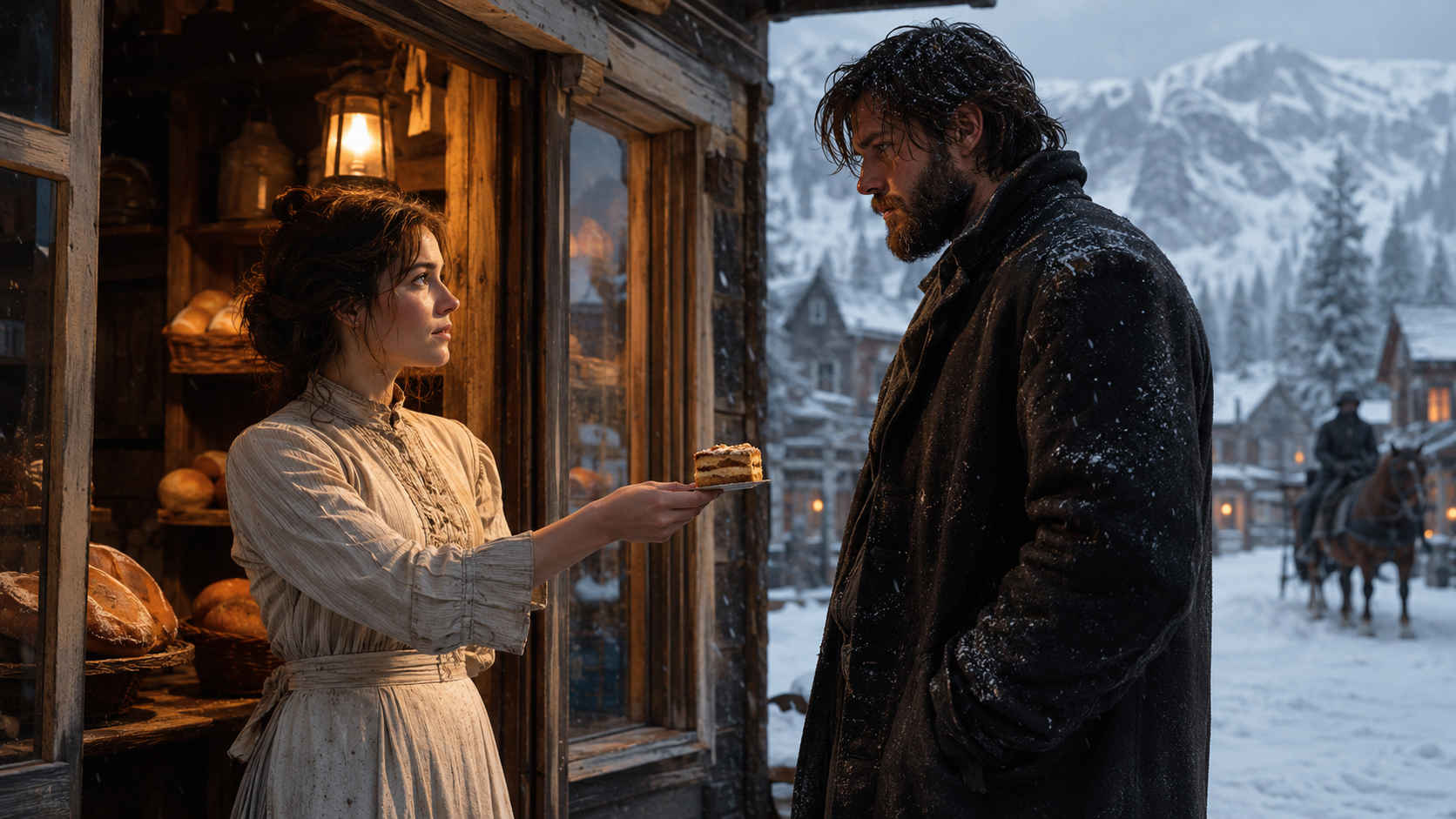
“My mother left it to me.”
“Verbally, perhaps. Women often mistake wishes for documents.”
Lydia stepped closer. “Say that again.”
Victor’s eyes glittered. “Careful. Anger does not change ink.”
“How much?”
“Three hundred and eighty dollars, including interest.”
“That is theft dressed as arithmetic.”
“That is lending.”
“That is bloodletting.”
Victor leaned one elbow on the counter. “There are gentler ways to settle accounts.”
Amos whispered, “Lydia, listen to him.”
She did not look at her father.
Victor lowered his voice. “Marry me before Christmas Eve. I forgive the debt. The bakehouse stays open. Your father keeps his dignity. You gain protection.”
Lydia laughed once, short and sharp.
Victor’s smile faded.
“You think I’m joking?” he asked.
“I think you mistake a noose for a necklace.”
Amos covered his face.
Victor straightened. “You have twelve days.”
“Get out.”
“You will come around.”
“I said get out.”
He took up his gloves.
At the door, he glanced back. “Pride is a luxury, Miss Marrow. Women alone cannot afford much of it.”
After he left, Lydia turned to her father.
Amos looked smaller than the man who had once lifted her to reach the sugared buns cooling on the highest shelf. Smaller than grief. Smaller than the bottle hidden under his coat.
“How could you?” she asked.
His mouth trembled. “I thought I could win it back.”
“You never win.”
“I was trying—”
“No,” Lydia said, voice breaking. “You were trying to forget you ruined one day, and you ruined every day after it too.”
He reached for the bottle.
She walked away before she saw him drink.
The next morning, Rowan came to the back door with a brace of pheasants.
Lydia had not slept.
He noticed at once.
“Who hurt you?” he asked.
The question was so blunt it nearly undid her.
“No one.”
His eyes moved over her face. “Lydia.”
She hated the sound of her name in his mouth because it made her want to answer honestly.
“It’s nothing.”
“Nothing does not put shadows under both eyes.”
She wrapped the pheasants in paper though they did not need wrapping.
“This is my trouble.”
“I didn’t ask whose it was.”
“Then ask better questions.”
His face closed.
She heard herself and winced.
“I don’t need a mountain man fixing my roof, my door, my debts, and my life,” she said, though she already regretted every word. “I am not helpless.”
“No,” Rowan said quietly. “You are afraid.”
That was worse because it was true.
She turned away.
When she looked back, he was gone.
No bundle came the next day.
Or the next.
On the third morning, snow began before dawn.
By noon, the town had drawn itself inward. Shop doors closed early. Chimneys smoked hard. Horses stamped in their stalls and shook frost from their manes.
Near sunset, Mrs. Bell came into the bakehouse carrying eggs under her shawl.
“Rowan rode north,” she said.
Lydia kept cutting dough. “He lives north.”
“Not that north.”
The knife stopped.
Mrs. Bell’s voice gentled. “Jonas saw him take the pass toward the old Halloway place.”
Lydia looked toward the window.
Snow thickened against the glass.
“No one goes there in weather like this.”
“No one but a man trying to lose an argument with the dead.”
After Mrs. Bell left, Lydia opened her mother’s recipe book.
She did not know what she was searching for. Proof. Comfort. A miracle hidden between measurements.
Her fingers turned page after page until they reached the honeycake.
For M.R., who said every sad man should be dared into sweetness.
Lydia stared at the initials.
M.R.
Maeve Rowan?
No.
A smear of old honey had darkened the lower margin. Lydia rubbed at it gently with her thumb until another line emerged.
If Rowan ever forgets the way home, feed him honey and call him coward.
Lydia sat down hard.
For a moment, she could hear her mother laughing.
Then, outside, a horse screamed.
Lydia ran to the front window.
A black gelding stood in the street, reins dragging, saddle empty, eyes rolling white in the storm.
Rowan’s horse.
Lydia did not stop to think.
Thinking would have invited fear, and fear had too many reasonable things to say.
She packed blankets, bandages, whiskey, matches, a lantern, and three honeycakes wrapped in oilcloth. She pulled on her mother’s heavy coat and ran to the livery.
Jonas Pike barred the door with his body.
“You cannot ride into that.”
“I need my mare.”
“You’ll die.”
“Then saddle her quickly so I don’t die standing here arguing.”
“Lydia—”
She grabbed him by the collar. “If Rowan Halloway is lying hurt in that snow and you delay me another breath, I will come back from the grave and haunt your stable until every horse refuses your hand.”
Jonas stared.
Then he saddled the mare.
The storm swallowed Lydia before the town bell struck eight.